Explainer · Energy
Microreactors on Army bases: what happens next
Updated October 21, 2026 · Numbers as published by each source on the date shown
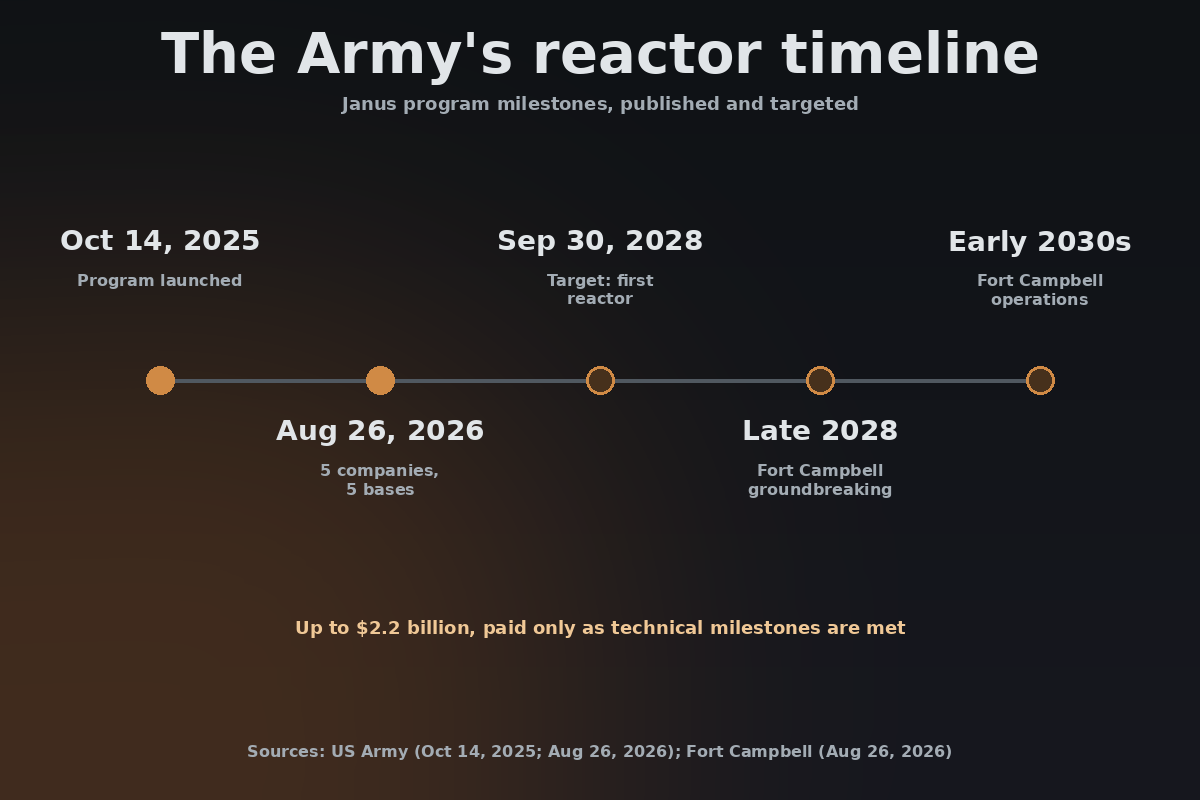
On August 26, 2026, the Army's Janus program picked five companies to build, own and run small nuclear reactors at Fort Bragg, Fort Campbell, Fort Hood, Fort Benning and Fort Drum. Up to $2.2 billion will be paid only as technical milestones are met. The Army is working toward a first Army-regulated reactor on a base by September 2028. Next come site studies, licensing and design.
What a microreactor is
A microreactor is a compact nuclear reactor, small enough to move by truck, the Department of Energy explains. Its parts are built and assembled in a factory and shipped to the site. They are designed to use passive safety systems and to run for up to 10 years without refueling, the department says.
The five bases and five companies
- Fort Bragg, North Carolina. Antares Nuclear.
- Fort Campbell, Kentucky. BWXT Advanced Technologies.
- Fort Hood, Texas. General Atomics Electromagnetic Systems.
- Fort Benning, Georgia. Radiant Industries.
- Fort Drum, New York. Westinghouse Government Services.
The Army paired companies with bases after a year-long review of each installation's energy needs, seismic and water conditions, and safety. With private money added to government funds, it expects more than 20 microreactors to be built across defense installations, and more sites will be announced later.
How the money works: paid per milestone
Companies receive government money only after they hit specific technical goals. The program brings about $2.2 billion across fiscal years 2027 to 2031, plus significant investment from each company. The prototype reactors will be owned and operated by the companies. The Army modeled the approach on NASA's Commercial Orbital Transportation Services program.
The Army says success means reliable, affordable reactors that the companies can also sell to buyers beyond the military.
Timeline: 2028 target and early 2030s operations
Executive Order 14299 directs the Department of War to begin operating an Army-regulated reactor on a domestic base no later than September 30, 2028. The Army's announcements do not name which site will meet that target. Of the five bases, Fort Campbell has published a schedule.
Why bases want their own power
A reactor on post lets a base keep critical operations running if the outside grid goes down. At Fort Campbell, the plant will run "behind the meter" and power only mission-essential operations on the base. It can island from the commercial grid during severe weather, cyber disruptions or regional blackouts, the garrison says.
What happens next at each site
- Fort Campbell. BWXT plans a single 20-megawatt reactor on less than 5 acres, entirely on post. Site study, licensing and design begin immediately, with groundbreaking projected for late 2028 and operations in the early 2030s. The reactor uses TRISO fuel and is designed to cool and shut down on its own in an emergency.
- Community review. Local communities near Fort Campbell will have chances to ask questions and comment as environmental assessments under the National Environmental Policy Act proceed.
- The other four bases. Schedules for Fort Bragg, Fort Hood, Fort Benning and Fort Drum were not included in the Army's announcement.
- Utilities. The Army plans to work with the utilities that serve each base, and invites utilities to propose larger, grid-facing power projects on Army land.
The Monday Haul tracks each milestone and other power projects every week. Past issues are in the archive, and you can follow energy in every state on the live dashboard.
Common questions
What is the Army's Janus program?
Janus is the Army's next-generation nuclear power program, launched on October 14, 2025. It pays private companies to build, own and run small nuclear reactors on military bases, with government money released only as technical milestones are met.
Which bases are getting microreactors?
The first five are Fort Bragg in North Carolina, Fort Campbell in Kentucky, Fort Hood in Texas, Fort Benning in Georgia and Fort Drum in New York. The Army says more sites will be announced later.
When will the first Army microreactor run?
The Army is working toward a September 2028 target, set by Executive Order 14299, for a first Army-regulated reactor operating on a military base. At Fort Campbell, groundbreaking is projected for late 2028 and operations for the early 2030s.
Sources
- Army reaches agreement with private industry for nuclear micro-reactors, US Army, Aug 26, 2026.
- Army announces Janus Program for next-generation nuclear energy, US Army, Oct 14, 2025.
- Fort Campbell selected to host Next-Generation Advanced Energy Resilience Project, US Army Garrison Fort Campbell, Aug 26, 2026.
- What is a nuclear microreactor?, US Department of Energy, Office of Nuclear Energy, Feb 26, 2021.
The Monday Haul · free weekly email
Energy, industry, infrastructure and policy in one short email every Monday, including new factories and grid projects. Every item sourced and dated. More about the Haul