Explainer · Industry
The factories growing now are the ones plugged in
Updated October 21, 2026 · September figures are preliminary and will be revised
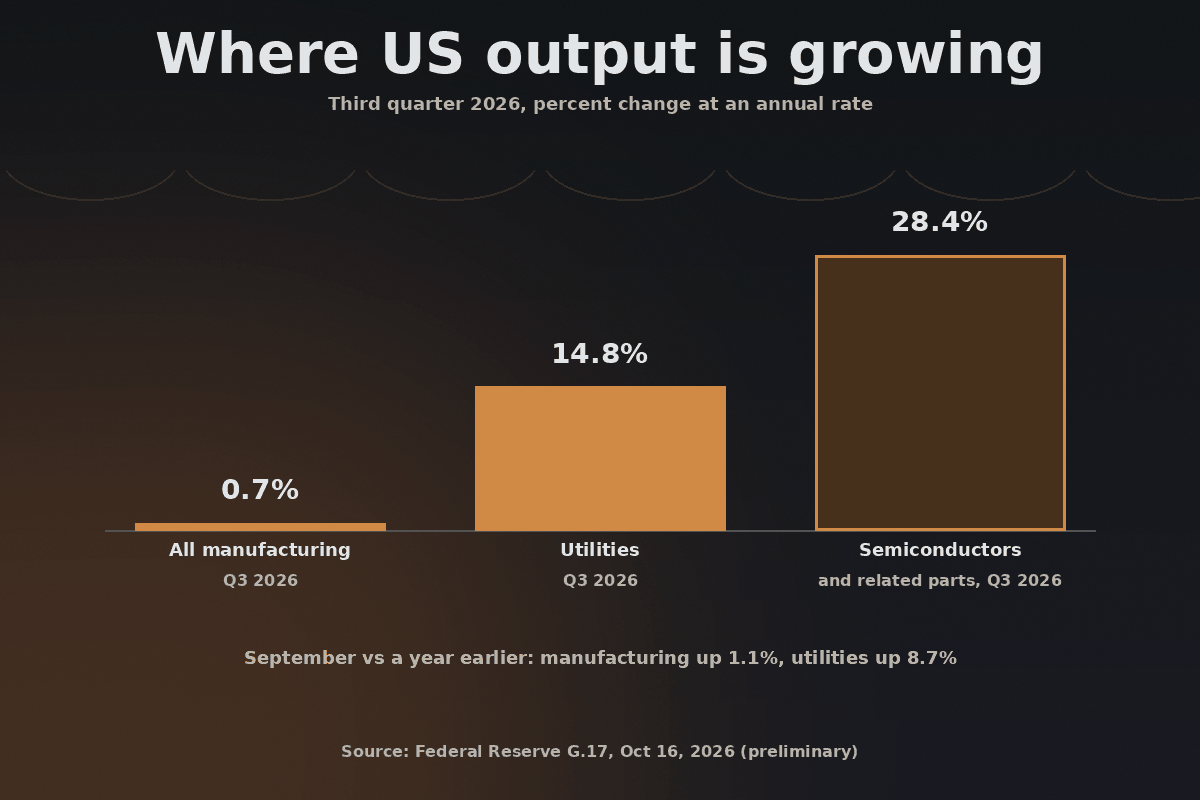
US manufacturing output in September 2026 was only 1.1% above a year earlier, but the parts tied to chips and power are growing fast. Output of semiconductors and related parts rose at a 28.4% annual rate in the third quarter, and utilities output was 8.7% higher than a year ago, the Federal Reserve reports. The new capacity from the factory building boom is concentrated in high tech.
The headline: factory output barely moving
Manufacturing output rose 0.3% in September and grew at an annual rate of 0.7% in the third quarter, according to the Federal Reserve's industrial production report of October 16, 2026. Factories ran at 75.9% of capacity, 2.3 percentage points below their 1972 to 2025 average. Total industrial production, which also counts mining and utilities, was 2.2% above a year earlier.
Where the growth is: chips and electronics
Durable goods manufacturing grew at a 3.8% annual rate in the third quarter, driven in part by a 28.4% gain in output of semiconductors and related electronic components. In September, primary metals, machinery, and electrical equipment each rose 1% or more, while motor vehicles and parts fell 3.0%.
Utilities: power output climbing
Utilities output rose 3.5% in September, with gains at both electric and natural gas utilities, and grew at a 14.8% annual rate in the third quarter. It was 8.7% above a year earlier. Utilities ran at 73.8% of capacity, still well below their long-run average. The Fed's report does not say what drove the increase.
Why the two go together
Chips and power are two parts of the same investment boom. Chip plants need large upfront investment in buildings and equipment, and their new output arrives after the plants are finished. Data centers, the next wave of building, draw power that adds to fast-growing electricity demand and need large volumes of transformers, switchgear and generators, the Kansas City Fed explains.
The industries serving that build-out are running hot. Makers of computers and related equipment ran at 83% of capacity, the highest since 2011, and electrical equipment plants at 87%, the highest since 2008, according to the Kansas City Fed's October 13, 2026 bulletin.
The Monday Haul brings the monthly factory and power numbers every week, along with new plants. Past issues are in the archive, and you can follow industry across the country on the live dashboard.
What the factory building boom left behind
Spending on new manufacturing plants surged after 2021, led by computer, electronic and electrical plants. After adjusting for construction costs, it peaked in November 2024, the Kansas City Fed found. In August 2026 it ran at a $168.2 billion annual rate, 19.8% below a year earlier. Spending on computer, electronic and electrical plants was $52.3 billion, down 45.2%, according to the Census Bureau.
That building did add capacity, but in a narrow band. Capacity in computers, communications equipment and semiconductors is up 72% since December 2019. Those industries are about 3% of manufacturing output, so total manufacturing capacity is up about 2%, and some of the boom's added capacity is likely still ahead as plants are finished, the Kansas City Fed says. Data center construction is now the second phase, and in April 2026 it passed spending on electronics plants for the first time since 2021.
What to watch next
- The annual revision. The Federal Reserve plans to revise its industrial production and capacity numbers on November 24, 2026, with 2022 as the new base year.
- Construction spending. The Census Bureau's next construction spending report is due November 2, 2026.
- Capacity spreading out. Whether new capacity grows beyond today's narrow high-tech segment is the development to watch, the Kansas City Fed says.
Common questions
Is US manufacturing growing?
Slowly. Manufacturing output in September 2026 was 1.1% above a year earlier and grew at a 0.7% annual rate in the third quarter, the Federal Reserve reports. Semiconductors and related parts grew much faster, at a 28.4% annual rate in the third quarter.
Has the investment boom expanded US factory capacity?
Mostly in one narrow area. Capacity in computers, communications equipment and semiconductors has risen 72% since December 2019, but those industries are about 3% of manufacturing output, so total manufacturing capacity rose about 2%, the Kansas City Fed found.
Why is factory construction spending falling?
Spending on new factories peaked in 2024 after a surge led by computer, electronic and electrical plants. In August 2026 it ran at a $168.2 billion annual rate, 19.8% below a year earlier, with most of the drop in that same electronics category, according to the Census Bureau.
Sources
- Industrial Production and Capacity Utilization, G.17, Federal Reserve Board, Oct 16, 2026. September figures preliminary.
- Has the investment boom expanded U.S. productive capacity?, Nida Çakır Melek, Federal Reserve Bank of Kansas City, Oct 13, 2026.
- Value of private construction put in place, seasonally adjusted annual rate, US Census Bureau, Oct 1, 2026 release, August 2026 data.
The Monday Haul · free weekly email
Energy, industry, infrastructure and policy in one short email every Monday, including new factories and grid projects. Every item sourced and dated. More about the Haul