Explainer · Energy
Why Fervo's 33-megawatt Utah geothermal plant matters
Updated October 21, 2026 · Numbers as published by each source on the date shown
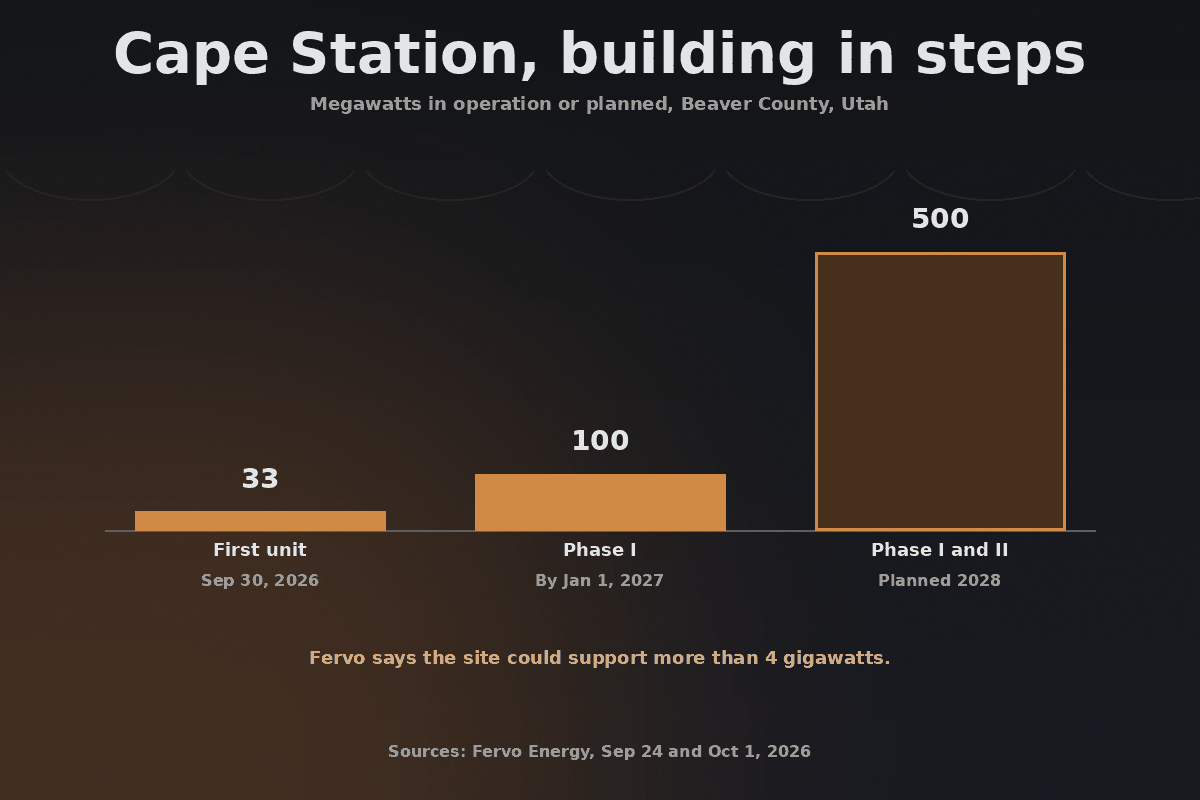
On September 30, 2026, the first 33-megawatt unit at Fervo Energy's Cape Station in Beaver County, Utah, began commercial operation, one day before its contract date. Fervo says it is the first greenfield enhanced geothermal development in the world to reach that point. It makes power around the clock from hot rock, and it was built in 23 months. Two more units are due by January 1, 2027, and 400 megawatts more by 2028.
What happened at Cape Station
The first unit synchronized to the grid on September 24 and declared commercial operation six days later, Fervo reported. It produced 33 megawatts of net power, meeting the threshold in its power purchase agreement, and it is now earning revenue under that contract.
What enhanced geothermal is, in plain words
Heat exists underground everywhere, but a conventional geothermal plant also needs water and cracks in the rock so fluid can flow, the Department of Energy explains. Many places lack one or both. Enhanced geothermal systems create the reservoir: wells are drilled, water is pumped in to open flow paths, and the water then circulates continuously to make electricity.
Fervo uses horizontal drilling techniques adapted from the oil and gas industry, which let it drill several wells from one pad. The Energy Department says the United States has more than five terawatts of geothermal potential, and most of it is reachable only through man-made reservoirs like these.
Why 33 megawatts is a big step
The size is modest. The proof is the point. Fervo's earlier Project Red pilot in Nevada, about 3.5 megawatts, has supplied the grid since 2023 and showed the technology works. Cape Station shows the approach can reach utility scale and export power to wider markets, Fervo's head of development, Dawn Owens, told Canary Media.
Firm power is the other reason. Enhanced geothermal draws on heat deep underground, so it runs day and night in any weather, Fervo notes. Geothermal is now about 0.4% of US electricity generation, according to Canary Media.
How it was built in 23 months
From groundbreaking to commercial operation, the first unit took 23 months, TechCrunch reported. Fervo says it expects to reach an 18-month timeline for future units as it applies lessons from the first.
What comes next: 100 megawatts, then 500
- Phase I. About 100 megawatts across three 33-megawatt units. The other two are expected to reach commercial operation by January 1, 2027.
- Phase II. Another 400 megawatts, already under construction, expected in 2028.
- Buyers. About 900 megawatts at Cape Station are fully contracted, Fervo says. Google, Southern California Edison and others have committed to buy power. Google signed a 396-megawatt agreement on September 1, the Deseret News reported.
- Room to grow. Fervo says the site has more than 4 gigawatts of capacity. PacifiCorp, Utah's dominant power provider as Rocky Mountain Power, said on October 14 that at Fervo's stated prices geothermal would be competitive with gas in its planning model, even without tax credits.
The Monday Haul follows each new unit and other power projects every week. Past issues are in the archive, and you can follow energy in every state on the live dashboard.
Questions still being worked on: water, cost, scale
- Cost. Fervo previously told Canary Media that Phase I would cost $7,000 per kilowatt and Phase II $5,500, compared with an average of $2,157 per kilowatt for a natural gas plant in 2025. PacifiCorp plans to model Fervo's costs starting at $5,500 per kilowatt in 2030 and falling to $3,000 per kilowatt by 2036.
- Water. Energy Department analysis finds almost all planned geothermal growth could run on non-fresh water, such as municipal wastewater and brackish water.
- Earthquakes. A National Research Council study found geothermal does not pose a high risk of felt quakes, because fluid pumped in is also removed. Federally funded projects follow Energy Department safety protocols.
- Scale. Growing geothermal's share will take more projects and lower drilling costs, experts told Canary Media. The Energy Department's Enhanced Geothermal Shot aims to cut enhanced geothermal costs by more than 90%, to under $40 per megawatt-hour.
Common questions
What is enhanced geothermal?
Enhanced geothermal systems create a man-made geothermal reservoir where hot rock lacks enough natural water or cracks. Wells are drilled and water is pumped in to open flow paths, and the water then circulates continuously to make electricity, the Department of Energy explains.
Who buys Cape Station's power?
Southern California Edison, Google and others have committed to buy power from Cape Station. Shell Energy, a retail power provider in California, receives power from the first unit, according to Canary Media.
When will the rest of Cape Station come online?
Fervo expects two more 33-megawatt units to reach commercial operation by January 1, 2027, bringing Phase I to about 100 megawatts. Phase II, another 400 megawatts, is under construction for 2028.
Sources
- Fervo Energy declares commercial operation at Cape Station ahead of schedule, Fervo Energy, Oct 1, 2026.
- Fervo Energy achieves First Power at Cape Station, Fervo Energy, Sep 24, 2026.
- World's first enhanced geothermal power plant completed in just 23 months, Tim De Chant, TechCrunch, Oct 1, 2026.
- First utility-scale enhanced geothermal plant goes live, Maria Gallucci, Canary Media via IEEE Spectrum, Oct 12, 2026.
- Fervo's 4-gigawatt geothermal plant in Utah will power everyone but Utahns, for now, Leah Bowers, Deseret News, Oct 14, 2026.
- Enhanced Geothermal Shot frequently asked questions, US Department of Energy, September 2022.
The Monday Haul · free weekly email
Energy, industry, infrastructure and policy in one short email every Monday, including new factories and grid projects. Every item sourced and dated. More about the Haul