Explainer · Energy
Why gas prices don't follow oil prices right away
Updated October 21, 2026 · Numbers as published by each source on the date shown
Crude oil is only about half the price of a gallon of gasoline: 51.9% in May 2026, with refining, distribution and taxes making up the rest. Prices also take time to travel. A 2003 EIA study found about half of a change in wholesale gasoline prices reached the pump within two weeks, and all of it within about two and a half months.
What you pay for in a gallon of gasoline
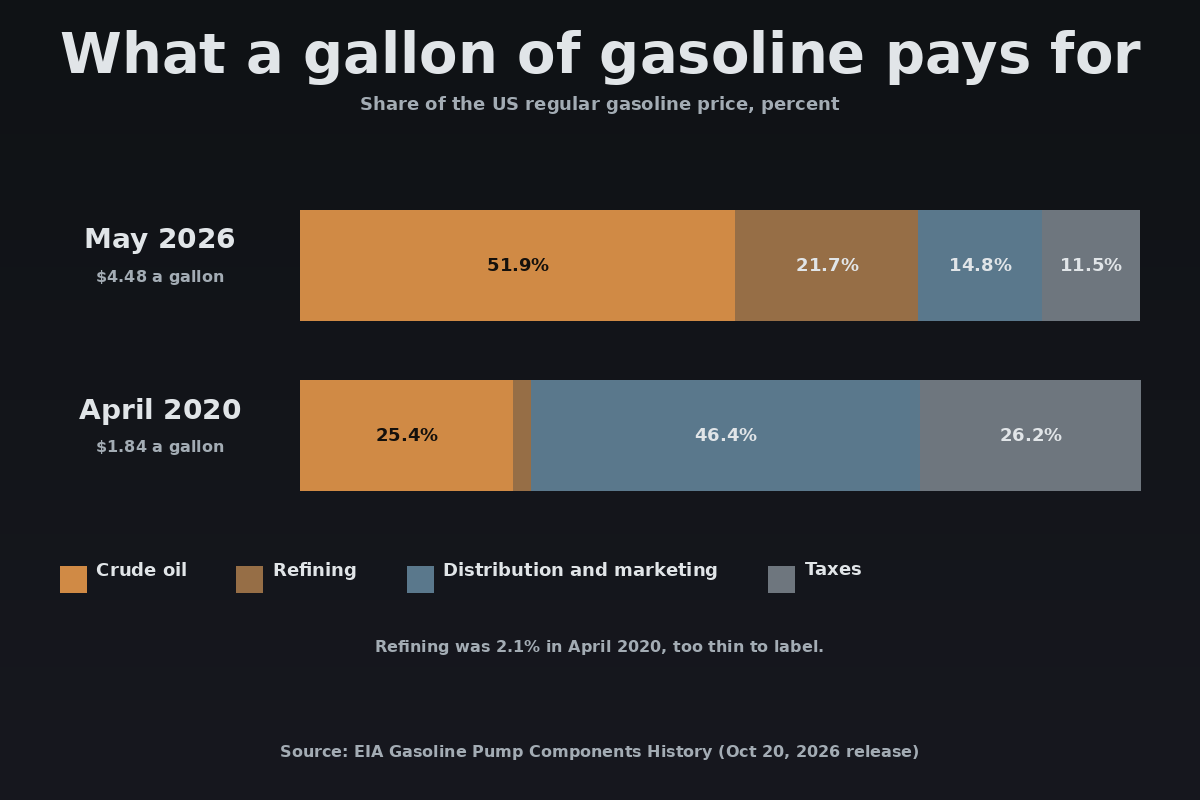
EIA splits the retail price of regular gasoline into four parts: crude oil, refining costs and profits, distribution and marketing, and taxes. In May 2026, the latest month in its table, the US average was $4.479 a gallon. Crude oil was 51.9% of that, refining 21.7%, distribution and marketing 14.8%, and taxes 11.5%.
Why the crude share changes from month to month
The parts move on their own. The federal tax is a fixed 18.40 cents a gallon, and state taxes and fees averaged 33.55 cents as of January 2026, according to EIA. When the price rises and those cents stay the same, the tax share shrinks. In April 2020, when gasoline averaged $1.841, taxes were 26.2% of the price and crude oil 25.4%. In May 2026, at $4.479, taxes were 11.5%.
How a price change travels from refinery to station
Gasoline is sold several times before it reaches your tank. EIA describes the levels: spot sales of thousands of barrels at a refinery, port or pipeline junction; terminal or "rack" sales by the truckload; dealer tankwagon deliveries into a station's storage; and retail sales at the pump. A change at one level ripples down through the others as prices rise and fall.
How long it takes
A 2003 EIA study by Michael Burdette and John Zyren compared wholesale (spot) gasoline prices with weekly retail prices, using data through 2002. It found the pass-through was complete within about two and a half months, with about 50 percent of a change showing up within 2 weeks and 80 percent within 4 weeks. The Rocky Mountain and West Coast regions (PADDs 4 and 5) were slower, with slightly less than 40 percent passed through in the first two weeks. The study measured wholesale gasoline, not crude oil, and it is more than two decades old, so treat it as a rule of thumb.
The Monday Haul tracks fuel prices and other energy news every week. Past issues are in the archive, and you can follow US energy on the live dashboard.
Why diesel and gasoline can move in opposite directions
Diesel and gasoline are separate products with their own supply and demand. In EIA's weekly survey for October 19, 2026, regular gasoline fell 4.7 cents to $4.284 a gallon, while diesel rose 9.7 cents to $6.276. On October 15, the IEA Governing Board pointed to continued tightness in oil markets, notably for diesel. The board agreed to speed up the remaining emergency stock releases, including more than 20 million barrels of diesel as soon as possible.
Why prices differ so much by state
Taxes, local market conditions and supply all vary. EIA notes that refining costs vary by region partly because different areas require different gasoline blends to reduce air pollution. On October 19, regular gasoline averaged $6.031 a gallon in California, $4.274 in Colorado and $3.704 in Texas.
What to watch next
EIA updates its gasoline and diesel survey every week; the next release is October 27, 2026. Wholesale gasoline prices, refinery outages and the pace of emergency diesel releases will show up at the pump over the following weeks.
Common questions
How much of the price of gasoline is crude oil?
In May 2026, crude oil was 51.9% of the average US retail price of regular gasoline, which was $4.479 a gallon, according to EIA. Refining was 21.7%, distribution and marketing 14.8%, and taxes 11.5%.
How long does it take for price changes to reach the pump?
A 2003 EIA study found that about 50 percent of a change in wholesale (spot) gasoline prices reached retail prices within 2 weeks, 80 percent within 4 weeks, and all of it within about two and a half months. It measured wholesale gasoline, not crude oil.
Why can diesel rise when gasoline falls?
They are separate products with separate supply. In EIA's survey for October 19, 2026, regular gasoline fell 4.7 cents to $4.284 a gallon while diesel rose 9.7 cents to $6.276. On October 15, the IEA Governing Board pointed to continued tightness in oil markets, notably for diesel.
Sources
- Gasoline Pump Components History, US Energy Information Administration, Oct 20, 2026 release.
- Gasoline and Diesel Fuel Update, US Energy Information Administration, Oct 20, 2026 release.
- Factors affecting gasoline prices, US Energy Information Administration, accessed Oct 21, 2026.
- Gasoline Price Pass-through, Michael Burdette and John Zyren, US Energy Information Administration, January 2003.
- IEA Governing Board statement on energy markets and security, International Energy Agency, Oct 15, 2026.
The Monday Haul · free weekly email
Energy, industry, infrastructure and policy in one short email every Monday, including new factories and grid projects. Every item sourced and dated. More about the Haul