Is new solar in America now being built with batteries?
Roadrunner, a solar and battery plant in Cochise County, Arizona, started up in January 2026. Here's how common that pairing has become, and where it is growing fastest.
Updated November 24, 2026 · Numbers as published by each source on the date shown
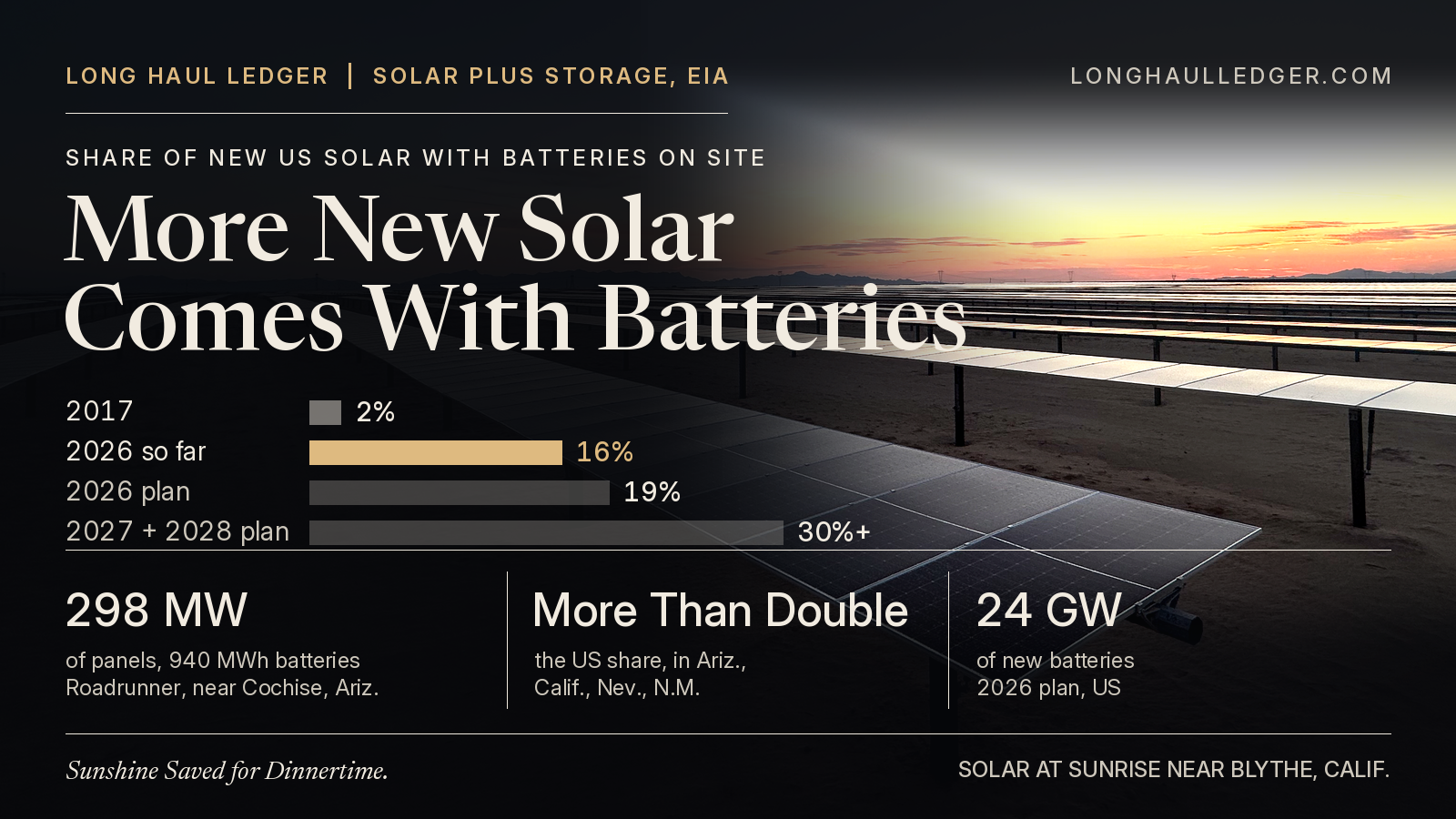
More and more, yes. As of September 2026, over 16% of new utility-scale solar capacity added this year is co-located with battery storage, up from 2% in 2017, EIA says, and plans for 2027 and 2028 top 30%. Southwest states like Arizona, home of the new Roadrunner plant near Cochise, pair far more often.
Sunshine saved for dinnertime.
Photo: EDF Renewables via BLM California, August 3, 2024, public domain mark, via Wikimedia Commons. Desert Quartzite Solar near Blythe, California, at sunrise. Not the Roadrunner plant. Figures: U.S. Energy Information Administration and Clēnera. Planned bars are developer plans and can change.
Panels that can hold their power for the evening make every new solar farm more useful to the people on the other end of the wire, and the share being built that way keeps climbing.
Roadrunner is running in Arizona
Roadrunner, also called Apache Solar II, sits near the small community of Cochise in Cochise County, southeast Arizona. It pairs 298 megawatts of solar panels (a DC rating) with 940 megawatt-hours of batteries. Clēnera, which built and owns it, announced commercial operations on January 22, 2026.
The power goes to Arizona Electric Power Cooperative, or AEPCO, the not-for-profit supplier for rural co-ops in Arizona, California, Nevada and New Mexico, under a 20-year contract. AEPCO CEO Patrick Ledger called it the cooperative's largest renewable project to date. Clēnera says the batteries give AEPCO “a dispatchable source,” meaning power it can call on when its members need it. (For what a megawatt-hour measures, see megawatts vs megawatt-hours.)
How common the pairing is now
EIA reported on October 30, 2026 that as of September, “over 16% of new utility-scale solar capacity added this year is co-located with operable battery storage, compared with 2% in 2017.” Co-located means the batteries sit at the same plant and share its hookup to the grid.
This year could finish higher. Plants planned for the last three months of 2026 could lift the share to 19% for the year, EIA says.
The next two years look higher still. In developer plans for 2027 and 2028, the share is “more than 30%.” Plans can slip, so treat that as a plan, not a count.
Across the whole fleet, solar is 13% of US utility-scale generating capacity, and 18% of that solar is co-located with batteries.
Why developers put batteries next to panels
EIA explains that in solar-heavy regions, wholesale power prices tend to fall when solar output is high and rise as it fades. A plant with both can send its power to the grid or into the battery, depending on the price. In plain terms: charge at noon when power is cheap, and sell at dinnertime when it is worth more.
Clēnera says co-locating “greatly increases the availability of low-cost energy” for the co-op's members. Another example opened this month in California: Terra-Gen celebrated commercial operation of its Lockhart solar and storage complex in San Bernardino County on November 10, 2026, with 365 megawatts of solar and 173.7 megawatts of batteries.
Where pairing runs highest
EIA says the share of solar co-located with batteries in California, Arizona, New Mexico and Nevada is “more than double the national average.” Roadrunner sits right in that group. In its February 20, 2026 outlook, EIA said Arizona was planned for 6% of the year's new US solar but 13% (3.2 gigawatts) of its new battery capacity.
Get the free Monday Haul, which tracks new solar, battery and power plant builds every week.
The Monday Haul · free weekly email
Energy, industry, infrastructure and policy in one short email every Monday, including new factories and grid projects. Every item sourced and dated. More about the Haul
Lots of batteries are being built on their own sites too
The 16% only counts batteries at solar plants, so it understates how many batteries are going up. EIA said on February 20, 2026 that developers planned to add 24 gigawatts of utility-scale batteries in 2026, compared with a record 15 gigawatts in 2025, alongside 43.4 gigawatts of utility-scale solar. Many of those batteries sit at their own sites and charge from the whole grid.
Texas shows what that looks like. Per Grid Status data reported by Heatmap News, batteries on the Texas grid hit a record 13,256 megawatts of discharge on August 23, 2026 at 7:45 p.m. Central, right as solar faded for the evening. (For more on summer peaks, see peak load records.)
Where people land
4 camps in the debate over pairing solar with batteries. Each camp gets the same space. This is not a poll, and the segments are not shares of support.
The question
Should new solar come with its own batteries?
Where they agree Batteries are earning a real place on the grid and more are coming. Even the most skeptical voice here, Energy Secretary Chris Wright, said “I'm all in on batteries” and that they “help in stabilizing the grid.”
Pair them at the plant
Putting batteries right next to the panels lets one plant soak up cheap midday sun and sell it in the evening, through a single grid hookup, with one owner responsible for both. Clēnera CEO Jared McKee said of Roadrunner: “This facility will produce and store reliable energy right in their backyard.” Terra-Gen CEO John O'Connor said “storage extends its value by making that energy available when it's needed most.”
What they get right EIA says co-located plants can send output to the grid or the battery depending on wholesale prices, which tend to drop when solar is high and rise as it fades.
A battery does not have to sit beside a solar farm to store solar power, they say. Placed where the grid is tight, it can charge from all the cheap midday power and cover the evening rush. Joshua Rhodes, a University of Texas research scientist, told Heatmap News: “We have so much solar on the system that we're charging batteries when prices are low, getting ready to discharge as the sun goes down before the wind picks back up.”
What they get right Texas batteries discharged a record 13,256 megawatts on August 23, 2026 at 7:45 p.m. Central, per Grid Status data, and the Texas grid operator issued no conservation appeals that summer, Heatmap reported.
Batteries cover the evening well, they say, but carrying a whole country through long nights and windless weeks on stored sunshine would take an enormous fleet, so nuclear, gas and geothermal need to keep growing alongside. Energy Secretary Chris Wright said on Heatmap's Shift Key podcast: “you said you can use solar and store it through the night. That is a monster amount of batteries.”
What they get right Even in Texas, the evening handoff runs from solar to batteries and then to wind and other plants later at night, as Rhodes described.
Big battery yards bring fire and emergency-response questions to rural places, they say, so neighbors want clear rules, setbacks and trained local crews before more get approved. Kenosha County Executive Samantha Kerkman said of a proposed 200-megawatt battery project in Wheatland, Wisconsin: “I stand with the people of the Town of Wheatland and other Kenosha County residents in opposition to this project.”
What they get right Some counties are writing those rules now, and one developer walked away after years of local pushback: AES withdrew its 320-megawatt Seguro battery project in San Diego County, pv magazine USA reported.
The batteries are already working Roadrunner has been storing Arizona sunshine for rural co-ops since January, and EIA's plans show more than 30% of the solar coming in 2027 and 2028 arriving with batteries attached.
What to watch next
EIA's next annual capacity outlook, usually published in February, will show what developers plan for 2027; check whether the 30%+ co-location share holds. EIA's monthly generator inventory updates the count of paired plants. In Arizona, watch AEPCO and other co-ops for more paired plants. In Wisconsin, the state Public Service Commission is reviewing the Wheatland battery application. The Monday Haul follows these each week, and the grid queue explainer shows how many projects are waiting to connect.
Common questions
What does co-located solar and storage mean?
It means the batteries sit at the same plant as the solar panels and share its connection to the grid. The plant can send its power straight to the grid or store it in the batteries and send it out later.
How much new US solar comes with batteries?
EIA says over 16% of new utility-scale solar capacity added in 2026, as of September, is co-located with operable battery storage, up from 2% in 2017. Planned projects could lift that to 19% for 2026, and plans for 2027 and 2028 show more than 30%.
Why do solar plants add batteries?
In solar-heavy regions, wholesale power prices tend to fall when solar output is high and rise as it fades, EIA explains. Batteries let a plant charge when power is cheap at midday and sell it in the evening when it is worth more. Clēnera says Roadrunner's batteries give its buyer a dispatchable source of power.
Are most US batteries at solar farms?
No. EIA's 16% counts only batteries at solar plants. Developers planned 24 gigawatts of utility-scale batteries for 2026, and many of them sit at their own sites and charge from the whole grid, like the Texas batteries that set a record of 13,256 megawatts on August 23, 2026, per Grid Status data.
Sources
Solar and batteries
The share of solar generation with co-located battery storage is increasing, U.S. Energy Information Administration, Today in Energy, October 30, 2026. 16% of new 2026 solar (as of September) versus 2% in 2017; 19% possible for 2026; more than 30% in 2027 and 2028 plans; 13% and 18% fleet shares; Southwest more than double the average; price pattern.
Desert Quartzite Solar at sunrise, EDF Renewables via BLM California, August 3, 2024, public domain mark, Wikimedia Commons. A 300 MW solar plant with 150 MW of battery storage near Blythe, California. Not the Roadrunner plant. Toned, cropped and overlaid with text for this page.