Eight things that moved the economy this week, in plain words. Every item links to its source and shows the date it was published. Not investment advice. Not real-time.
Energy
1. Rich countries are speeding up the last of their promised emergency oil releases, with diesel first.
Members of the International Energy Agency (IEA), the group that coordinates wealthy countries' emergency oil stocks, said on October 15 that about 330 million barrels have been released since March. They agreed to speed up the last 100 million or so, including more than 20 million barrels of diesel as soon as possible, because diesel supplies are especially tight.
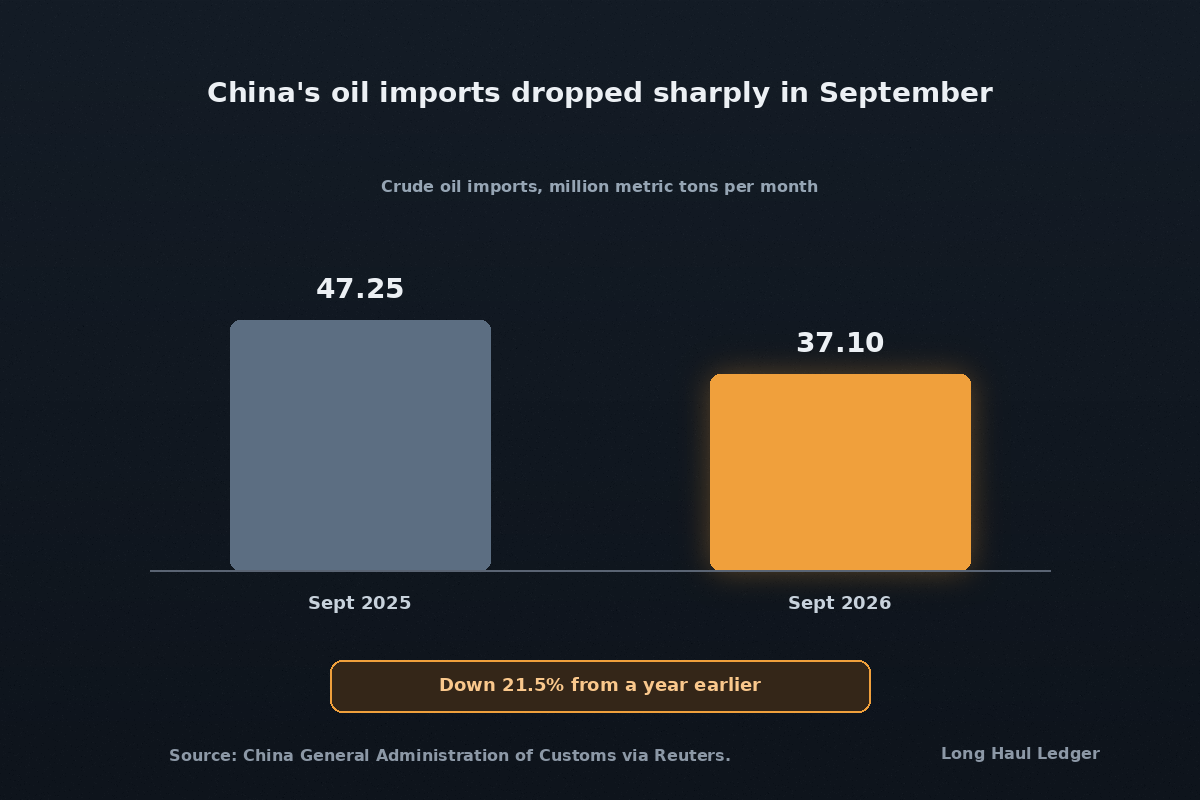
2. China, the world's biggest oil buyer, imported far less crude in September and drained its storage to make up for it.
China brought in 37.1 million tonnes of crude in September, down 21.5% from a year earlier, as shipping delays around the Strait of Hormuz held up cargoes. Its refiners pulled oil out of storage instead, the biggest monthly draw in data firm Kpler's records going back to 2017.
3. Venezuela says it expects almost $76 billion of oil and gas investment over the next five years.
Acting President Delcy Rodríguez said the government has signed 61 agreements with companies and is negotiating 44 more. Venezuela has the world's largest crude reserves but pumps far below its old highs, and turning these deals into oil will take years of work on worn-out fields and power systems.
4. The US is putting steep new duties on solar panels from India, Indonesia and Laos.
The US International Trade Commission ruled on October 14 that cheap, government-backed imports from the three countries are hurting American solar makers. That clears the way for combined duties of about 150% to more than 260% of the import price, depending on the country and company. The Commerce Department plans to issue the orders on November 2.
5. Microsoft will pay for about 1,100 megawatts of new power for its Indiana data center campus.
Utility company NiSource signed a 20-year deal starting in 2028 to supply Microsoft's campus in northwest Indiana, with Microsoft funding all the new power plants and power lines it needs. NiSource says the deal raises its expected savings for existing customers to about $1.75 billion over the life of its data center contracts.
6. Policy: The IMF expects Kuwait's and Qatar's economies to shrink by more than 15% this year because the Strait of Hormuz remains largely closed.
In its October outlook, the International Monetary Fund forecast that Kuwait's economy will shrink 16.7% in 2026 and Qatar's 15.6%. It now assumes the strait starts to reopen gradually in March 2027, while it kept its forecast for world growth this year at 3.1%.
7. Manufacturing: China's economy grew 4.5% in the third quarter, with high-tech factories a standout.
China's statistics bureau said output from July to September was 4.5% higher than a year earlier. Over the first nine months, high-tech manufacturing grew 14.3%, far faster than industry overall.
8. Technology: Japan will fund up to $21 billion for two new chip factories in upstate New York.
Under a US and Japan trade deal, GlobalFoundries will run two new chip plants at its Malta, New York, site, with the first, about $10 billion, expected online in 2029. The company expects more than 1,000 factory jobs and about 27,000 construction and related jobs.
That's the haul for this week. Thanks for reading. If something here caught your eye, you can dig into any place on the map, from the whole world down to major cities, at longhaulledger.com. See you next Monday.
Management
Figures are as published by each source on the date shown and may be revised.