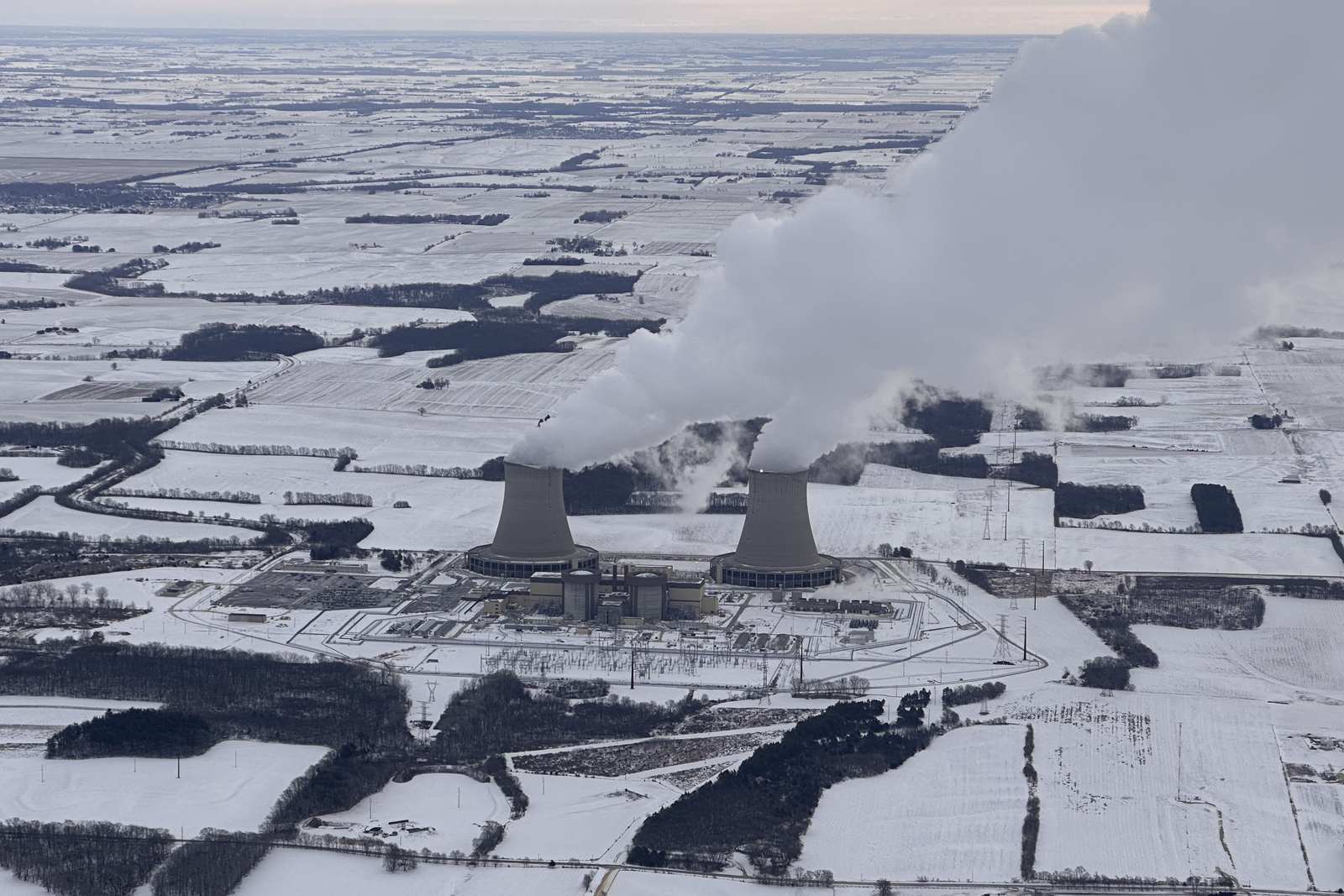
Byron, Illinois, where the Energy Department announced up to $5 billion for nuclear upgrades on October 27.
Oil started the week lower on hopes of a deal to reopen the Strait of Hormuz, and the building carried on all week. Washington backed more power from nuclear plants that are already standing, Qatar came back for more Louisiana gas, and the biggest tech companies kept their giant construction budgets in place.
This week at a glance
Energy
1. Oil prices fell about 6% on Monday as talks in Qatar raised hopes of reopening the Strait of Hormuz.
Brent crude fell 6.07% to $106.54 a barrel and US crude fell 6.2% to $97.65 early Monday, after Secretary of State Marco Rubio said President Trump prefers to end the Iran war through diplomacy and Iran signaled a deal is possible after two days of talks hosted by Qatar. A day earlier, seven core OPEC+ producers, including Saudi Arabia and Russia, kept their December output at September levels.
Why it matters: The strait normally carries about a fifth of the world's oil, and Goldman Sachs estimates that about $27 a barrel of war risk explains most of October's rally, which briefly took Brent to $118.
Talk is cheap, but this week it made oil cheaper too.
2. EQT agreed to buy Range Resources, creating a natural gas company worth more than $50 billion.
In the all-stock deal, each Range share becomes 0.987 EQT shares, leaving EQT's owners with about 73% of a company that would produce more than 9 billion cubic feet equivalent of gas a day. EQT says the combination will be America's largest natural gas producer, run from Canonsburg, Pennsylvania, with closing expected in the first quarter of 2027.
Why it matters: The combined company would hold more than 30 years of drilling inventory on nearly 3 million net acres and expects $325 million a year in base savings within two years, putting more gas supply under one roof as power plants and export terminals ask for more.
3. The Energy Department offered Constellation up to $5 billion to get more power out of eight nuclear plants it already runs.
The conditional loan would pay for upgrades, called uprates, at Braidwood, Byron, Clinton, Dresden, LaSalle and Quad Cities in Illinois, Calvert Cliffs in Maryland and Limerick in Pennsylvania, adding nearly 1,100 megawatts. Energy Secretary Chris Wright announced it at the Byron plant on October 27, and the loan becomes final only once Constellation meets the department's conditions.
Why it matters: The department says the added power is enough for more than 930,000 homes and will support more than 10,000 project jobs, all without building a new plant from scratch.
The quickest new power plant is sometimes the one already standing.
4. Qatar signed its second deal for American gas in a week, up to 3 million tonnes a year from Louisiana LNG.
QatarEnergy will buy the liquefied natural gas from Woodside's project near Lake Charles for 20 years starting in 2030, and says it is now the largest buyer of US LNG. In Europe, the benchmark gas price topped 100 euros per megawatt hour for the first time in almost four years, with storage at its lowest for the season since records began in 2011.
Why it matters: Long contracts help pay for new export plants, and Louisiana LNG's first phase is built for 16.5 million tonnes a year, with first gas targeted for 2029.
Last week a gas giant bought gas. This week it came back for seconds.
5. Alliant Energy closed a $5.1 billion federally backed loan package to build gas plants, batteries and gas storage in Iowa and Wisconsin.
The Energy Department said the package supports more than 2.6 gigawatts of new or upgraded power, including about 1,500 megawatts of new gas generation, 1,000 megawatts of batteries and 2 billion cubic feet of LNG storage. Unlike a conditional offer, the loans are signed, though each payout still needs state and environmental approvals.
Why it matters: Alliant expects electricity demand to rise about 60% by 2031, driven largely by data centers from Google, QTS and Meta, and it estimates the cheaper financing could save customers up to $1.2 billion over 30 years.
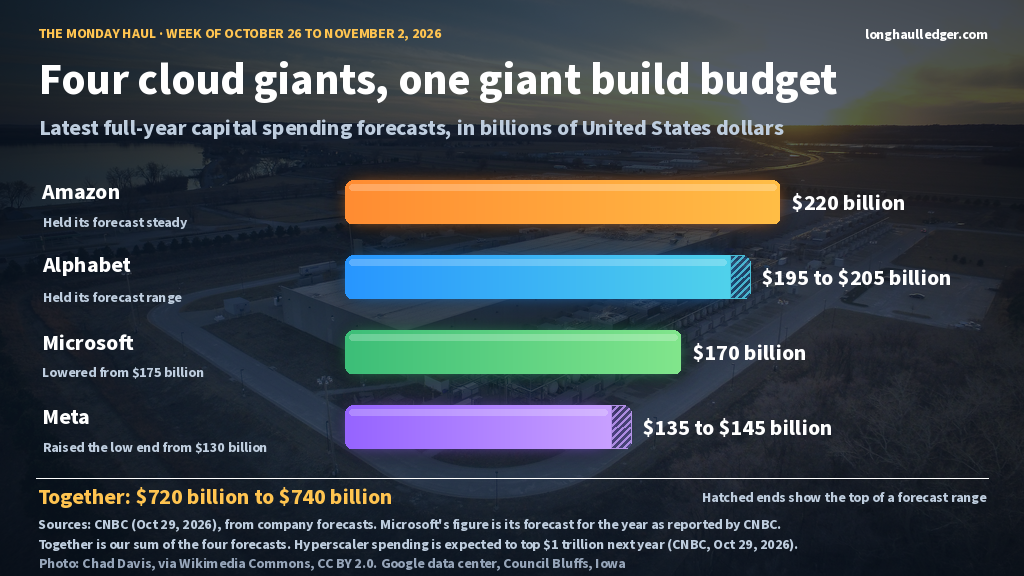
6. Technology: The four biggest cloud builders still plan to spend $720 billion to $740 billion between them this year, even as chip delays slow the pace.
Amazon held its 2026 forecast at $220 billion after spending $77.3 billion in the third quarter alone, Alphabet held at $195 billion to $205 billion, Meta expects $135 billion to $145 billion, and Microsoft trimmed its forecast to $170 billion from $175 billion. Microsoft's finance chief said delays at outside chip suppliers will push some capacity into the first half of 2027.
Why it matters: Much of this money becomes AI/SI data centers, power deals and construction work, and spending by the group is expected to top $1 trillion next year.
Even the biggest shopping lists run into back orders.
7. Services: DoorDash agreed to buy Instacart for about $17 billion, putting restaurant and grocery delivery under one roof.
DoorDash will pay $65 a share, 26% above Instacart's price before word of the deal leaked, at least 75% of it in cash, and plans to keep Instacart's brand and app. The deal needs shareholder and antitrust approval and is expected to close at the end of 2027 or in the first half of 2028.
Why it matters: Instacart works with nearly 100,000 stores, DoorDash says the deal would open more than 50,000 more to Instacart customers, and members of both services would pay one fee instead of two, saving an estimated $100 million a year.
8. Manufacturing: Infineon will invest about 1.1 billion euros in the world's first high-volume plant for gallium nitride power chips on 300 millimeter wafers.
The plant in Villach, Austria, reuses existing cleanrooms, is due to start production by the end of 2027, and has 319 million euros in state aid approved under the European Chips Act. Gallium nitride chips switch and convert electricity with less waste, for uses from AI/SI data centers to power grids, electric cars and robots.
Why it matters: Larger wafers yield 2.3 times as many chips each, and analysts cited by Infineon expect this market to reach about $3.5 billion by 2031, growing about 35% a year.
News summary, not investment advice. Figures are as published by each source on the date shown and may be revised. Opening photo: MediaGuy768, via Wikimedia Commons, licensed CC BY-SA 4.0, cropped. Cloud chart background photo: Chad Davis, via Wikimedia Commons, licensed CC BY 2.0, cropped and darkened; Google's data center in Council Bluffs, Iowa.