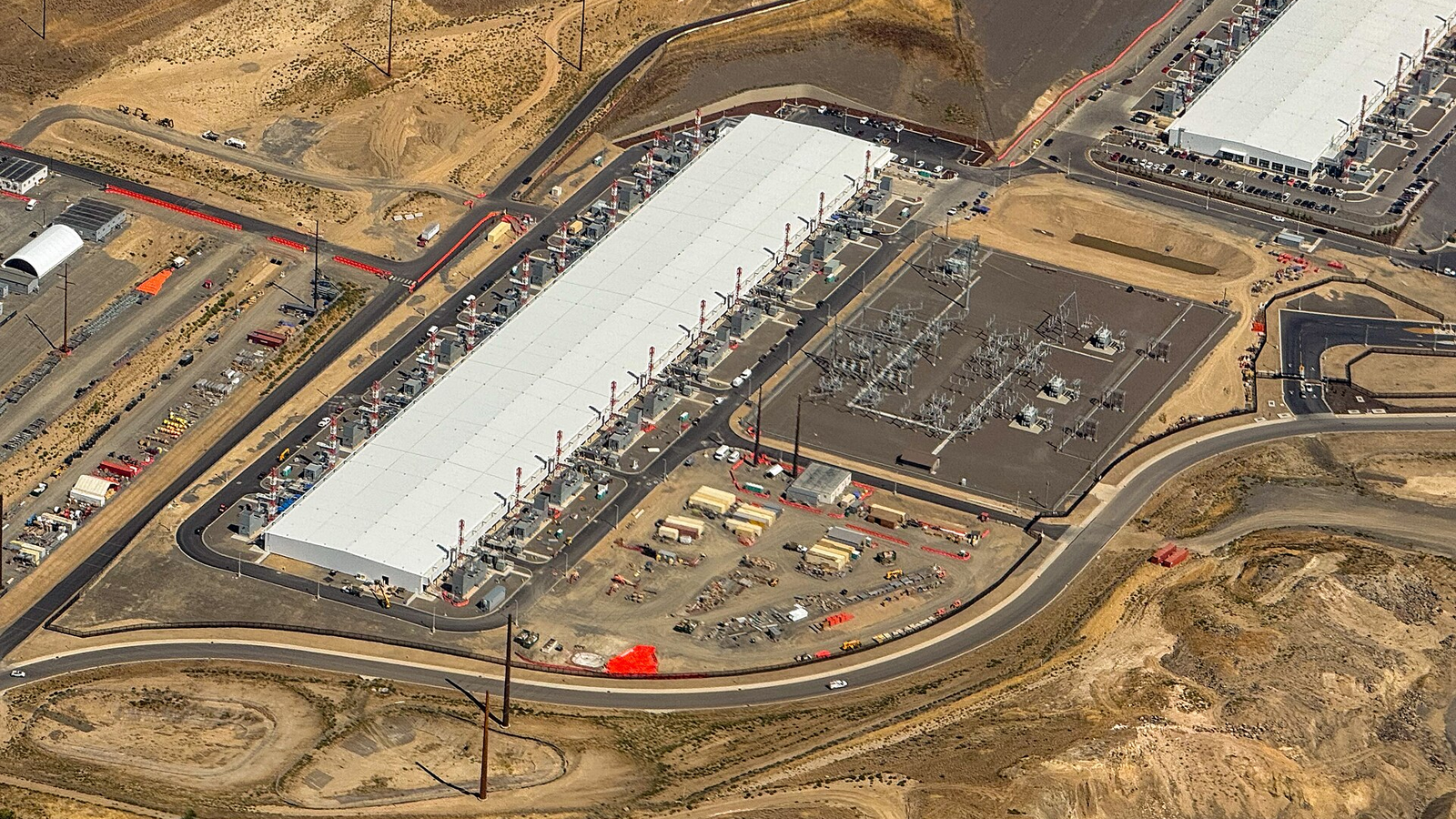
Data center halls near Wenatchee, Washington. This week brought plans for $65.1 billion more.
Oil fell sharply on hopes of an Iran deal and more Gulf supply, and employers hired far more people than expected in October. The building kept going too, with $65.1 billion of new data centers announced in two days, a bigger grid plan in Michigan and a $9 billion bet on the parts that carry high-voltage power.
This week at a glance
Energy
1. Oil prices posted their steepest weekly drop since the pandemic began, on hopes of an Iran deal and recovering Gulf supply.
Brent crude fell 16% last week and held near $98.35 a barrel early Monday, after President Trump said new strikes on Iran were highly unlikely while talks progress. A Bloomberg survey found OPEC pumped 22.8 million barrels a day in October, up 930,000, led by Saudi Arabia.
Why it matters: OPEC output is back to about 88% of its February level from before the war, and JPMorgan estimates world supply ran 1.4 million barrels a day above demand in October.
2. Michigan's DTE Energy raised its five-year building plan by nearly $10 billion, to about $44 billion, mostly to serve data centers.
The plan includes about 7.6 gigawatts of new solar and wind, 2.1 gigawatts of gas plants to replace the retiring Monroe coal plant, and 2.7 gigawatts of batteries. DTE has signed 2.4 gigawatts of data center demand, including 1.4 gigawatts for an Oracle project in Saline Township with OpenAI and Related Digital.
Why it matters: DTE says its contracts make data centers cover their own costs, and Emera also unveiled a 21.5 billion Canadian dollar five-year plan, with about 82% going to Florida.
3. GE Vernova agreed to buy Trench Group for $9 billion, bringing a key maker of high-voltage grid parts in-house.
Trench makes bushings, instrument transformers and coils found in most high-voltage direct current lines built worldwide, with more than 3,000 workers at 11 sites in Europe, North America and Asia. GE Vernova will pay half in cash and half with debt, and expects to close in late 2027 after approvals.
Why it matters: Trench's North American orders have risen almost 400% since 2024, and its new plant in Charlotte, North Carolina, expects to start making 765 kilovolt equipment in late 2027.
4. Marathon Petroleum agreed to sell its Minnesota and North Dakota refineries to CVR Energy for $4.2 billion.
The St. Paul Park refinery can process 105,000 barrels of crude a day and Mandan 72,000, and the sale includes a pipeline stake, storage and three terminals. Closing is expected at the end of 2026 after antitrust review.
Why it matters: Marathon plans to reinvest mainly on the Gulf Coast and in pipeline growth in the Permian and Marcellus basins, and keeps about 2.8 million barrels a day of refining capacity.
5. Abu Dhabi signed two new gas deals in a week, sending LNG to TotalEnergies and to India's Gujarat Energy.
ADNOC Gas will supply TotalEnergies with up to 1.6 million tonnes of liquefied natural gas over five years. ADNOC also agreed to sell Gujarat Energy up to 4 million tonnes of LNG under a 10-year deal starting in 2028.
Why it matters: The Gujarat gas is the first sale from fields owned by ADNOC's investment arm XRG outside the Gulf, and ADNOC's new trading platform aims to sell 47 million tonnes a year beyond 2030.
Gas from outside the Gulf is a strong selling point this year.
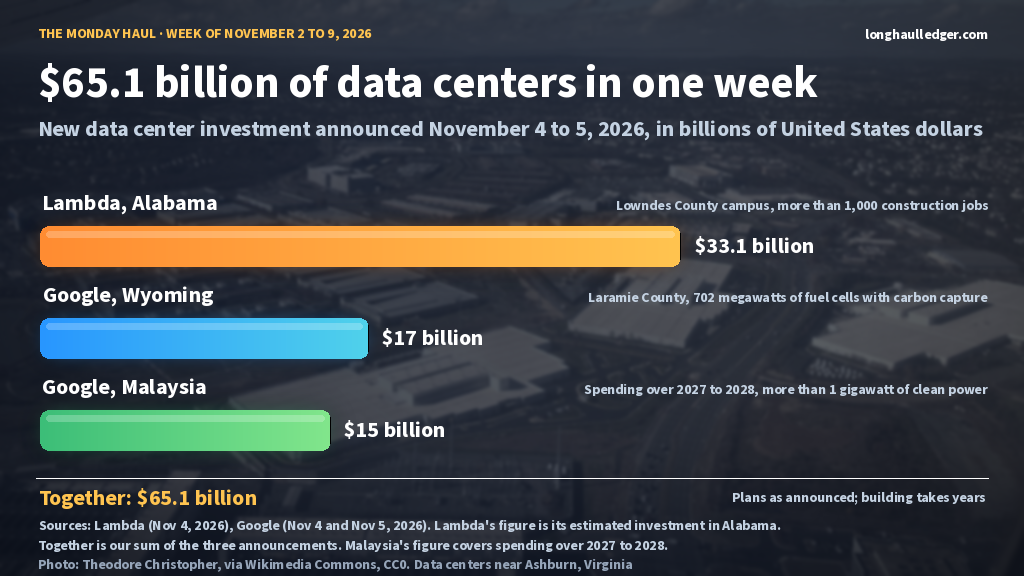
6. Technology: Lambda and Google announced $65.1 billion of new data centers in two days.
Lambda plans an estimated $33.1 billion campus in Lowndes County, Alabama, with more than 1,000 construction jobs, and Google announced a $17 billion campus in Laramie County, Wyoming, plus $15 billion in Malaysia over 2027 and 2028. The Wyoming site will draw on 702 megawatts of natural gas fuel cells from Bloom Energy, with carbon capture.
Why it matters: Lambda projects more than $1.6 billion for Lowndes County schools through 2049, and both companies say they will pay for the power and grid connections their sites need, answering the power bill worries voters raised last week.
7. Jobs: Employers added 165,000 jobs in October, far more than expected, and unemployment slipped to 4.1%.
Economists surveyed by Dow Jones had expected 59,000, and August and September were revised up by a combined 84,000. Professional and business services led with 70,000 jobs, followed by health care at 42,000, transportation and warehousing at 25,000 and manufacturing at 19,000.
Why it matters: Average hourly pay rose 3.1% from a year earlier to $38.00, while consumer prices rose 3.7% in the year to September, so paychecks are still catching up.
8. Raw materials: Mitsui Chemicals will buy chip materials maker JSR for about $11.6 billion, the biggest deal in Japan's chemicals industry.
JSR makes photoresists, the light-sensitive coatings used to print circuit patterns onto chip wafers, and is being sold by the state-backed Japan Investment Corp for 1.84 trillion yen. The Development Bank of Japan will invest 200 billion yen, and Mitsui will sell up to 150 billion yen in new shares.
Why it matters: The deal is more than twice the size of the old record, Showa Denko's $4.55 billion purchase of Hitachi Chemical in 2020, and Mitsui aims for 40 billion yen in added yearly profit.
News summary, not investment advice. Figures are as published by each source on the date shown and may be revised. Opening photo: Tedder, via Wikimedia Commons, licensed CC BY 4.0, cropped; Microsoft Azure data centers in Wenatchee, Washington. Data center chart background photo: Theodore Christopher, via Wikimedia Commons, dedicated to the public domain under CC0 1.0, cropped, blurred and darkened; data centers near Ashburn, Virginia.