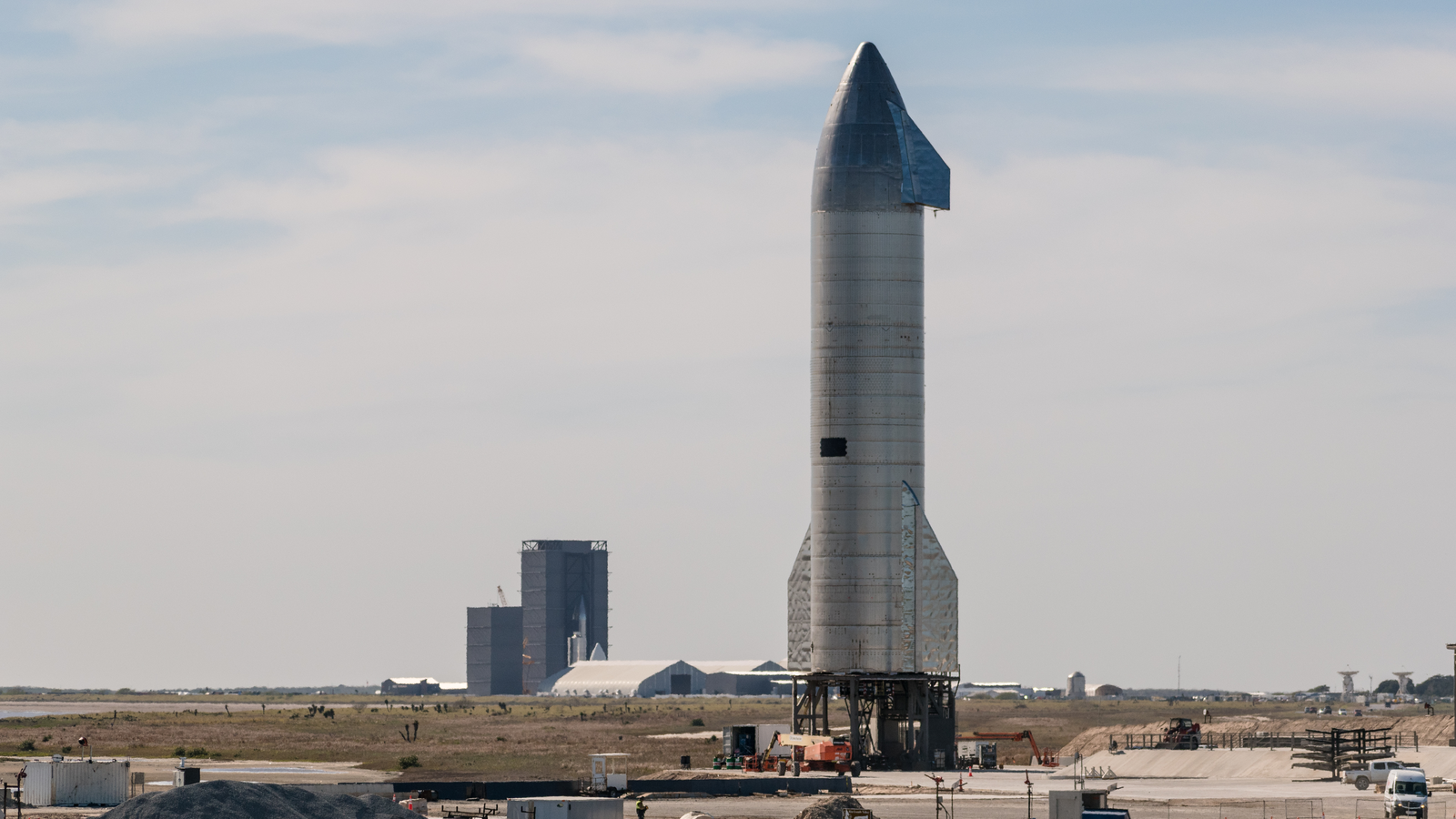
The Starship build site at Starbase, Texas, in 2021. SpaceX now plans more than $24 billion of supercomputing here.
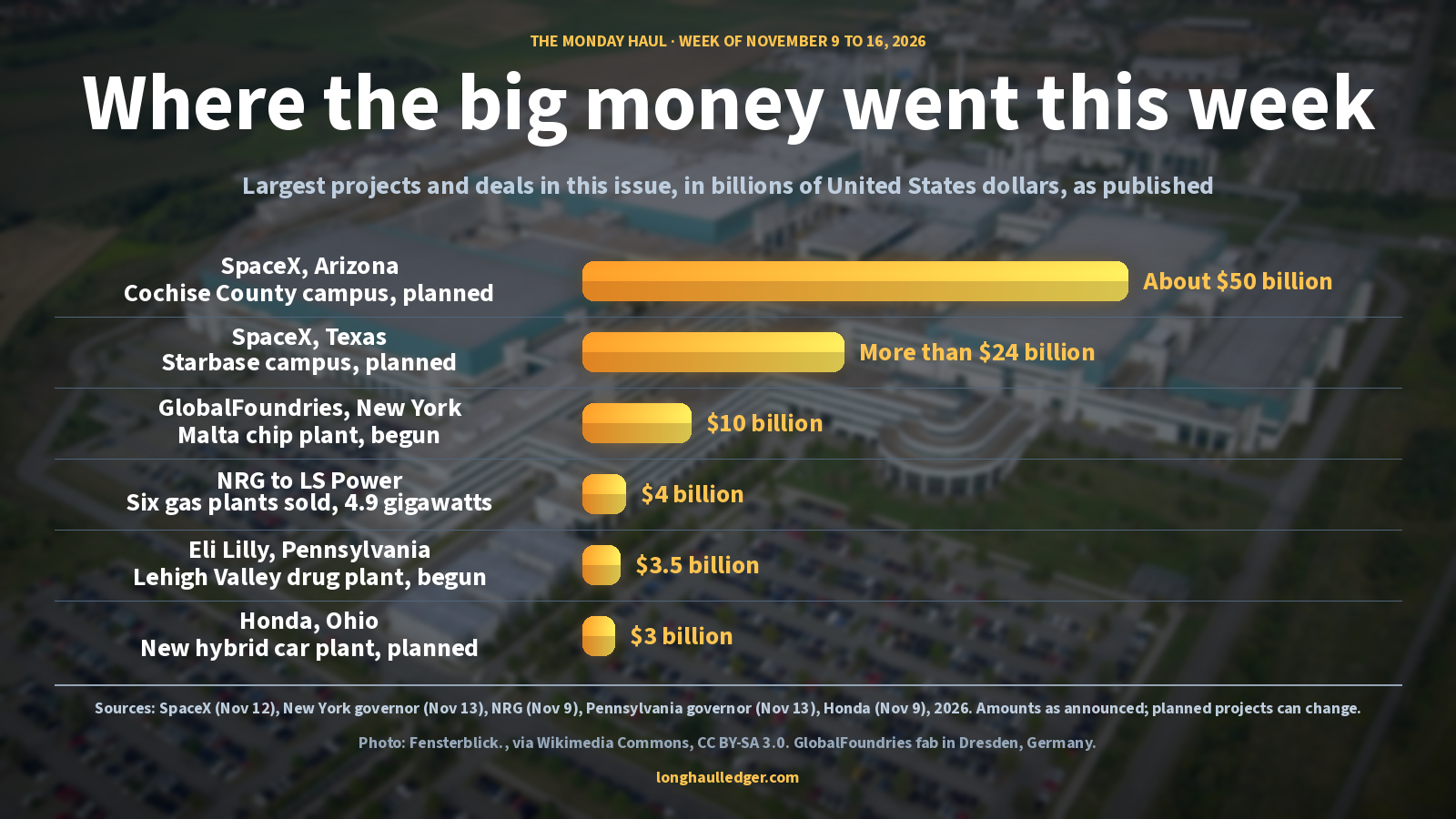
Oil is easing as the world edges toward a surplus, and builders kept pouring concrete. A first-of-its-kind reactor permit, a $950 million solar and battery plant and a $10 billion chip plant all moved forward. Prices still need watching, but new capacity keeps arriving.
This week at a glance
Energy
1. Oil is edging toward a surplus, with the IEA now expecting more supply than demand this quarter.
The International Energy Agency said Friday that supply will average 105 million barrels a day this quarter, 1.7 million above demand, reversing its earlier forecast of a shortage. Brent crude traded near $95 a barrel Monday, down about 1%.
Why it matters: The IEA says 71 million barrels of emergency stocks will still be released by the end of February, and Goldman Sachs expects Brent to average $88 a barrel in 2027. Fresh tanker incidents show shipping risks remain.
A surplus is a nice problem after months of worrying about a shortage.
2. The US issued its first construction permit for a high-temperature gas-cooled nuclear reactor in nearly 60 years.
The Nuclear Regulatory Commission approved the permit on Nov 9 for Dow's Long Mott station in Seadrift, Texas, where four X-energy reactors would supply steam and electricity to a chemical site. It is the agency's third advanced reactor construction permit this year.
Why it matters: The four reactors could provide up to 320 megawatts of electricity, plus steam, for 60 years, the Department of Energy says. The permit does not allow operation, and Dow's preliminary investment decision is expected in 2027.
Nuclear steam for a chemical plant is a very practical kind of ambition.
3. ExxonMobil signed a first step back into Venezuela, nearly two decades after its assets there were seized.
ExxonMobil and state oil company PDVSA signed a non-binding agreement on Nov 9 in Caracas that gives Exxon one year to review data and negotiate terms. Sources told Reuters that Exxon can evaluate seven areas, including the Petromonagas project in the Orinoco Belt.
Why it matters: Exxon says any investment depends on stable policies, clear rules, strong protections and competitive returns, and Russia's Roszarubezhneft holds 40% of Petromonagas. Neither report gives an investment amount.
A memorandum is a polite way of saying let's look at the maps first.
4. NRG Energy will sell six gas power plants to LS Power for $4 billion, a total of 4.9 gigawatts of capacity in four states.
The plants are in Texas, New York, Rhode Island and Connecticut, and the sale is expected to close in the second quarter of 2027 after regulatory approvals. NRG says the money supports $3 billion of share buybacks across 2026 and 2027 and $2 billion of debt reduction at closing.
Why it matters: With a pending 4.4 gigawatt purchase from Constellation, LS Power says its gas fleet will grow from 2.2 to 11.5 gigawatts. NRG will keep about 20 gigawatts, split evenly between Texas and the PJM grid.
5. California's $950 million Lockhart solar and battery plant is finished, with power for about 350,000 homes and businesses.
Terra-Gen's project in San Bernardino County has 365 megawatts of solar generation and 173.7 megawatts of battery storage, using more than 925,000 solar panels. It began commercial operation after a ribbon-cutting at the Hinkley site.
Why it matters: Building it created more than 1,000 on-site jobs over four years, and the plant is expected to pay more than $40 million in property taxes over its life.
Sunshine by day, batteries by night, taxes all year.
6. Technology: SpaceX plans more than $74 billion of supercomputing campuses in Arizona and Texas to train its AI and super intelligence models.
SpaceX plans about $50 billion in Cochise County, Arizona, and more than $24 billion at Starbase, Texas. The Arizona campus still needs county approval, and county staff had not yet reviewed its figures, KVOA reports.
Why it matters: SpaceX says Arizona would bring about 5,500 construction jobs and 1,000 permanent jobs, with up to six gigawatts of power and dry cooling with no planned industrial groundwater use. Starbase would make its own electricity and has already generated more than 3,000 construction jobs.
Big computing needs big power, so the plan starts with where the power comes from.
7. Prices: US consumer prices rose 0.4% in October, more than economists expected.
The Bureau of Labor Statistics said core prices, which leave out food and energy, rose 0.3%, also above forecasts. Gasoline rose 1%, food 0.5% and shelter 0.3%.
Why it matters: Shelter alone made up more than 30% of the October rise, and September prices had jumped 0.6%, with gasoline up 9.1% that month. The bureau did not publish a yearly rate because last year's shutdown stopped data collection.
8. Manufacturing: GlobalFoundries broke ground on a $10 billion chip plant in Malta, New York, the first phase of a US and Japan plan to invest up to $21 billion.
The new fab will have about 386,000 square feet of cleanroom space and is part of a $12.3 billion expansion. New York State is backing it with $570 million, including $535 million in performance-based tax credits.
Why it matters: The governor's office says the project will create more than 1,100 manufacturing jobs and support thousands of construction jobs, and GlobalFoundries commits $60 million to the community.
Almost 386,000 square feet of spotless floor makes for an impressive mop budget.
News summary, not investment advice. Figures are as published by each source on the date shown and may be revised. Opening photo: Jared Krahn, via Wikimedia Commons, licensed CC BY-SA 4.0, cropped; the Starship build site at Starbase, Texas, photographed in January 2021. Chart background photo: Fensterblick., via Wikimedia Commons, licensed CC BY-SA 3.0, cropped, blurred and darkened; GlobalFoundries Fab 1 in Dresden, Germany.