Explainer · Energy
Why China's crude oil imports fell in 2026
Updated October 20, 2026 · Numbers as published by each source on the date shown
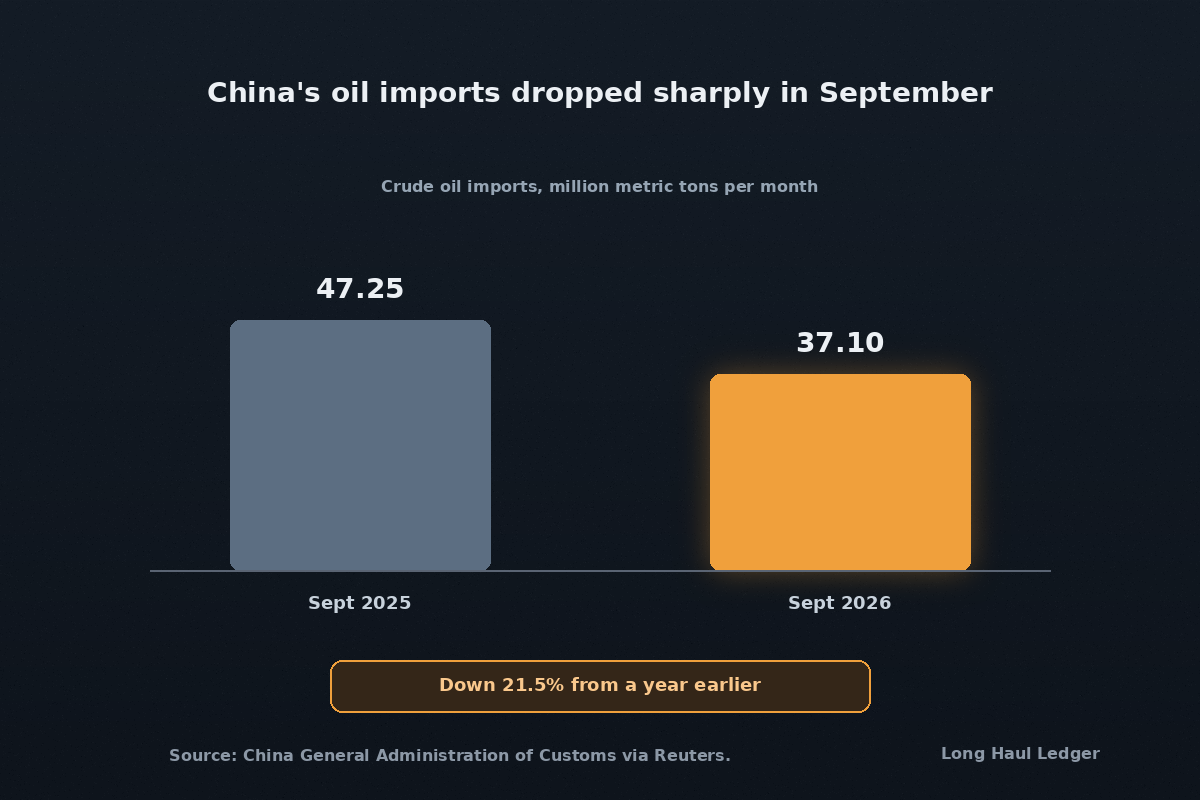
China is buying less crude mainly because shipping around the Strait of Hormuz has been disrupted, which delayed tankers and made oil more expensive. Instead of buying more, China has been drawing on oil it already had in storage. In September 2026 it imported 37.1 million tonnes, 21.5% less than a year earlier.
How much less oil is China buying?
September 2026 in numbers
China is the world's biggest oil buyer. In September 2026 it imported 37.1 million tonnes of crude, about 9.03 million barrels a day, according to China's customs data as reported by Reuters. A year earlier, in September 2025, it imported 47.25 million tonnes, about 11.5 million barrels a day. That is a drop of 21.5%.
The low point came in the spring and early summer
September was not the lowest month. In June 2026 China imported 29.27 million tonnes, about 7.12 million barrels a day, the lowest since October 2016. Across the second quarter, imports averaged 8.1 million barrels a day, 32% below the first quarter, according to the US Energy Information Administration (EIA).
Why imports fell
Hormuz shipping delays and higher prices
The concrete reason is shipping. Disruption around the Strait of Hormuz, the narrow sea lane out of the Persian Gulf, held up tankers and pushed oil prices higher. September's drop came from delayed tanker arrivals: cargoes China would normally have received that month had not yet arrived.
September was about delays, not weaker refining
It would be easy to read a 21.5% drop as Chinese refineries slowing down. That is not what happened in September. Refinery runs rose that month: China's crude distillation utilisation climbed to 66.36% in September, up 1.98 points from August, per Oilchem data reported by Reuters via Baird Maritime (Oct 14, 2026). The oil they processed came partly from storage, because the tankers were late.
Where the missing oil came from: storage
China kept its refineries supplied by drawing down its stockpiles. September 2026 saw the biggest monthly storage draw in data firm Kpler's records, which go back to 2017.
The same pattern showed up earlier in the year. Researchers at Columbia University's Center on Global Energy Policy found that China's net crude imports (imports minus exports) fell 30% year on year in the second quarter, and that changes in storage explain more than half (54%) of that decline. Note that this 30% is a different measure from the EIA's 32%: Columbia compares net imports with the same quarter a year earlier, while the EIA compares second quarter imports with the first quarter.
What it means for world oil prices
When the biggest buyer takes fewer cargoes, there is less competition for the oil that does get through, which can take some pressure off prices. But oil drawn from storage has to be replaced at some point. If China starts refilling its tanks, its imports could rise again, adding demand back to the market.
What to watch next
- Monthly customs data. China publishes its import figures each month. A rebound would suggest delayed cargoes are arriving or storage is being refilled.
- Storage levels. Tracking firms like Kpler show whether China is still drawing down its stocks or building them back up.
- Shipping around Hormuz. How quickly tankers move through the region shapes how much oil reaches China.
The Monday Haul tracks the monthly number. It first covered the September drop in the October 19, 2026 issue. You can also follow China and every other country on the live dashboard.
Common questions
How much crude oil does China import a month?
In September 2026, 37.1 million tonnes, about 9.03 million barrels a day. In September 2025 it was 47.25 million tonnes, about 11.5 million barrels a day.
Is China using its oil stockpiles?
Yes. September 2026 saw the biggest monthly storage draw in Kpler's records going back to 2017. In the second quarter, storage changes explained 54% of the drop in net imports.
How does the Strait of Hormuz affect China's oil?
Disrupted shipping there delayed tanker arrivals and pushed prices up. September's import drop came mainly from those delayed cargoes.
Did Chinese refineries cut back in September?
No. Refinery runs rose in September. The import drop came from late tankers, and storage filled the gap.
What was the lowest month?
June 2026, at 29.27 million tonnes, the lowest since October 2016.
Sources
- China burns through crude stockpiles after massive import drop, Reuters via Baird Maritime, Oct 14, 2026. September 2026 imports, higher refinery runs (Oilchem utilisation) and Kpler storage draw.
- China's September oil imports, Reuters, Oct 13, 2025. September 2025 imports.
- China's June oil imports hit near 10-year low, Reuters, Jul 14, 2026. June 2026 imports.
- Today in Energy, US Energy Information Administration, Jul 31, 2026. Second quarter imports versus first quarter.
- How China is managing lower oil imports, Erica Downs and Michal Meidan, Columbia Center on Global Energy Policy, Aug 13, 2026. Net imports and storage share.
- The import cut Beijing did not order, Zongyuan Zoe Liu, Council on Foreign Relations, Oct 6, 2026. Background.
The Monday Haul · free weekly email
Energy, industry, infrastructure and policy in one short email every Monday, including the monthly China number. Every item sourced and dated. More about the Haul