Explainer · Jobs
Do data centers create local jobs, or just a few on site?
On-site staff are small. County job gains show up later, mostly outside the building.
Updated November 9, 2026 · Numbers as published by each source on the date shown
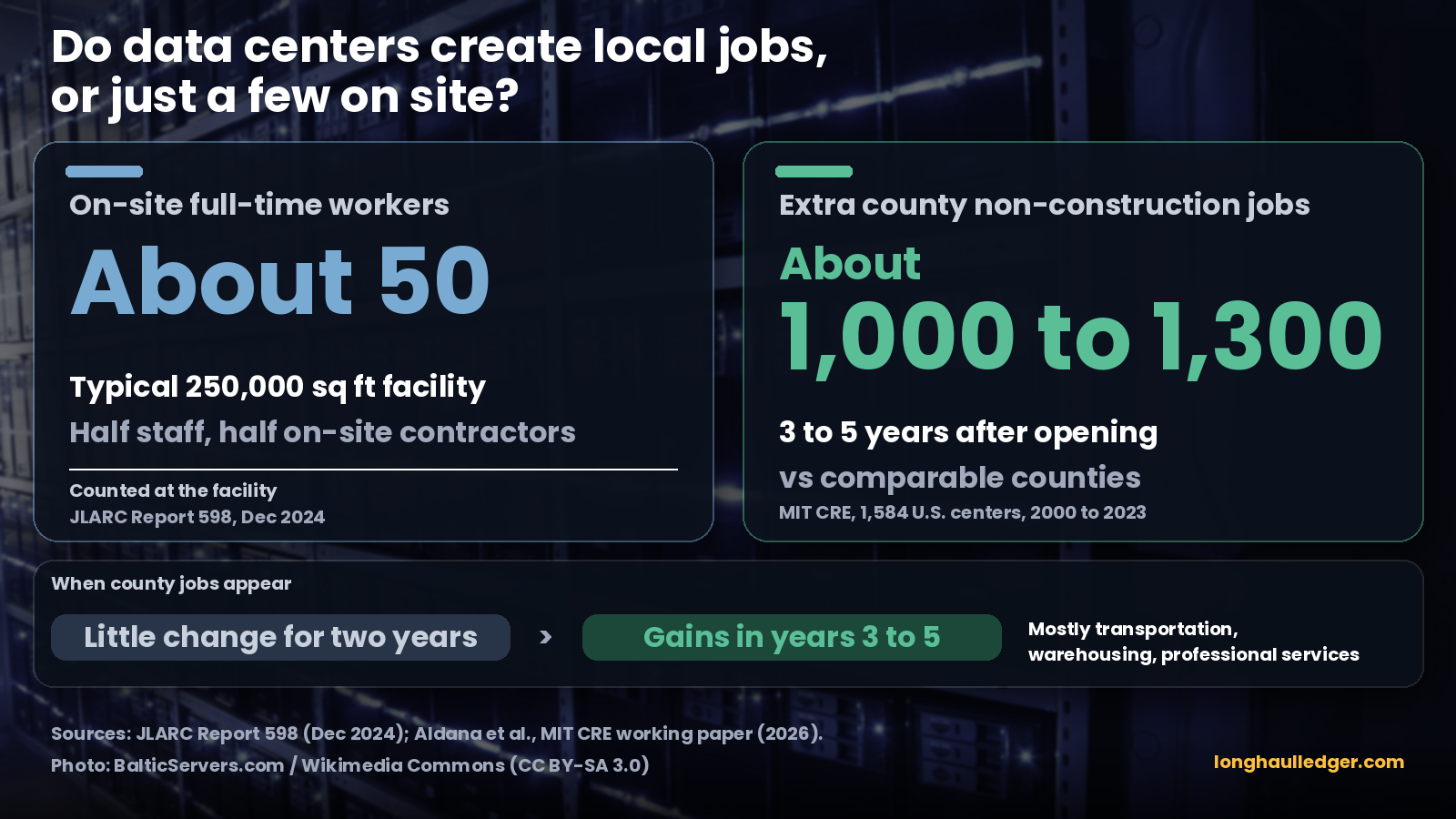
Both can be true. Several data center representatives indicated that a typical 250,000-square-foot data center may have approximately 50 full-time workers, Virginia's Joint Legislative Audit and Review Commission reports. An MIT Center for Real Estate working paper on 1,584 U.S. data centers finds that local non-construction employment changes little for two years after a data center opens, then begins to rise. Three to five years after opening, the authors report that those counties had roughly 1,000 to 1,300 additional nonconstruction jobs than comparable counties.
Clearer job counts help communities and builders weigh the local hiring path that follows new capacity as more campuses come online.
What is moving forward right now
Data center campuses keep getting built, and a working paper from the MIT Center for Real Estate is now part of the public debate over the jobs that follow. Simon Buechler of Miami University, a coauthor, and Lyndsey Rolheiser summarized the study in The Conversation on October 27, 2026. They report that the 1,584 U.S. data centers that opened between 2000 and 2023 created 1,000 to 1,300 jobs in the counties where they are located, on average. The authors say those jobs are for work performed outside data centers rather than inside them, and that they take a few years to appear.
On November 9, 2026, an Innovation Council clip of Buechler carried that county estimate into the day's discussion: about 1,000 to 1,300 additional jobs within 3 to 5 years of opening, on top of construction. Buechler is listed as Simon Büchler on the working paper.
Counties weighing a new campus can put the on-site crew and the later county hiring on the same page while the project moves ahead.
On-site staff are a few dozen
Data centers typically employ a small number of workers for data center operations, relative to their facility size, Virginia's Joint Legislative Audit and Review Commission wrote in Report 598 on December 9, 2024. Several data center representatives indicated that a typical 250,000-square-foot data center may have approximately 50 full-time workers. About half of these workers are likely direct employees of the data center company, including facility managers, engineers, data technicians, and facility maintenance staff. The other half are contract workers, including electricians, pipefitters, and security personnel who work full-time at the facility.
Construction is the larger pulse of hiring, and it is shorter. Construction of an individual data center building usually takes about 12 to 18 months, and data center representatives indicated that, at the height of construction, approximately 1,500 workers are on site.
That operations crew is the steady team that keeps a finished center running while the next building goes up.
What the 1,584-center study actually measured
Ernesto Aldana, Simon Büchler, Alexander Carlo, Lyndsey Rolheiser, Albert Saiz, and Carles Vergara-Alert wrote "Serving the Servers: Do Data Centers Create Local Employment?" as a working paper for the MIT Center for Real Estate. SSRN lists it as a forthcoming MIT Center for Real Estate research paper. The date written is September 12, 2026, and SSRN posted it on September 16, 2026.
The abstract says the authors combined proprietary data on 1,584 U.S. data centers with synthetic difference-in-differences and local projections. In The Conversation, the authors say they recorded each facility's location, opening date, and power capacity, and matched those records with federal data on employment, wages, and the number of businesses in each county. They compared counties that received data centers with similar counties that did not. The jobs in the result are local non-construction employment in the county.
The abstract says local non-construction employment changes little for two years after a data center opens, then begins to rise. The county total that follows is a change in local employment, including suppliers and related industries, and it is measured against comparable counties.
When the county jobs appear, and where
During the first two years after a county's first data center opened, the authors found little change in employment outside construction. Three to five years after a center opened, these counties had roughly 1,000 to 1,300 additional nonconstruction jobs than comparable counties without data centers, the authors wrote in The Conversation.
Installed capacity is associated with 7.4 additional non-construction jobs per megawatt, the working paper says, five years after new capacity is installed. Because each installed megawatt also predicts a further 1.7 megawatts of capacity over the same period, the paper says this corresponds to 2.74 jobs per effective megawatt. In The Conversation, the authors describe that second figure as about 2.7 nonconstruction jobs per megawatt of eventual data center capacity. A large 100-megawatt facility, for example, would be correlated with roughly 275 additional local jobs outside the data center itself. For what a megawatt measures, see is a megawatt the same as a megawatt-hour.
Read the two bars on one scale. The short bar is the on-site operations crew JLARC described. The long bar runs to 1,300, the top of the range of about 1,000 to 1,300 additional county non-construction jobs the authors report for three to five years after opening. The label on the chart is Aldana et al. 2026.
These gains are concentrated in two sectors, transportation and warehousing and professional and technical services, the working paper's abstract says. The authors' Conversation summary also names real estate. Retail, restaurants, and other local services show little employment growth. Existing capacity mostly predicts expansion by incumbent operators, and only a small share of subsequent capacity is attributable to new entrants.

A hall like this is where the on-site crew works. The county job gains the authors measure show up mostly in transportation and warehousing and in professional and technical services, as suppliers and related firms hire around the campus.
Get the free Monday Haul for data-center and jobs numbers each week.
The Monday Haul · free weekly email
Energy, industry, infrastructure and policy in one short email every Monday, including new factories and grid projects. Every item sourced and dated. More about the Haul
Why a few on-site jobs and 1,000 county jobs both fit
JLARC is counting the people who work at the facility, the working paper is counting how county-wide non-construction employment changes after a center opens, including suppliers and related industries, and construction is a shorter pulse of hiring, with approximately 1,500 workers on site at the height of building a data center.
Holding those counts apart lets a town plan for the build, the steady on-site team, and the later hiring in supplier industries. For how factory payrolls and factory output can move on different paths, see are US factories shrinking because they have fewer workers. For who the unemployment rate counts when a project starts hiring, see if unemployment is 4.1%, are 95.9% of adults working.
What the study does not claim
The study covers data centers that opened through 2023, before the current AI/SI wave of massive facilities. Larger data centers do not necessarily create proportionally more jobs, the authors write, so the pattern may not carry over in the same proportion to today's biggest projects. The authors looked only at job gains. They did not explore whether data centers are worth their cost to local communities. They note that these facilities consume large amounts of electricity and water, can generate noise, and may receive substantial tax breaks, and they did not address those questions. For how data centers fit into the power bill, see why your power bill is rising, and what brings it down.
The November 9 clip rounded the study's 1,584 data centers to 1,600. The 1,000 to 1,300 figure in that discussion is county non-construction employment, mostly outside the building, three to five years after opening. IESE Insight, on November 6, 2026, also reports about 1,000 to 1,300 more non-construction jobs than control counties from three to five years after opening, attributed to the same working paper.
The job figures are one input communities and builders can set next to power, water, and local revenue as more capacity is built.
What to watch next
Next updates to the MIT Center for Real Estate paper will show whether the authors revise the county estimates. State audit and economic-development filings that separate on-site operations headcount from county totals will make the two counts easier to line up. Utility large-load dockets that disclose staffing will add facility-level crews to the JLARC example. The open question is whether post-2023 AI/SI campuses show the same pattern of 7.4 additional non-construction jobs per installed megawatt at five years.
For how to read the line of projects waiting to connect, see is 2,000 GW of new power about to hit the grid. Follow the projects on the live dashboard. Past issues are in the archive.
Common questions
Do data centers create local jobs, or just a few on site?
Both can be true. Several data center representatives indicated that a typical 250,000-square-foot data center may have approximately 50 full-time workers, Virginia's Joint Legislative Audit and Review Commission reports. An MIT Center for Real Estate working paper on 1,584 U.S. data centers finds that local non-construction employment changes little for two years after a data center opens, then begins to rise. Three to five years after opening, the authors report that those counties had roughly 1,000 to 1,300 additional nonconstruction jobs than comparable counties.
How many people work in a data center?
Several data center representatives indicated that a typical 250,000-square-foot data center may have approximately 50 full-time workers, Virginia's Joint Legislative Audit and Review Commission reported on December 9, 2024. About half of these workers are likely direct employees, including facility managers, engineers, data technicians, and facility maintenance staff. The other half are contract workers, including electricians, pipefitters, and security personnel who work full-time at the facility.
How many permanent jobs does a data center create?
JLARC is describing the people who work at the facility, about 50 full-time workers at a typical 250,000-square-foot center. The working paper finds roughly 1,000 to 1,300 additional nonconstruction jobs in the county, compared with similar counties, three to five years after opening. Construction is a separate pulse: data center representatives indicated that approximately 1,500 workers are on site at the height of construction.
How many jobs does a data center add per megawatt?
Installed capacity is associated with 7.4 additional non-construction jobs per megawatt, the working paper says. Because each installed megawatt also predicts a further 1.7 megawatts of capacity, that corresponds to 2.74 jobs per effective megawatt. The authors' summary in The Conversation describes the second figure as about 2.7 nonconstruction jobs per megawatt of eventual data center capacity.
Sources
- Serving the Servers: Do Data Centers Create Local Employment?, Ernesto Aldana, Simon Büchler, Alexander Carlo, Lyndsey Rolheiser, Albert Saiz, and Carles Vergara-Alert, MIT Center for Real Estate research paper forthcoming, date written September 12, 2026, posted on SSRN September 16, 2026 (doi:10.2139/ssrn.7467778). Working paper. Proprietary data on 1,584 U.S. data centers, synthetic difference-in-differences and local projections. Local non-construction employment changes little for two years after a data center opens, then begins to rise. Installed capacity is associated with 7.4 additional non-construction jobs per megawatt. Each installed megawatt also predicts a further 1.7 megawatts of capacity, corresponding to 2.74 jobs per effective megawatt. Gains concentrated in transportation and warehousing and professional and technical services. Retail, restaurants, and other local services show little employment growth.
- We studied 1,584 data centers and found the buildings full of machines are tied to modest local job growth, Simon Buechler and Lyndsey Rolheiser, The Conversation, October 27, 2026. Authors' summary of the same working paper. Roughly 1,000 to 1,300 additional nonconstruction jobs three to five years after opening, about 7.4 more nonconstruction local jobs per additional megawatt, about 2.7 nonconstruction jobs per megawatt of eventual capacity, and roughly 275 additional local jobs outside a large 100-megawatt facility. Sample ends in 2023, before the current wave of massive facilities built to power AI.
- Even when data centers create jobs, their local economic benefits appear limited, IESE Insight, November 6, 2026. Reports about 1,000 to 1,300 more non-construction jobs than control counties from three to five years after opening, attributed to the MIT Center for Real Estate working paper.
- Data Centers in Virginia, Joint Legislative Audit and Review Commission, Report 598, December 9, 2024. A typical 250,000-square-foot data center may have approximately 50 full-time workers. About half are likely direct employees and the other half are contract workers on site. At the height of construction, approximately 1,500 workers are on site.
- Innovation Council post, November 9, 2026. A clip of Simon Buechler on county job estimates. The clip rounds the study's 1,584 data centers to 1,600.
- BalticServers data center, photo by BalticServers.com. CC BY-SA 3.0, via Wikimedia Commons. Used as the chart background and as the hall photograph on this page.
