Explainer · Energy
Why your power bill is rising, and what brings it down
Updated October 21, 2026 · Numbers as published by each source on the date shown
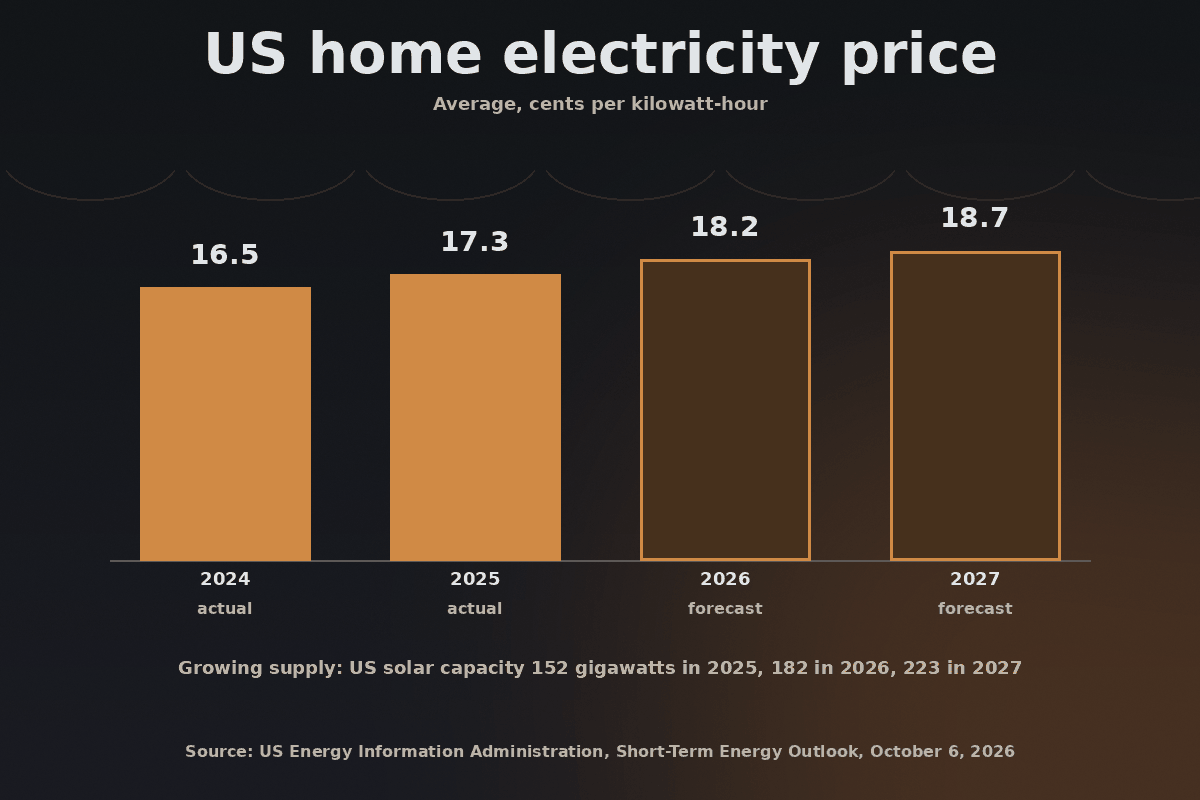
The average US home is forecast to pay 18.2 cents per kilowatt-hour for electricity in 2026, up from 17.3 cents in 2025, according to the Energy Information Administration (EIA). Data centers are one part of that. The bigger drivers are spending to rebuild and strengthen the grid, higher natural gas prices and weather. The fix is more supply and more grid, and both are being built.
What is happening to power prices
The EIA's October 2026 outlook puts the average US residential price at 16.5 cents per kilowatt-hour in 2024 and 17.3 cents in 2025. It forecasts 18.2 cents for 2026, a rise of about 5%, and 18.7 cents for 2027.
Wholesale power, the price utilities pay for electricity itself, is forecast to average $52 per megawatt-hour across the 11 trading hubs the EIA tracks in 2026, 11% higher than in 2025. Where prices rose, the EIA points mainly to weather, such as Winter Storm Fern and a hot July. It expects wholesale prices to ease to $49 in 2027.
How a power bill is built
A bill pays for three things. The first is generation, the cost of making the electricity. The second is transmission, the high-voltage lines that carry power long distances. The third is distribution, the local poles, wires and transformers that bring it to your street. Regulators can add other approved costs, such as bill assistance programs, according to the Congressional Research Service (CRS).
Buying wholesale power is typically about half of the retail price, according to the Federal Reserve Bank of Dallas. The rest covers transmission, distribution and other approved costs. So a jump in wholesale prices moves your bill by about half as much in percentage terms.
In some regions, bills also include capacity costs, which pay power plants to be available when demand peaks. The EIA lists these alongside grid upgrades as part of what residential prices cover.
Where data centers fit in
Data centers used about 4.7% of US electricity in 2024, and a Department of Energy study projects 9.5% to 15.3% by 2030, CRS reports. The North American Electric Reliability Corporation expected peak demand in 2026 to be 11 gigawatts higher than in 2025, largely because of data centers.
Where spare power plants are scarce, that new demand can raise prices for everyone. The CRS calls it one of several contributing factors behind higher prices in the PJM region, the grid that serves all or part of 13 states and Washington, DC, from New Jersey to Illinois, including northern Virginia's data center hub. The EIA forecasts PJM wholesale prices in 2026 to be 41% higher than in 2025, the largest increase of any region.
The national picture so far is different. Lawrence Berkeley National Laboratory found that from 2019 through 2025, states with the most data center demand growth generally saw prices fall. One likely reason is that the grid's fixed costs were spread across more electricity sales. Researchers at EPRI and Watershed reached a similar result in a 2026 preprint, a paper shared before peer review. They estimate that data centers caused average retail rates to fall modestly from 2015 to 2024. Its authors caution that supply limits could reverse that effect.
The bigger drivers are the grid, fuel and weather
Rebuilding the grid
From 2019 through 2025, the main reason prices went up was utility spending on the grid, mostly to replace aging equipment and make it more resilient, Lawrence Berkeley National Laboratory found. In 22 states, distribution costs pushed prices up from 2024 to 2025, some of it to pay back storm repairs. The equipment itself also costs more. Prices for gear used to build and run the grid have risen well above inflation.
Natural gas
Wholesale power prices track natural gas prices. In 2025 the average price of gas delivered to power plants rose 36% from its all-time low in 2024, the same laboratory found.
Weather
Cold snaps and heat waves raise demand and bring more expensive plants online. The EIA points to Winter Storm Fern and a hot July as the main reasons wholesale prices rose in some regions in 2026.
What is being built to bring costs down
- More power plants. The EIA forecasts US solar capacity to grow from 152 gigawatts in 2025 to 182 in 2026 and 223 in 2027, and wind from 159 to 170 to 179 gigawatts. Total generation is forecast to rise from 4,430 billion kilowatt-hours in 2025 to 4,613 in 2027.
- Faster hookups. Federal regulators have approved fast-track study processes at several grid operators so that large, controllable power plants can connect sooner, CRS reports.
- New customers paying their share. The Ratepayer Protection Pledge, announced in March 2026, asks tech companies to build, bring or buy the energy their data centers need and pay the full cost. Google, Microsoft and Amazon are among the companies that agreed to it, CRS reports, and more than 300 organizations have signed on, according to the White House. The pledge is voluntary. Many states are also considering or adopting special rates for very large customers.
- Spreading fixed costs. When a big new customer uses wires that already exist, the cost of those wires is shared by more users. Some utilities expect savings. NIPSCO estimates $1 billion in bill credits over a 15-year contract with Amazon data centers in Indiana. These are utility estimates, not guarantees.
The Federal Reserve Bank of Dallas found that the pace of new supply changes the outcome. In its model, if only a quarter of planned solar gets built and no new onshore wind arrives, the effect of data centers on inflation by 2030 nearly doubles. More supply is how that pressure eases.
The Monday Haul covers new power plants and grid projects every week, including the October 19, 2026 issue. You can also follow energy in every state on the live dashboard.
What to watch next
- The EIA's monthly outlook. The next one is due November 10, 2026.
- PJM capacity prices. They show whether the Mid-Atlantic and Midwest are adding power plants fast enough.
- State rules for large customers. New rates decide who pays for new lines and plants.
Common questions
Why is my electric bill going up?
The average US home price is forecast to reach 18.2 cents per kilowatt-hour in 2026, up from 17.3 cents in 2025, per the Energy Information Administration. The main reasons are spending on the grid itself, higher natural gas prices, storm and weather costs, and in some regions higher payments to keep enough power plants available.
Are data centers raising my power bill?
In some places they add to costs, especially in the PJM region of the Mid-Atlantic and Midwest. But Lawrence Berkeley National Laboratory found that from 2019 through 2025, states with the most data center growth generally saw prices fall, because fixed grid costs were spread across more electricity sales.
Will electricity prices keep rising?
The Energy Information Administration forecasts 18.7 cents per kilowatt-hour for 2027, a smaller rise than in 2026. It expects wholesale power prices to ease slightly in 2027, while solar and wind capacity keep growing.
What share of my bill is the electricity itself?
Typically about half, according to the Federal Reserve Bank of Dallas. The rest covers transmission, distribution and other approved costs.
Sources
- Short-Term Energy Outlook: Electricity, coal and renewables, US Energy Information Administration, Oct 6, 2026. Residential prices, wholesale prices, PJM, solar and wind capacity, generation.
- Retail Electricity Price Trends and Drivers: 2026 Edition, Lawrence Berkeley National Laboratory and the Brattle Group, April 2026. Drivers of price changes, gas prices, distribution costs, equipment prices, utility estimates.
- Data Centers and the Electricity Grid: Frequently Asked Questions, Congressional Research Service, Sep 1, 2026. How rates are set, data center share of use, PJM, fast-track hookups, Ratepayer Protection Pledge.
- Data center boom expected to raise electricity component of PCE inflation, Owen Kay, Lutz Kilian and Reid Taylor, Federal Reserve Bank of Dallas, Mar 5, 2026. Wholesale share of retail price, effect of new supply.
- Have Data Centers Raised Your Electric Bill?, Asa Watten, John Bistline and Geoffrey Blanford, preprint first posted Jun 18, 2026. Effect of data centers on retail rates, 2015 to 2024.
The Monday Haul · free weekly email
Energy, industry, infrastructure and policy in one short email every Monday, including new power plants and grid projects. Every item sourced and dated. More about the Haul