Explainer · Economy
If inflation is falling, why are prices still high?
A lower inflation rate means prices are climbing more slowly, not coming down.
Updated November 17, 2026 · Numbers as published by each source on the date shown
Because a falling inflation rate means prices are rising more slowly, not dropping. The yearly rate fell from 9.1% in June 2022 to 2.4% in January and February 2026, the U.S. Bureau of Labor Statistics (BLS) reports. From June 2022 to October 2026, the Consumer Price Index (CPI) still rose 13.9%. Prices only come down when the rate turns negative. The Federal Reserve Bank of St. Louis notes that the annual inflation rate has been positive in every year since 1973, with one exception, in 2009.
Prices that climb slowly and steadily give families and businesses room to plan, sign contracts and keep building.
What is moving forward right now
The Consumer Price Index for All Urban Consumers increased 0.4% on a seasonally adjusted basis in October 2026 after rising 0.6% in September, the U.S. Bureau of Labor Statistics reported on November 10, 2026. The monthly pace slowed, and prices still went up.
The index for all items less food and energy, often called core inflation, rose 0.3% in October, as it did in September and August.
The unadjusted all-items index increased to a level of 337.511, where the average for 1982-84 equals 100. That is a new high.
BLS did not collect survey data for October 2025 because of a lapse in appropriations. For most CPI series, BLS could not publish October 2025 indexes. As a result, BLS cannot publish 12-month percent changes for October 2026 for indexes where October 2025 data are unavailable, the October release says.
The rate and the level are two different numbers
The price level is the CPI itself, the index of prices paid by urban consumers. The inflation rate is how fast that index is climbing. A rate of 4% means the level is still 4% higher than a year earlier.
The Federal Reserve Bank of St. Louis, in a March 1, 2024 Page One Economics essay by Mary Clare Peate, puts it this way: "When the inflation rate falls, say from 8% to 4%, we call it disinflation, meaning the price level is rising at a slower rate." The same essay says, "It's not until the inflation rate becomes negative that deflation is occurring."
What happened from 2022 to now
The 12-month all-items rate was 9.1% in June 2022, BLS reported, then 3.0% in June 2023, and 2.4% in both January and February 2026. The rate then rose to 3.7% in September 2026, as gasoline prices were 34.2% higher than a year earlier, BLS reports.
Over the longer span, the index itself kept rising. It stood at 296.311 in June 2022 and 337.511 in October 2026, not seasonally adjusted. That is a 13.9% increase. A basket of goods that cost $100 in June 2022 cost $113.90 in October 2026.
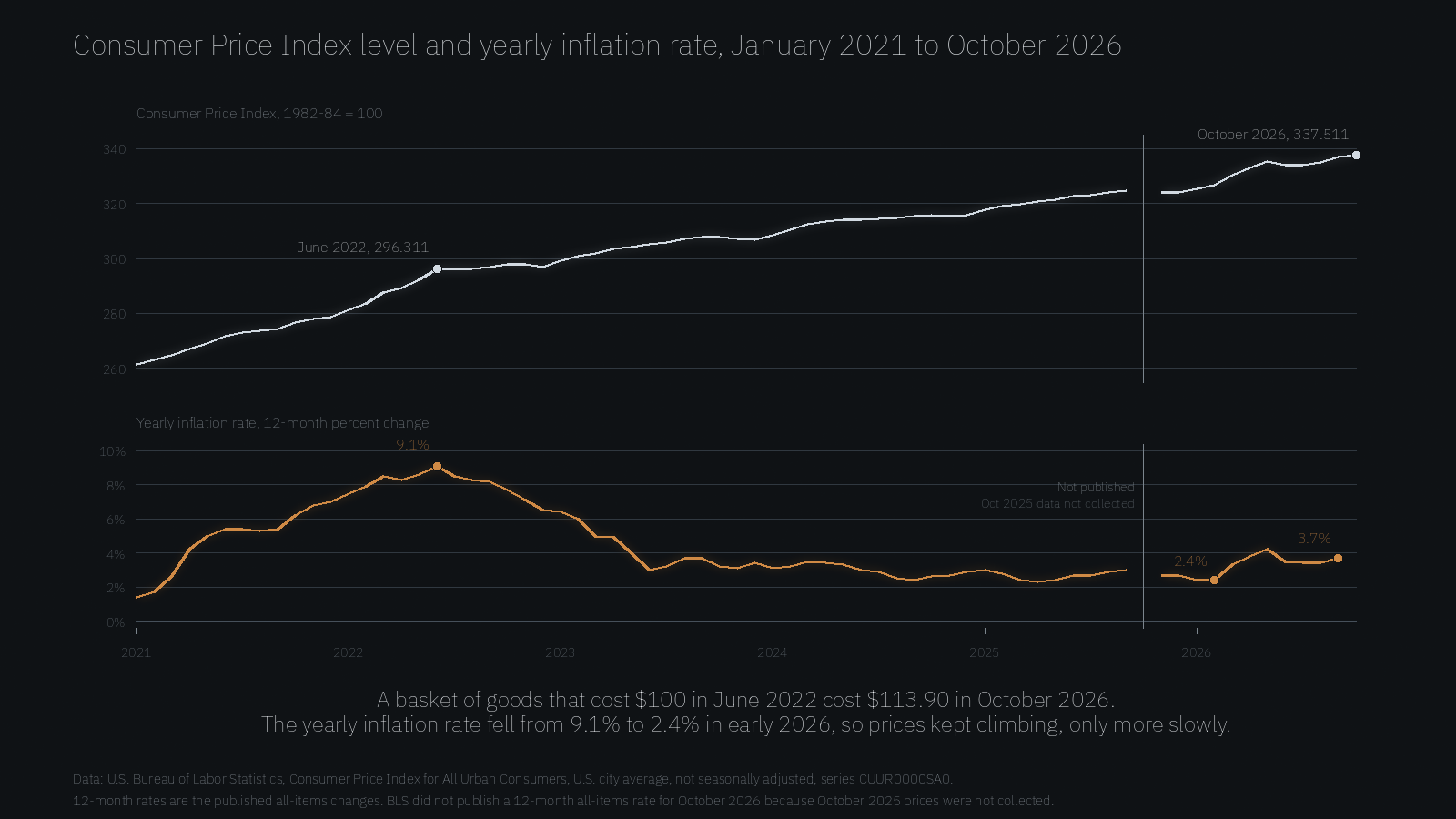
A basket of goods that cost $100 in June 2022 cost $113.90 in October 2026. The yearly inflation rate fell from 9.1% to 2.4% in early 2026, so prices kept climbing, only more slowly.
Get the free Monday Haul for the price numbers each week.
The Monday Haul · free weekly email
Energy, industry, infrastructure and policy in one short email every Monday, including new factories and grid projects. Every item sourced and dated. More about the Haul
Why prices rarely fall back
The St. Louis Fed essay notes, "The annual inflation rate has been positive in every year since 1973, meaning that the price level has risen almost continuously over the past five decades. The only exception is in 2009, when the inflation rate was slightly negative."
Averages hide a spread. Some items do fall. The October 2026 release says the index for used cars and trucks declined 1.2% in October and was 3.3% lower over the prior 12 months.
Why it matters for contracts, bids and wages
Long-term contracts, bids and escalation clauses work off the price level, not the latest rate. In the technical note to the October 2026 release, BLS says unadjusted data "are also used extensively for escalation purposes." Many collective bargaining contract agreements and pension plans, BLS says, "tie compensation changes to the Consumer Price Index before adjustment for seasonal variation."
For how price changes are removed from output figures, see Did the economy really grow 5.6% last quarter?. For why pump prices move, see why gas prices and oil prices can part ways.
What to watch next
The Consumer Price Index news release for November 2026 is scheduled to be published on Thursday, December 10, 2026, at 8:30 a.m. Eastern time, which is 6:30 a.m. Mountain time, the October release says.
The Monday Haul follows the price numbers each week with the rest of the buildout in energy, industry, and infrastructure. Follow the projects on the live dashboard. Past issues are in the archive.
Common questions
If inflation is falling, why are prices still high?
Because a falling inflation rate means prices are rising more slowly, not dropping. The yearly rate fell from 9.1% in June 2022 to 2.4% in January and February 2026, the U.S. Bureau of Labor Statistics reports. From June 2022 to October 2026, the Consumer Price Index still rose 13.9%. Prices only come down when the rate turns negative. The Federal Reserve Bank of St. Louis notes that the annual inflation rate has been positive in every year since 1973, with one exception, in 2009.
Does a lower inflation rate mean prices will go down?
No. A lower positive rate means the price level is still rising, only more slowly. The Federal Reserve Bank of St. Louis says a fall "from 8% to 4%" is disinflation, and that "it's not until the inflation rate becomes negative that deflation is occurring."
What is disinflation?
The Federal Reserve Bank of St. Louis, in a March 1, 2024 essay by Mary Clare Peate, says: "When the inflation rate falls, say from 8% to 4%, we call it disinflation, meaning the price level is rising at a slower rate."
How much have prices gone up since June 2022?
The Consumer Price Index for All Urban Consumers, not seasonally adjusted, rose from 296.311 in June 2022 to 337.511 in October 2026, a 13.9% increase. A basket of goods that cost $100 in June 2022 cost $113.90 in October 2026.
What did the October 2026 CPI report show?
The U.S. Bureau of Labor Statistics reported on November 10, 2026, that the Consumer Price Index for All Urban Consumers increased 0.4% on a seasonally adjusted basis in October after rising 0.6% in September. The index for prices excluding food and energy rose 0.3% in October, as it did in September and August. The unadjusted index level was 337.511. BLS did not publish a 12-month all-items change for October 2026 because October 2025 prices were not collected during a lapse in appropriations.
Has the annual inflation rate been negative since 1973?
The Federal Reserve Bank of St. Louis notes that the annual inflation rate has been positive in every year since 1973, with one exception, in 2009, when the inflation rate was slightly negative.
Sources
- Consumer Price Index, October 2026, USDL-26-1685, U.S. Bureau of Labor Statistics, released November 10, 2026. All items up 0.4% seasonally adjusted after 0.6% in September; all items less food and energy up 0.3%; unadjusted index level 337.511; used cars and trucks down 1.2% in October and 3.3% over 12 months; gasoline up 37.4% over 12 months ended October; no 12-month all-items change for October 2026 because October 2025 data were not collected; next release December 10, 2026, at 8:30 a.m. Eastern time. The release also states BLS's note on using unadjusted data for escalation agreements.
- Consumer Price Index, September 2026, USDL-26-1574, U.S. Bureau of Labor Statistics, released October 14, 2026. 12-month all-items rate 3.7%; gasoline (all types) up 34.2% over the 12 months ending September; unadjusted index level 336.940.
- Consumer Price Index, January 2026, USDL-26-0186, U.S. Bureau of Labor Statistics, released February 13, 2026. 12-month all-items rate 2.4%; unadjusted index level 325.252.
- Consumer Price Index, February 2026, USDL-26-0437, U.S. Bureau of Labor Statistics, released March 11, 2026. 12-month all-items rate 2.4%.
- Consumer Price Index, June 2022, USDL-22-1470, U.S. Bureau of Labor Statistics, released July 13, 2022. 12-month all-items rate 9.1%.
- Consumer Price Index, June 2023, U.S. Bureau of Labor Statistics, released July 12, 2023. 12-month all-items rate 3.0%; unadjusted index level 305.109.
- CPI-U, U.S. city average, all items, not seasonally adjusted, series CUUR0000SA0, U.S. Bureau of Labor Statistics public API, pulled November 11, 2026. Index levels used in the chart, including 296.311 in June 2022 and 337.511 in October 2026, and the 13.9% rise between those months. October 2025 is marked unavailable because of the 2025 lapse in appropriations.
- Approximating missing CPI data, U.S. Bureau of Labor Statistics factsheet, cited in the October 2026 release for how missing October 2025 data are handled.
- The Inflation Rate Is Falling, but Prices Are Not, Mary Clare Peate, Federal Reserve Bank of St. Louis, Page One Economics, March 1, 2024. Quoted wording on disinflation, deflation, and the annual inflation rate since 1973.