Why did medical care get so expensive, and can we make it cheap again?
From a pharmacy built into trailers in Tupelo, Mississippi, to robot surgeons trained in Baltimore, Maryland, here is what 230 years of medicine say about making care cheap again.
Updated November 19, 2026 · Numbers as published by each source on the date shown
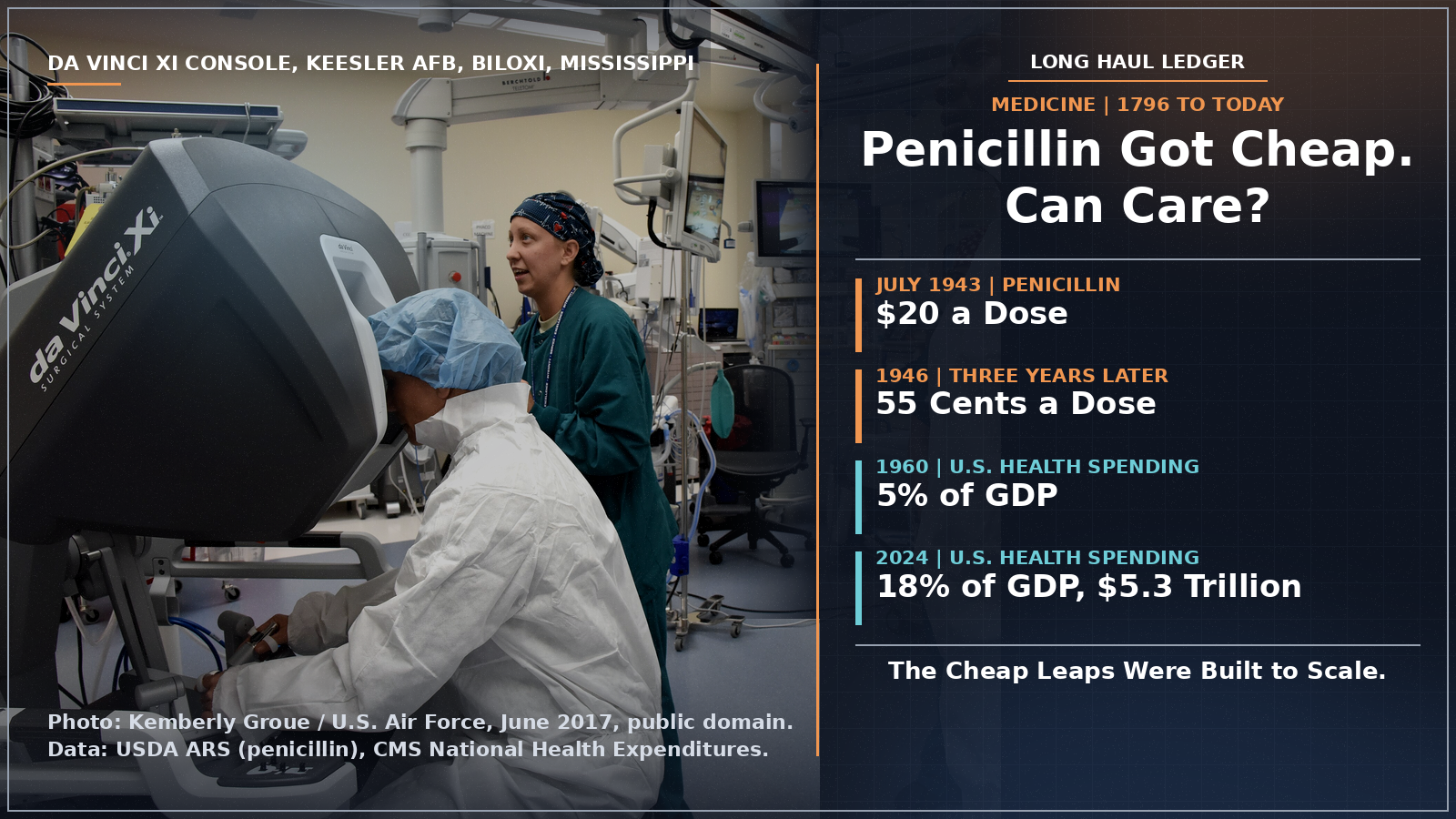
The early leaps were cheap and reached almost everyone: a cowpox scratch, a breath of ether, hand washing, and penicillin, whose price dropped from $20 a dose in 1943 to 55 cents three years later as American plants scaled up. Much new care costs far more. CMS says U.S. health spending reached $5.3 trillion in 2024, 18.0% of GDP, up from 5.0% in 1960. Robots, home hospitals and on-site drug making are early tries at the next cheap leap.
The cheap leaps were built to scale.
Photo: Kemberly Groue, U.S. Air Force, June 16, 2017, public domain, via Wikimedia Commons. Data: USDA Agricultural Research Service; Centers for Medicare & Medicaid Services.
Penicillin went from nearly priceless to 55 cents a dose in about six years because Americans built the plants to make it. The next leap is being built now, one robot, one living room and one trailer pharmacy at a time.
The cheap leaps
On May 14, 1796, in Gloucestershire, England, Edward Jenner took matter from a cowpox sore on the hand of a milkmaid, Sarah Nelmes, and inserted it into the arm of James Phipps, an 8-year-old boy, through two small cuts. Jenner's own 1798 book gives the date. On July 1, Jenner exposed the boy to smallpox. The World Health Organization says "Phipps remained in perfect health, the first person to be vaccinated against smallpox."
The idea spread on its own. WHO says smallpox killed "300 million people in the 20th century alone," and on May 8, 1980, the World Health Assembly officially declared the world free of it. WHO puts the cost of the final eradication push at "approximately US$300 million," with two thirds of it paid by the countries where the disease was still spreading.
On October 16, 1846, at Massachusetts General Hospital in Boston, Massachusetts, a Boston dentist, William T. G. Morton, gave ether to a patient named Gilbert Abbott, and surgeon John Collins Warren operated on a growth on his neck. The hospital's library calls it "the first successful public demonstration of the use of ether as an anesthetic agent." Abbott's records show he was partly aware during the operation, but he later said he had felt no pain. Within months, surgeons around the world were using ether.
In May 1847, in Vienna, Ignaz Semmelweis made doctors in his maternity clinic wash their hands in chlorinated lime between patients. In his 1861 book, he reported that 459 of 4,010 mothers died in that clinic in 1846, or 11.4 percent, and 45 of 3,556 died in 1848, or 1.27 percent. Many doctors rejected his idea while he was alive. Today it is the first rule of every hospital.
A cowpox scratch, a breath of ether and a bowl of chlorinated water cost almost nothing. Each one reached almost everyone.
How American plants made penicillin cheap
Alexander Fleming found penicillin in London in 1928. A team at Oxford University later showed it could kill infections, but wartime Britain could not make enough to test it. The U.S. Department of Agriculture says the British scientists arrived at its lab in Peoria, Illinois on July 14, 1941, and work began the next day.
The Peoria team grew the mold in deep, air-pumped tanks of corn-steep liquor, a leftover from milling corn, instead of on the surface of shallow trays. A strain found on a moldy cantaloupe from a Peoria market turned out to make the most penicillin. Drug companies took the methods and scaled them up fast enough to treat Allied soldiers wounded on D-Day.
In the USDA's words, "the price dropped from nearly priceless in 1940, to $20 per dose in July 1943, to $0.55 per dose three years later." Those are dollars of the time (see how price levels and inflation differ). The leap got cheap because it was made at scale, in plants and tanks, by people who built a new kind of factory (see what factory output measures).
Get the free Monday Haul to follow the builds that could make care cheaper, every week.
The Monday Haul · free weekly email
Energy, industry, infrastructure and policy in one short email every Monday, including new factories and grid projects. Every item sourced and dated. More about the Haul
Where the $5.3 trillion goes
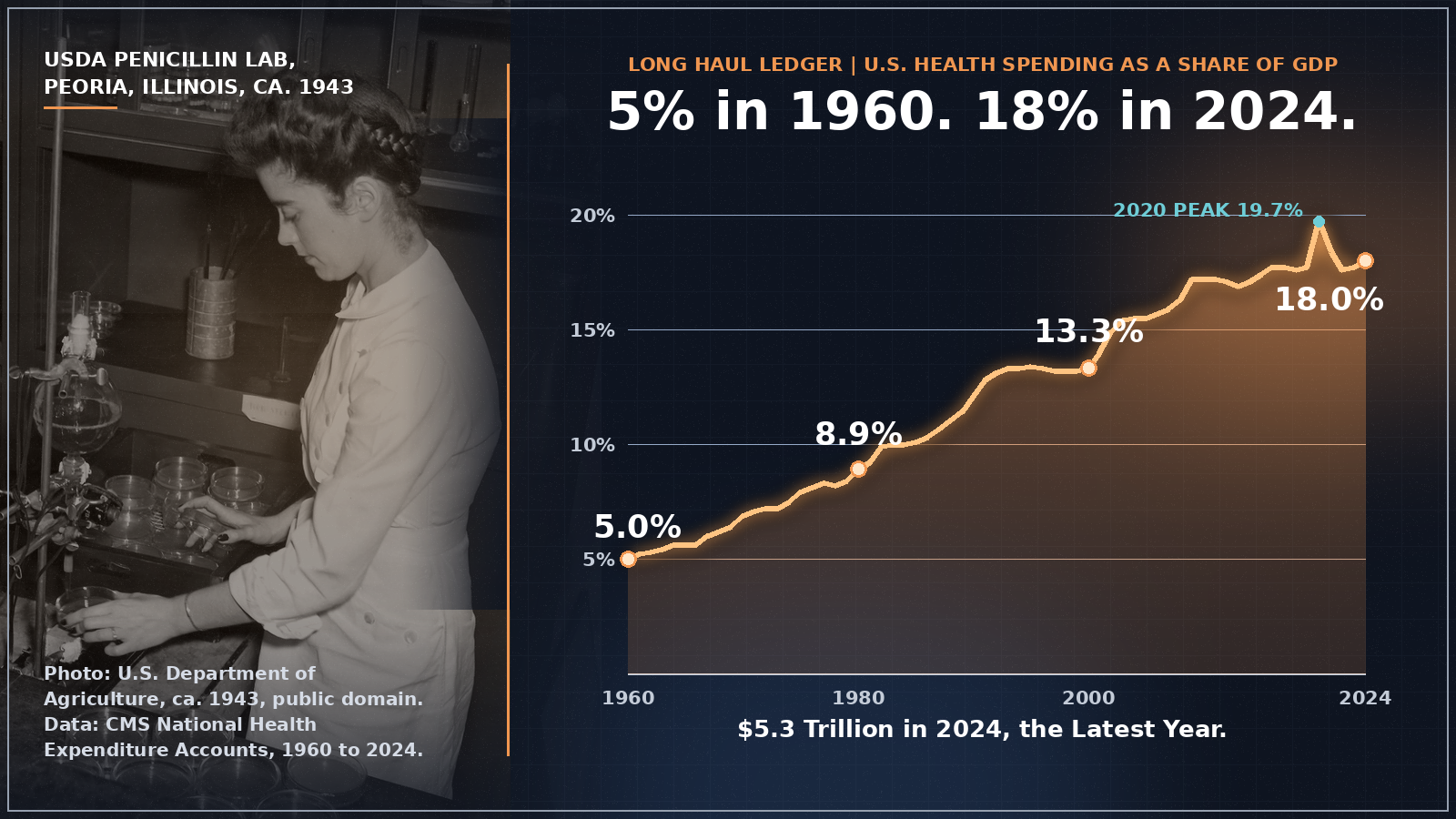
The Centers for Medicare & Medicaid Services, which keeps the official count, says U.S. health care spending "grew 7.2 percent in 2024, reaching $5.3 trillion or $15,474 per person." That was 18.0 percent of the economy. In 1960 the country spent $27.1 billion, or $146 per person, which was 5.0 percent of GDP.
Spending rose from 5% of the economy in 1960 to 18% in 2024.
Data: Centers for Medicare & Medicaid Services, National Health Expenditure Accounts, 1960 to 2024 (share of GDP each year). The 2020 peak reflects the pandemic year, when spending jumped and the economy shrank. Photo: U.S. Department of Agriculture, ca. 1943, public domain, via Wikimedia Commons.
Most of the money goes to hospitals and doctors' offices. In CMS's 2024 tables, hospital care was $1,634.7 billion, or 31 percent of all spending. Physician and clinical services were $1,109.7 billion, or 21 percent. Prescription drugs bought at pharmacies were $467.0 billion, or 8.8 percent. Home health care was $169.4 billion, or 3.2 percent.
Why new care costs more
Economists have argued about this for decades. The Congressional Budget Office, in a January 2008 report, concluded that "about half of all growth in health care spending in the past several decades was associated with changes in medical care made possible by advances in technology." Most of the rest came from rising incomes, wider insurance coverage and higher prices. CBO also wrote that new technology "can theoretically reduce costs and, for many types of goods and services, often does," but that in medicine it had tended to raise spending.
Prices matter too. A 2019 study in Health Affairs by Gerard Anderson, Peter Hussey and Varduhi Petrosyan found that the US had fewer hospital beds, nurses and doctors per person than the median rich country, and concluded that higher prices "are the primary reason why the US spends more on health care than any other country."
Robots are a live test of both ideas. In a randomized trial published in JAMA Surgery in 2020, 75 patients had a hernia repaired either by a robot run by a surgeon or by standard keyhole surgery. Results were comparable, and the authors found the robot "adds cost," mostly from about 52 extra minutes in the operating room. So far, many new tools have been added on top of the old way of doing things. The cheap leaps replaced costly care.
Paperwork, middlemen and mistakes
Some of the bill never reaches a doctor or nurse. A 2019 review in JAMA by William Shrank and colleagues estimated the cost of "administrative complexity" at $265.6 billion a year, in 2019 dollars, the largest of the six kinds of waste it measured. Across all six, it put waste at $760 billion to $935 billion a year, about 25 percent of spending. A 2018 JAMA study by Irene Papanicolas and colleagues found administration took 8 percent of U.S. health spending, against 1 to 3 percent in 10 other rich countries. In CMS's own 2024 accounts, government administration and the net cost of health insurance came to $372.1 billion, about 7 percent of all spending.
Middlemen sit between the drug factory and the pharmacy counter. Pharmacy benefit managers, or PBMs, negotiate drug prices and coverage for insurers and employers. The Federal Trade Commission's July 2024 interim staff report says "the three largest PBMs now manage nearly 80 percent of all prescriptions filled in the United States."
Public programs have their own leaks. CMS's fiscal year 2025 estimates, released January 15, 2026, put improper payments at $28.83 billion in traditional Medicare, $23.67 billion in Medicare Advantage and $37.39 billion in Medicaid. CMS says improper payment measurement "is not a measure of fraud," and most of the Medicaid total came from missing or insufficient paperwork. The Government Accountability Office has listed Medicare as high risk since 1990, and Medicaid program integrity since 2003. Separately, the Medicare Payment Advisory Commission estimated in March 2026 that Medicare spends "approximately 14 percent more" for Medicare Advantage enrollees than it would if they were in traditional Medicare, a projected $76 billion in 2026.
Most of the spending follows long-term illness. CDC says 90 percent of the nation's $4.9 trillion in annual health care spending is for people with chronic and mental health conditions. That counts all of their care, not only the care for those conditions.
The next leap is being built
Robots in the operating room. Intuitive, the maker of the da Vinci system, says in its 2025 annual report that "da Vinci procedures increased by 18% to over 3.1 million procedures." In the United States, procedures rose 15 percent to more than 2 million. A surgeon runs every one of them from a console.
The next step is a robot that can do part of the work on its own. At Johns Hopkins University in Baltimore, Maryland, a robot called STAR joined two ends of pig intestine in four live animals in 2022. First author Hamed Saeidi said it planned, adapted and carried out the surgery "with minimal human intervention," and senior author Axel Krieger said its results were "significantly better" than humans doing the same procedure. On July 9, 2025, the same lab reported that a newer robot, SRT-H, did the clipping and cutting phase of gallbladder removal, 17 tasks in a row, with "a 100% success rate across eight different ex vivo gallbladders, operating fully autonomously without human intervention." Reuters noted the organs had been removed from pigs. A review published October 23, 2026, in the journal Artificial Intelligence Surgery says demonstrations like these were all "performed under controlled, preclinical conditions (simulation, ex vivo, and animal models)." No robot has yet done an autonomous step of surgery on a person.
Hospital care at home. Since November 2020, Medicare has let approved hospitals treat patients who would otherwise be admitted, in their own homes, with nurse and doctor visits, IV medicines and remote monitoring. CMS lists "358 approved CCNs across 134 health systems in 37 states" as of October 19, 2026. A CCN is a single hospital's Medicare number, so that is 358 hospitals. Congress extended the program to September 30, 2030.
The best cost evidence so far comes from Brigham and Women's Hospital in Boston, Massachusetts. In a randomized trial of 91 adults published in the Annals of Internal Medicine in January 2020, "the adjusted mean cost of the acute care episode was 38% lower for home patients," and 7 percent of home patients were readmitted within 30 days, against 23 percent of hospital patients. The sample was small and carefully chosen. CMS's own September 30, 2024 study found home patients generally had lower death rates, and lower Medicare spending after discharge for more than half of the top 25 conditions treated, while cautioning that differences in which patients were chosen make it "difficult to conclude" the program lowered Medicare spending overall. Many private insurers still do not pay for it.
Medicine made next to the patient. In Tupelo, Mississippi, On Demand Pharmaceuticals runs a pharmacy built into two mobile cleanroom trailers on the campus of North Mississippi Medical Center. The hospital says the first medicine made there, lidocaine, a numbing drug that had been "on the drug shortage list for over a decade," was given to a patient on December 18, 2023. The U.S. Department of Health and Human Services said on August 13, 2025 that the unit "can be as small as the size of a tractor trailer" and is deployed there "to produce medicines that are in shortage in real-time." HHS says the work is funded with the Department of Defense and is part of "more than $1 billion HHS has invested in domestic manufacturing" of drug ingredients and finished medicines. The company says its pilot made about 12,000 prefilled syringes of five shortage drugs, after which the Mississippi Board of Pharmacy let it expand to an open list of medicines. In October 2026 the company was hiring production staff for its Tupelo site.
Where people land
Four camps in the debate over why care costs so much and what could bring it down. Each camp gets the same space. This is not a poll, and the segments are not shares of support.
The question
Can the next leap make care cheaper?
Where they agree Every camp says care costs American families too much today, and none of them says to stop building new tools. The fight is over what proves its worth and who pays.
Build the next leap
Care got cheap before when people built ways to make it at scale, they say. Robots that do steady, repeatable work, hospital care in the living room and medicine made next to the patient can do it again. Johns Hopkins' Axel Krieger said robot surgery could bring "a democratized surgical approach to patient care with more predictable and consistent patient outcomes."
What they get right Penicillin's price dropped from $20 a dose to 55 cents in three years once American plants scaled up, and a Boston trial found hospital care at home cost 38% less per stay.
New tools should help doctors and nurses reach more patients, not stand in for their judgment, they say. Hospitals want care at home to grow, with steady rules and proof it is safe. Jesse Ehrenfeld, a past president of the American Medical Association, warned: "We're simply not going to be able to grow our physician workforce sufficiently at the rate we need to over the next decade."
What they get right The robots doing real surgery today are run by surgeons, and the best result for a robot working alone so far was on pig organs that had already been removed.
Premiums track what hospitals, drugmakers and doctors charge, they say. Bring those prices down, and pay for a new tool when it lowers the bill. AHIP, the health insurers' trade group, wrote that "Families across the country are struggling with health care costs that continue to rise far faster than wages."
What they get right Researchers found the US has fewer hospital beds, nurses and doctors per person than the typical rich country, and that higher prices explain most of the gap. A randomized trial found robot hernia repair added cost with comparable results.
AHIP, January 15, 2026: "Health insurance premiums directly reflect the cost of medical care"
Medicines are a steady slice of the bill, they say, and new ones keep people out of the hospital, the most expensive place to get care. Middlemen between the factory and the pharmacy add cost. PhRMA, the drugmakers' trade group, says "spending on medicines remains a small and stable 14% of total health spending."
What they get right Drugs bought at pharmacies were 8.8% of U.S. health spending in 2024, below their share of about 10% in 1960. PhRMA's larger 14% also counts drugs given in hospitals and clinics.
The builders are at it again Penicillin went from $20 a dose to 55 cents in three years once American plants made it by the vat. In 2025, surgeons used da Vinci robots in more than 3.1 million procedures. As of October 19, 2026, 358 hospitals were cleared to treat patients at home, and shortage medicines are being made on site in Tupelo, Mississippi.
What to watch next
Intuitive expects worldwide da Vinci procedures to "increase approximately 13% to 15% in 2026," and its full-year results usually come out in late January. On autonomy, the milestone to watch is the first trial of a robot doing a surgical step on its own in a person, which no one has reported as of November 19, 2026. For hospital care at home, HHS owes Congress another study by September 30, 2029, and the program ends September 30, 2030 unless Congress acts again; the bigger question is whether private insurers start paying for it. In Tupelo, On Demand Pharmaceuticals has said it wants to turn the site into a larger-batch plant that can supply other hospitals. CMS usually publishes the next year of national spending figures in December.
Common questions
Did penicillin really cost $20 a dose?
Yes. The U.S. Department of Agriculture's history of its Peoria, Illinois lab says the price dropped from nearly priceless in 1940, to $20 per dose in July 1943, to $0.55 per dose three years later. Those are dollars of the time, not adjusted for inflation.
How much does the US spend on health care?
The Centers for Medicare & Medicaid Services says U.S. health care spending grew 7.2 percent in 2024, reaching $5.3 trillion or $15,474 per person, which was 18.0 percent of GDP. In 1960 it was $27.1 billion, or 5.0 percent of GDP.
Will robots replace surgeons?
Not today. Surgeons run the robots used in operating rooms, including the da Vinci systems used in more than 3.1 million procedures in 2025. Robots that work on their own have so far been tested on animals and on organs removed from animals, and a review published October 23, 2026 describes those demonstrations as preclinical.
Does Medicare pay for hospital care at home?
Yes, at approved hospitals. CMS listed 358 approved hospitals across 134 health systems in 37 states as of October 19, 2026, and Congress extended the program through September 30, 2030. Many private insurers do not cover it yet.
Why does the US spend more on health care than other countries?
A 2019 Health Affairs study by Gerard Anderson, Peter Hussey and Varduhi Petrosyan concluded that higher prices are the primary reason. The US had fewer hospital beds, nurses and doctors per person than the median rich country.
Sources
Every source this page uses, grouped by section. Quotes are word for word from the source named.
The cheap leaps
History of smallpox vaccination, World Health Organization, undated page, read November 19, 2026. Phipps "remained in perfect health"; eradication cost "approximately US$300 million."
About Edward Jenner, The Jenner Institute, University of Oxford, undated page, read November 19, 2026. Phipps vaccinated May 14, 1796; exposed to smallpox July 1.
Penicillin: Opening the Era of Antibiotics, USDA Agricultural Research Service, National Center for Agricultural Utilization Research, Peoria, Illinois, undated page, read November 19, 2026. $20 per dose in July 1943, $0.55 three years later.
Where the money goes
National Health Expenditure Data: Historical, Centers for Medicare & Medicaid Services, 2024 data, read November 19, 2026. $5.3 trillion, $15,474 per person, 18.0 percent of GDP.
Acute Hospital Care at Home, CMS QualityNet program page, read November 19, 2026. Waiver in effect through September 30, 2030.
Acute Hospital Care at Home Data Release Fact Sheet, Centers for Medicare & Medicaid Services, read November 19, 2026. Launched November 2020; extended to September 30, 2030 by section 6210 of the Consolidated Appropriations Act, 2026.
Prescription Medicines, PhRMA presentation to the Minnesota Prescription Drug Affordability Board, March 10, 2026. Cites Altarum, 2022, for the 14% figure.
Photos
Col. Lovette receives 81st MDG immersion tour, photograph by Kemberly Groue, U.S. Air Force, June 16, 2017, Keesler Medical Center, Biloxi, Mississippi, public domain (U.S. government work), via Wikimedia Commons. Toned, cropped and overlaid with text for this page.