Explainer · Energy
How the US pumps record oil with far fewer drilling rigs
Updated October 26, 2026 · Numbers as published by each source on the date shown
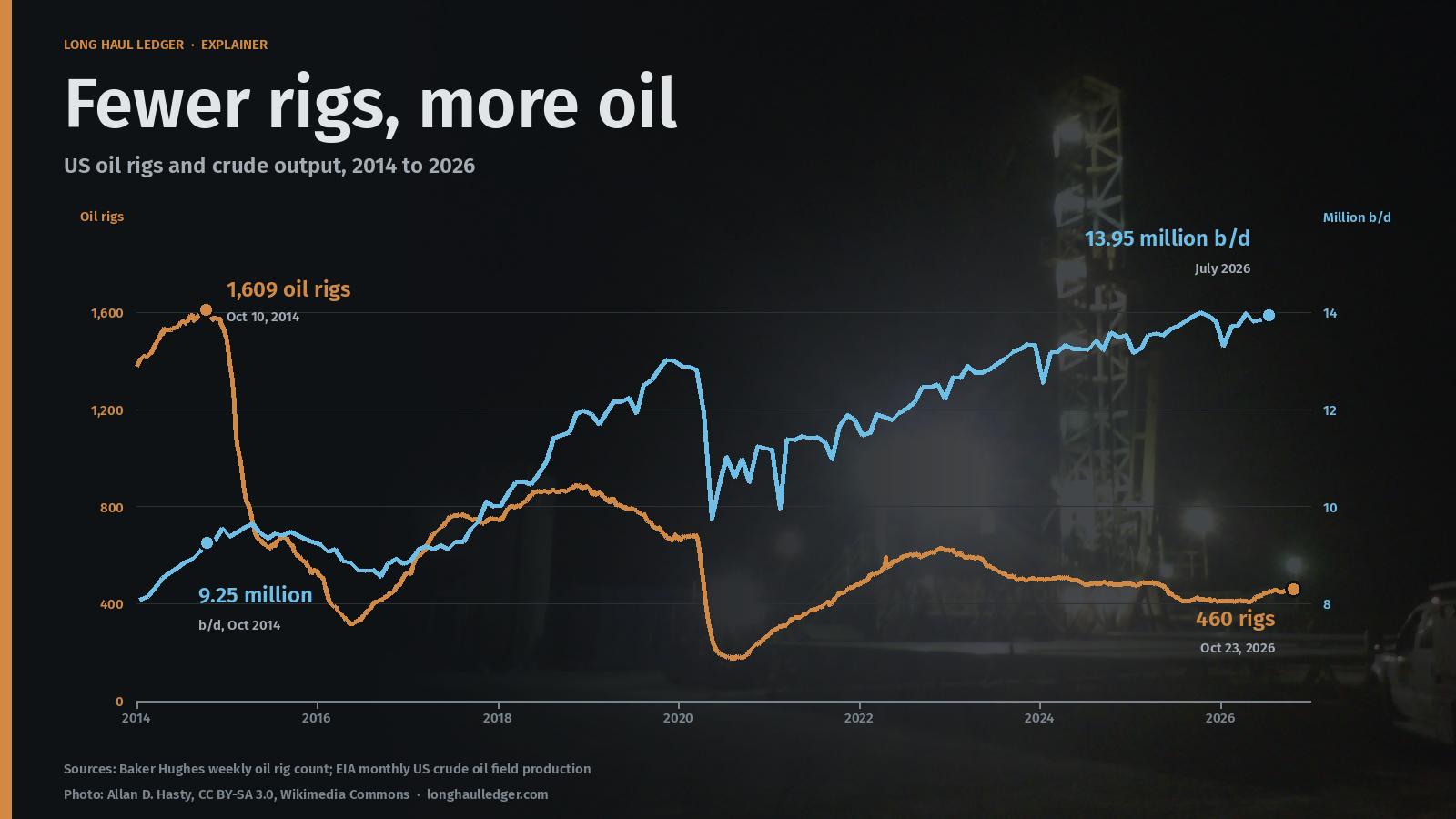
The US runs about 70% fewer oil rigs than at the 2014 peak, yet it pumps about half again as much oil. Each rig now drills faster and drills longer wells that reach more rock, and output follows rigs by months. So a lower rig count does not mean less oil right away.
The two numbers side by side
On October 10, 2014, Baker Hughes counted 1,609 rigs drilling for oil in the US. That month the country produced 9.25 million barrels of crude a day, according to EIA. In the week of October 23, 2026, the count was 460 oil rigs, and the latest monthly output figure, for July 2026, was 13.95 million barrels a day.
The rig count is actually rising again. It is up 40 from a year earlier and up 1 on the week. But it is still far below 2014, while output sits near the monthly record of 13.995 million barrels a day set in October 2025.
What a rig count actually counts
Baker Hughes has published a weekly count of active drilling rigs since 1944. A rig drills a hole. It does not pump oil. Once a well is drilled, crews finish it, frack it and hook it up, and then it can produce for years while the rig moves on to the next site.
Baker Hughes itself calls the count a leading indicator of demand for products used in drilling, completing, producing and processing oil and gas. In other words, it tracks drilling activity, not the oil coming out of the ground.
Reason 1: each well reaches more rock
Modern wells go down, then turn and run sideways through the oil-bearing rock. That sideways section keeps getting longer. In the Permian, the biggest US oil region, the average horizontal section grew 77%, from 6,149 feet in 2015 to 10,867 feet in 2025, according to EIA using Enverus data. That is about two miles.
Wells with sideways sections over 15,000 feet made up 15% of new Permian completions in 2025. EIA notes that Permian completions have held near 6,000 a year since 2022, while output kept rising. Fewer, longer wells can do the work that used to take many more.
Reason 2: rigs drill faster and sit idle less
EIA points to automated drilling, electronic fracking technology and AI/SI tools as ways companies cut downtime and get more from each rig. In the year to November 2024, Permian oil production per active rig rose 9%, and Lower 48 output grew about 3% even as the rig count fell.
The long view shows the same thing. In March 2024 EIA noted that rigs were down 69% from 2014 while output set records. The number of new wells peaked at 13,745 in 2014.
Reason 3: oil shows up months after drilling
Drilling comes first, then completion and fracking, then first oil. Each step takes time, and companies often keep a stock of wells that are drilled but not yet completed. Those wells act as a buffer, so output answers a change in the rig count with a lag, not in the same week.
The Monday Haul · free weekly email
Energy, industry, infrastructure and policy in one short email every Monday, including new factories and grid projects. Every item sourced and dated. More about the Haul
When the rig count does matter
Efficiency has limits. In August 2025, Reuters reported analysts saying rig cuts had begun to outpace efficiency gains, with one estimate of about a 25% improvement in rig efficiency against a rig count that had fallen over 30%. Fewer rigs for long enough does mean less new oil.
The good news is that the count has turned up since then. It now stands at 460 oil rigs, and EIA has been raising its output forecasts. More rigs on top of longer, faster wells is how output can keep climbing.
What to watch next
Baker Hughes posts the rig count every Friday. EIA's next Petroleum Supply Monthly is due October 30, 2026, and it may revise the July figure and add August. EIA's October 2026 Short-Term Energy Outlook forecasts 13.87 million barrels a day for 2026 and 14.30 million for 2027, up from 13.66 million in 2025. That 2027 figure would be the first full year above 14 million.
The Monday Haul tracks energy and industry every week, including Kinder Morgan's Permian pipeline news in the October 26 edition. For prices at the pump, see why gas prices don't follow oil right away, and follow US energy on the live dashboard. Past issues are in the archive.
Common questions
Why is US oil production up when the rig count is down?
Each rig now drills faster and drills longer wells that reach more rock. In the Permian, the average horizontal section grew from 6,149 feet in 2015 to 10,867 feet in 2025, according to EIA. Oil also shows up months after drilling, so output does not drop the same week the rig count does.
How many oil rigs does the US have now?
Baker Hughes counted 460 US oil rigs in the week of October 23, 2026, up 40 from a year earlier and out of 603 rigs in total. At the October 10, 2014 peak there were 1,609 oil rigs.
How much oil does the US produce?
EIA's latest monthly figure is 13.95 million barrels a day for July 2026. The monthly record is 13.995 million in October 2025. EIA's October 2026 outlook forecasts 13.87 million for 2026 and 14.30 million for 2027.
Does the rig count still predict oil production?
It still matters, just with a delay and less one to one than before. In August 2025, Reuters reported analysts saying rig cuts had begun to outpace efficiency gains. Baker Hughes describes its count as a leading indicator of demand for oilfield products and services.
Sources
- Rig Count Overview, Baker Hughes, week of Oct 23, 2026.
- US Rig Count 2026 and US Rig Count 2014, Baker Hughes weekly data as tabled by American Oil & Gas Reporter, accessed Oct 26, 2026.
- US Field Production of Crude Oil, monthly, US Energy Information Administration, data through July 2026, accessed Oct 26, 2026.
- Short-Term Energy Outlook, US Energy Information Administration, October 2026.
- Longer wells boost Permian crude oil and natural gas production, US Energy Information Administration, Aug 19, 2026, using Enverus data.
- Improved efficiency is enabling record U.S. crude oil production from fewer rigs, US Energy Information Administration, Dec 23, 2024.
- More productive wells spur U.S. crude oil production higher, US Energy Information Administration, Mar 5, 2024.
- Report on the falling rig count outpacing efficiency gains, Reuters, Aug 5, 2025.
- Lariat Rig Number 11, photo by Allan D. Hasty, CC BY-SA 3.0, Wikimedia Commons (chart background).