Explainer · Energy
What does a 1-gigawatt data center really mean?
That headline is usually capacity the site can draw, not what it uses every hour.
Updated November 12, 2026 · Numbers as published by each source on the date shown
It is usually a power-capacity figure, not a promise that the site pulls 1 gigawatt every hour of the year. Berkeley Lab's 2025 Update says data centers are often discussed in terms of power capacity, meaning either facility nameplate capacity (the IT hardware load the site is designed to serve) or the grid interconnection capacity requested. Total building energy is higher than IT energy alone. Yearly use is reported in terawatthours.
Clearer capacity figures help utilities and builders size wires, plants, and storage for the campuses now signing up for power.
What is moving forward right now
DTE Energy is moving forward to serve two hyperscale data center customers in Michigan. On its data-center facts page, last updated October 7, 2026, DTE describes a new 1.4 gigawatts of electric load for the data center proposed in Saline Township and a new 1.0 gigawatt of electric load for the data center proposed in Van Buren Township.
On November 5, 2026, DTE said the Michigan Public Service Commission had approved its energy contracts with Google for the planned data center in Van Buren Township. The same release says the company plans approximately $44 billion of customer-focused capital over the next five years, including investment to serve growing data center demand.

The Monday Haul reported that DTE's five-year plan includes about 7.6 gigawatts of new solar and wind, 2.1 gigawatts of gas, and 2.7 gigawatts of batteries, alongside 2.4 gigawatts of signed data center demand. Those gigawatts are the generation and the contracted load being lined up so the campuses can connect. For how power bills and data centers fit together, see why your power bill is rising, and what brings it down.
A gigawatt here is capacity, not a year of electricity
The Energy Information Administration defines electric generation capacity as the maximum output a generator can produce under specific conditions, and electricity generation as the amount produced during a specific time. A generator with 1 megawatt of capacity that operates at that capacity for one hour produces 1 megawatt-hour. For the units, see is a megawatt the same as a megawatt-hour.
A labeled illustration, and only an illustration: 1 gigawatt running flat out for all 8,760 hours in a year is 8,760 gigawatt-hours, or 8.76 terawatt-hours. Real campuses ramp. They do not sit at nameplate every hour. A homes count built from megawatts is a different question. For that math, see how many homes can a power plant really power.
Nameplate, interconnection, and how much of that is used
Berkeley Lab's 2025 Update says power capacity refers to either the facility's nameplate capacity (the IT hardware load it is designed to serve, based on infrastructure like uninterruptible power supply systems) or to the grid interconnection capacity requested to supply power to the facility. A "1 GW" line in a headline can be either of those two figures.
The same update says current utilization of interconnection capacity is not well documented but is estimated to be around 50% due to high redundancy requirements and maintenance needs. So a 1 gigawatt interconnection request is not the same thing as 1 gigawatt of continuous metered load. The projects still waiting on a grid study are a separate count. See is 2,000 GW of new power about to hit the grid.
Get the free Monday Haul for grid and data-center load numbers each week.
The Monday Haul · free weekly email
Energy, industry, infrastructure and policy in one short email every Monday, including new factories and grid projects. Every item sourced and dated. More about the Haul
IT load versus the whole building
Berkeley Lab defines power usage effectiveness (PUE) as the ratio of total building energy usage to that used by the IT equipment alone. Servers, storage, and networking are the IT piece. Cooling and the gear that conditions power add more, which is why total building energy sits above IT energy.
The Energy Department's December 20, 2024 release of the Berkeley Lab report says data centers consumed about 4.4% of total U.S. electricity in 2023, and that total data center electricity usage climbed from 58 terawatt-hours in 2014 to 176 terawatt-hours in 2023, with an estimate of 325 to 580 terawatt-hours by 2028. Berkeley Lab's January 15, 2025 news post says that between 2017 and 2023, data-center power demand more than doubled, largely due to the growth in AI servers.
The 2025 Update's Reference Case is 649 terawatt-hours in 2030, about 11.8% of forecasted 2030 US electricity, with compounded uncertainty bounds of 521 to 843 terawatt-hours (9.5% to 15.3%). Those are national annual energy totals. They are not a campus nameplate.
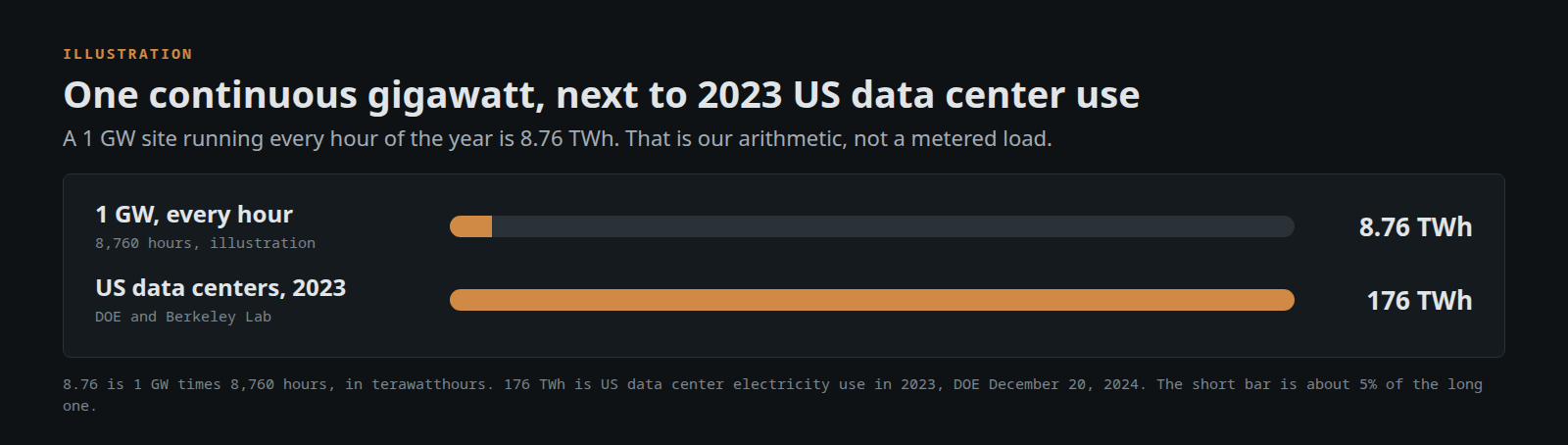
Set a single campus that ran at a full gigawatt every hour beside the 176 terawatt-hours the country used in data centers in 2023, and the campus year is about 5% of that national total. With interconnection use near the lab's rough 50% estimate, the year's energy would be lower still, about 4.38 terawatt-hours. Both readings are illustrations. The peak hour on a grid is yet another measure. See did the grid set a record for how much power it used this summer.
What to watch next
Watch the Saline Township and Van Buren Township loads as those contracts move from approval into service, and watch the next Berkeley Lab or Energy Department update on data center energy. Utility large-load filings are clearest when they separate requested interconnection capacity from metered peak. EIA's next Electric Power Monthly is November 24, 2026, and the Short-Term Energy Outlook is the place for the wider power-system context.
The Monday Haul follows these load numbers each week with the rest of the buildout. Follow the projects on the live dashboard. Past issues are in the archive.
Common questions
What does a 1-gigawatt data center mean?
It is usually a power-capacity figure, not a promise that the site pulls 1 gigawatt every hour of the year. LBNL's 2025 Update says data centers are often discussed in terms of power capacity, meaning either facility nameplate capacity, the IT hardware load the site is designed to serve, or the grid interconnection capacity requested. Yearly use is reported in terawatthours.
Is data center capacity the same as electricity use?
Capacity is the most the site is designed to draw, or the connection it has asked the grid for. Electricity use is energy over time. LBNL estimates current use of interconnection capacity at around 50%, because of redundancy and maintenance, and says that estimate is not well documented.
What is PUE for a data center?
LBNL defines power usage effectiveness as the ratio of total building energy usage to the energy used by the IT equipment alone. Servers, storage, and networking are the IT piece. Cooling and power equipment add the rest.
How large is 1 GW next to US data center use?
An illustration of 1 GW running every hour of an 8,760-hour year is 8.76 terawatthours. DOE and Berkeley Lab put US data center use at 176 TWh in 2023, so that continuous year is about 5% of the national total. A real site that does not sit at full output all year uses less.
Sources
- Data Centers and Customer Rate Protection, DTE Energy, last updated October 7, 2026. New 1.4 gigawatts of electric load for the data center proposed in Saline Township. New 1.0 gigawatt of electric load for the data center proposed in Van Buren Township.
- DTE Energy reports third quarter 2026 accomplishments, investments and earnings, DTE Energy, November 5, 2026. Michigan Public Service Commission approval of Google energy contracts for Van Buren Township. DTE is moving forward to serve two hyperscale data center customers in Michigan. Approximately $44 billion of customer-focused capital planned over the next five years, including investment to serve growing data center demand.
- DOE releases new report evaluating increase in electricity demand from data centers, U.S. Department of Energy, December 20, 2024. Data centers consumed about 4.4% of total U.S. electricity in 2023. Usage climbed from 58 TWh in 2014 to 176 TWh in 2023, with an estimate of 325 to 580 TWh by 2028. Load growth projected to double or triple by 2028.
- Berkeley Lab report evaluates increase in electricity demand from data centers, Lawrence Berkeley National Laboratory News Center, January 15, 2025. Same 4.4%, 58 to 176 TWh, and 325 to 580 TWh figures. Between 2017 and 2023, data-center power demand more than doubled, largely due to the growth in AI servers.
- United States Data Center Energy Usage Report: 2025 Update, Lawrence Berkeley National Laboratory, published June 2026. Reference Case 649 TWh in 2030, about 11.8% of forecasted 2030 US electricity. Compounded bounds 521 to 843 TWh (9.5% to 15.3%). Power capacity refers to facility nameplate capacity or requested grid interconnection capacity. Interconnection utilization is not well documented but is estimated to be around 50% due to high redundancy requirements and maintenance needs. PUE is the ratio of total building energy usage to that used by the IT equipment alone. Report text also at eScholarship.
- What is the difference between electric generation capacity and electricity generation?, U.S. Energy Information Administration, FAQ. A 1 MW generator operating at that capacity for one hour produces 1 MWh.
- The Monday Haul, Edition 4, Long Haul Ledger, November 9, 2026. DTE plan figures of about 7.6 GW of new solar and wind, 2.1 GW of gas, 2.7 GW of batteries, and 2.4 GW of signed data center demand.
- The 8.76 TWh figure is 1 GW times 8,760 hours. About 5% is 8.76 divided by 176. About 4.38 TWh is half of 8.76, using the lab's around-50% estimate. These are illustrations on this page.
- Data centers in Ashburn, Virginia, photo by Theodore Christopher. CC0 1.0, via Wikimedia Commons.
