Minnesota raises more turkeys than any other state, and Willmar, Minnesota is home to Jennie-O's turkey plant. Here's what food science says about cooking the bird, and what it takes to get one to your table.
Updated November 26, 2026 · Numbers as published by each source on the date shown
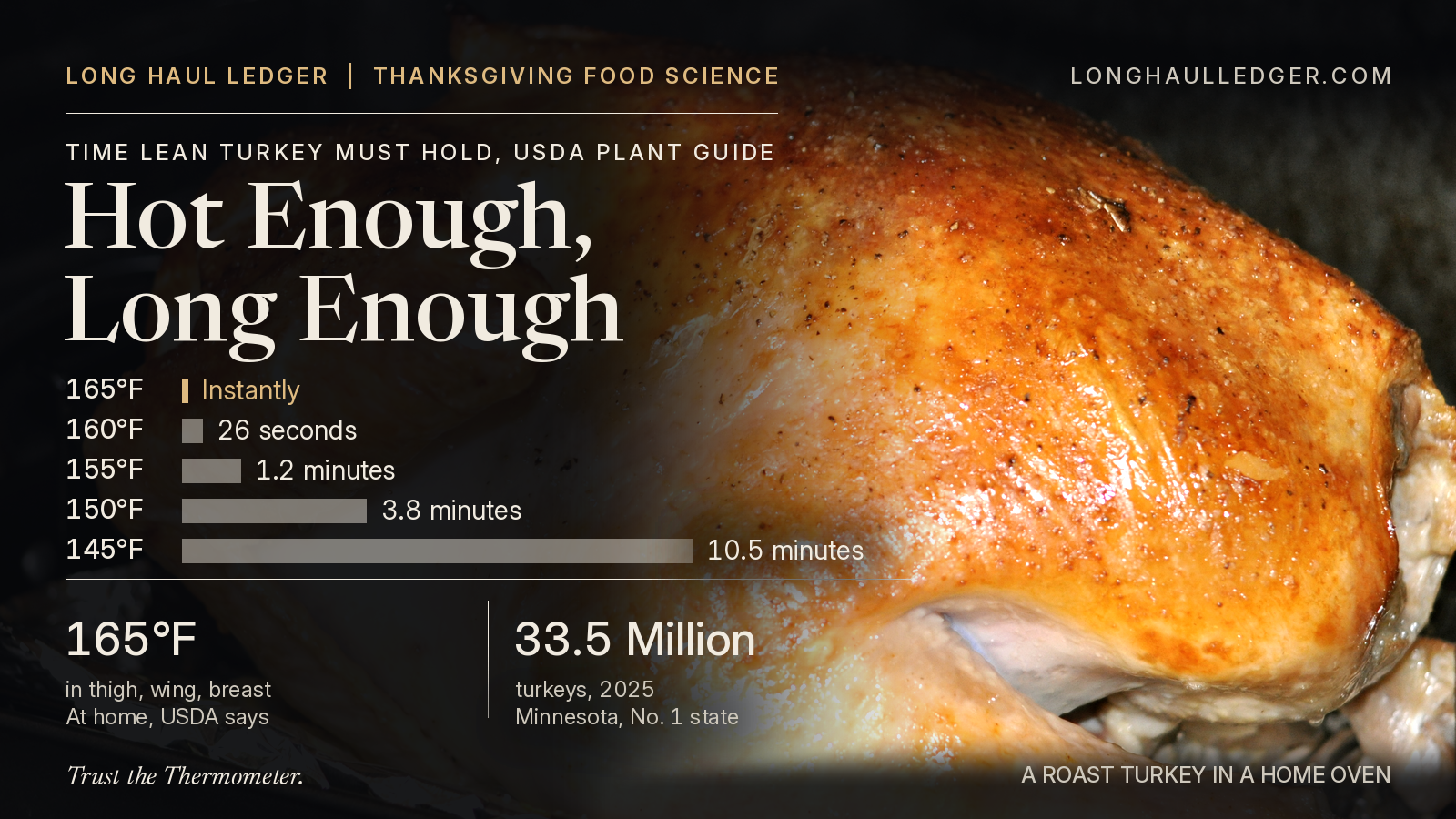
Pretty close, and it starts with a thermometer. A turkey is really two kinds of meat: lean white breast that dries out as it gets hotter, and dark thigh meat full of connective tissue that gets more tender with more heat. USDA says a whole turkey is safe at 165°F in the thigh, wing and breast. Brining, flattening the bird and resting it all help. The bird itself most likely came from a farm in a state like Minnesota, which raised 33.5 million turkeys in 2025, more than any other state.
Trust the thermometer.
Photo: Kimberly Vardeman, November 25, 2010, CC BY 2.0, via Wikimedia Commons. A roast turkey in a home oven. Figures: USDA Food Safety and Inspection Service cooking guideline for plants (turkey at 1% fat, the leanest column), USDA consumer guidance and USDA National Agricultural Statistics Service. The plant table is written for processors with precise controls; at home, USDA's number is 165°F.
Every Thanksgiving the same puzzle lands on the counter: one bird, two kinds of meat, one oven. Food scientists, USDA and some very opinionated cooks have spent decades on it, and they agree on more than you might think.
One bird, two kinds of meat
The breast is made of fast-twitch muscle that the bird uses in short bursts. “Those types of muscles are generally low in connective tissue, low in fat and very strong. And what that means is that it's relatively easy to overcook them,” J. Kenji López-Alt, author of The Food Lab, told NPR in 2021. The legs and thighs are slow-twitch muscle that works all day holding the bird up, so they carry far more connective tissue.
That connective tissue is mostly collagen, and it needs time and heat to melt into gelatin. Food writer Harold McGee told Science magazine in 1999: “For a really nice tasting leg, you want to cook it to 180 degrees Fahrenheit to make sure it has fully gelatinized, but by then the breast will be dry as dust.” His fix one year was to ice half the breast before roasting so the legs got a head start, and his guests “did think it was juicier.”
Breast. López-Alt aims for about 150°F in the breast, NPR reported.
Thighs. He aims for at least 165°F in the dark meat, and ideally about 175°F, where the connective tissue has broken down.
What USDA says, and why time matters too
USDA's Food Safety and Inspection Service says a whole turkey is safe when cooked to a minimum internal temperature of 165°F, checked with a food thermometer in the innermost part of the thigh and wing and the thickest part of the breast. It adds that a pop-up timer should be double checked with a thermometer.
Behind that number is a time and temperature trade. FSIS's cooking guideline for meat and poultry plants lists how long turkey must stay at each temperature to kill Salmonella. For the leanest turkey in its table, 165°F works instantly, 155°F takes 1.2 minutes and 150°F takes 3.8 minutes. “Food safety is actually about temperature and time,” López-Alt told NPR. That table is written for processors with precise equipment and records. For home cooks, USDA's advice stays 165°F.
Brining, wet or dry
Salt is the shared secret. López-Alt explained on Science Friday in 2022 that salt dissolves some of the proteins wrapped around the muscle fibers, so they squeeze less juice out as they cook, and a brined turkey keeps “about 7% more moisture” than one that was not brined.
Wet brine. The bird soaks in salt water. Texas A&M AgriLife Extension suggests 1 cup of kosher salt per gallon of water for 12 to 24 hours for a 12 to 15 pound bird. Clemson Extension says wet brines work faster but need a big container and fridge space, and the skin often browns a little less.
Dry brine. Salt goes straight on the bird. Texas A&M suggests 1 tablespoon of kosher salt per 5 pounds, left uncovered on a rack in the fridge for 24 to 72 hours. Clemson says it takes longer and gives browner, crispier skin.
Either way. The turkey has to be fully thawed first and kept in the fridge the whole time.
Spatchcocking: flatten the bird
Spatchcocking means cutting out the backbone so the bird lies flat. The thin legs and thighs end up out in the heat and the bulky breast lies lower, so the dark meat reaches about 175°F just as the breast gets to about 150°F, NPR reported. “So it works out perfectly,” López-Alt said. It also cooks much faster. López-Alt explained on Science Friday that air trapped in a whole bird's cavity just sits there, which is one reason a whole turkey takes so long to roast.
Resting and carryover cooking
A turkey keeps cooking after it leaves the oven. Texas A&M AgriLife Extension says carryover cooking raises the internal temperature another 5 to 10°F during the rest, while the juices settle back through the meat. It recommends resting at least 30 minutes for a small turkey and 45 to 60 minutes for a large one, tented with foil. USDA suggests at least 20 minutes “to allow juices to set.” The turkey also carves more easily.
Get the free Monday Haul for the farms, plants and builds that keep the shelves full, every week.
The Monday Haul · free weekly email
Energy, industry, infrastructure and policy in one short email every Monday, including new factories and grid projects. Every item sourced and dated. More about the Haul
The farms behind the bird
USDA's National Agricultural Statistics Service counted 193.5 million turkeys raised in the United States in 2025, down 3% from 2024, and valued the year's turkeys at $5.58 billion. Turkeys are fed mainly corn and soybean meal and grow to full maturity in about 4 to 5 months, USDA says.
Minnesota. 33.5 million turkeys, about 17% of the country, USDA's Economic Research Service says.
North Carolina. 28.0 million.
Arkansas. 21.5 million.
Indiana. 20.0 million.
Virginia and Missouri. 15.3 million and 14.7 million.
Thirteen states raised 89% of the country's turkeys in 2025, ERS reported.
The plants: Willmar, Minnesota
Jennie-O, owned by Hormel Foods since 1986, has been part of west central Minnesota for more than 80 years and makes more than 1,500 turkey products, the West Central Tribune reported. Willmar's mayor, Doug Reese, called it “the largest employer in Kandiyohi County.” In November 2024 the company broke ground on a $30 million, 20,000 square foot addition to its Willmar plant, which it expected to finish in late 2025 or early 2026. Production jobs there start at $20.35 an hour, in rooms kept between 32 and 40°F, a September 2026 posting says.
In North Carolina, Butterball, based in Garner, says it employs over 7,000 team members in production facilities, live operations and offices across Arkansas, Illinois, Kansas, Missouri and North Carolina.
The cold chain, farm to store
At the plant. Federal rules say turkeys must be chilled immediately after slaughter. Birds labeled quick frozen must go into a freezer within 48 hours of chilling, and frozen birds must reach 0°F at the center of the package within 72 hours of entering the freezer.
On the label. “Fresh” may only go on poultry that has never been below 26°F, USDA says. Poultry held at 0°F or below must say frozen or previously frozen.
On the road. Turkey is kept cold during distribution to stores, and USDA says the grocery should be the last stop before home.
In your kitchen. Thaw in the fridge at 40°F or below, allowing about 24 hours for every 4 to 5 pounds, or in cold water at about 30 minutes per pound, changing the water every 30 minutes.
And when it all goes sideways
Butterball's Turkey Talk-Line started in 1981, when six home economists answered about 11,000 turkey questions. Now more than 50 experts, including chefs, food scientists and registered dietitians, answer more than 100,000 questions every November and December, Butterball says. This year's line runs November 2 through December 24 at 1-800-BUTTERBALL. USDA runs its own Meat and Poultry Hotline too, at 1-888-674-6854.
Where people land
4 camps in the great turkey debate. Each camp gets the same space. This is not a poll, and the segments are not shares of support.
The question
What's the best way to cook a turkey?
Where they agree Every camp checks doneness with a thermometer instead of a clock, starts with a fully thawed bird kept cold, and lets the turkey rest before carving. USDA, the extension scientists and the cooks all land on 165°F as the number to check.
Dry brine it
Salt the bird a day or more ahead and leave it uncovered in the fridge, they say, and you get juicier meat, deeper seasoning and crisp skin, with no bucket of salt water to wrestle. J. Kenji López-Alt said on Science Friday: “you'll also get kind of crispier skin because you're not soaking it in water for a couple of nights.”
What they get right Clemson Extension's Kimberly Baker says dry brining “results in browner and crispier skin,” and it needs less fridge space than a wet brine.
A soak in salt water works fast and gets seasoning and moisture deep into the meat, they say, which makes the bird more forgiving if the oven runs hot or dinner runs late. Texas A&M AgriLife Extension's Gregory Archer wrote: “Brining is the single biggest upgrade to a roasted turkey.”
What they get right Clemson Extension says “Wet brines infuse flavor and moisture more quickly than dry brines,” and López-Alt says a brined turkey keeps about 7% more moisture.
Cut out the backbone and lay the bird flat, they say, and the thighs and breast finish together, the skin browns evenly and dinner is ready much sooner. López-Alt told NPR that the dark meat reaches about 175°F just as the breast reaches about 150°F: “So it works out perfectly.”
What they get right Spatchcocking is much faster than roasting a whole bird, López-Alt explained on Science Friday, because air trapped in a whole turkey's cavity slows the cooking.
Hot oil cooks a 14 pound turkey in about 45 minutes, they say, crisps the skin all the way around and frees the oven for the sides. Texas A&M AgriLife Extension says: “Fried skin is uniquely crispy all the way around, including the bottom, which is impossible to achieve in an oven.”
What they get right A 14 pound bird roasts in about 4 hours and fries in about 45 minutes, Texas A&M says. It also says to fry only outdoors, at least 10 feet from any structure, and never to overfill the pot.
Built long before the oven Every one of those turkeys started on a farm in a state like Minnesota, went through a plant like Jennie-O's in Willmar, and stayed cold all the way to the store, so the perfect turkey is a team effort by thousands of farmers, plant crews and truck drivers before anyone turns on an oven.
What to watch next
USDA's National Agricultural Statistics Service publishes its first estimate of the year's turkey count each September in Turkeys Raised, and the final count each April in Poultry Production and Value. USDA projects 2026 turkey meat production at 5.13 billion pounds, up from 4.84 billion in 2025, and a 2026 average wholesale price for frozen whole hens of $1.76 a pound, ERS says. Butterball's Talk-Line stays open through December 24. The Monday Haul follows the farms, plants and builds behind everyday prices each week, and factory output vs jobs explains how plants keep making more.
Common questions
What temperature should a turkey be cooked to?
USDA says a whole turkey is safe at a minimum internal temperature of 165°F, measured with a food thermometer in the innermost part of the thigh and wing and the thickest part of the breast. Many cooks take the thighs higher, to about 175°F, because the dark meat gets more tender.
Why do turkey breast and thigh need different temperatures?
Breast meat is lean fast-twitch muscle with little connective tissue, so it dries out as it gets hotter. Thighs are slow-twitch muscle with much more connective tissue, which needs more heat and time to turn into gelatin and soften.
Is dry brining or wet brining better?
Both add moisture and flavor. Clemson Extension says wet brines work faster but need more fridge space and the skin browns a little less, while dry brining takes longer and gives browner, crispier skin.
How long should a turkey rest?
USDA suggests at least 20 minutes. Texas A&M AgriLife Extension recommends 30 minutes for a small turkey and 45 to 60 minutes for a large one, and says carryover cooking raises the temperature another 5 to 10°F while it rests.
Which state raises the most turkeys?
Minnesota. USDA counted 33.5 million turkeys raised there in 2025, about 17% of the national total of 193.5 million, followed by North Carolina, Arkansas and Indiana.