Why does it take close to 10 years to permit a new mine in America?
The Stibnite mine, in the mountains near Yellow Pine, Idaho, spent about nine years in permitting. Here's where the time went, and what crews are building there now.
Updated November 25, 2026 · Numbers as published by each source on the date shown
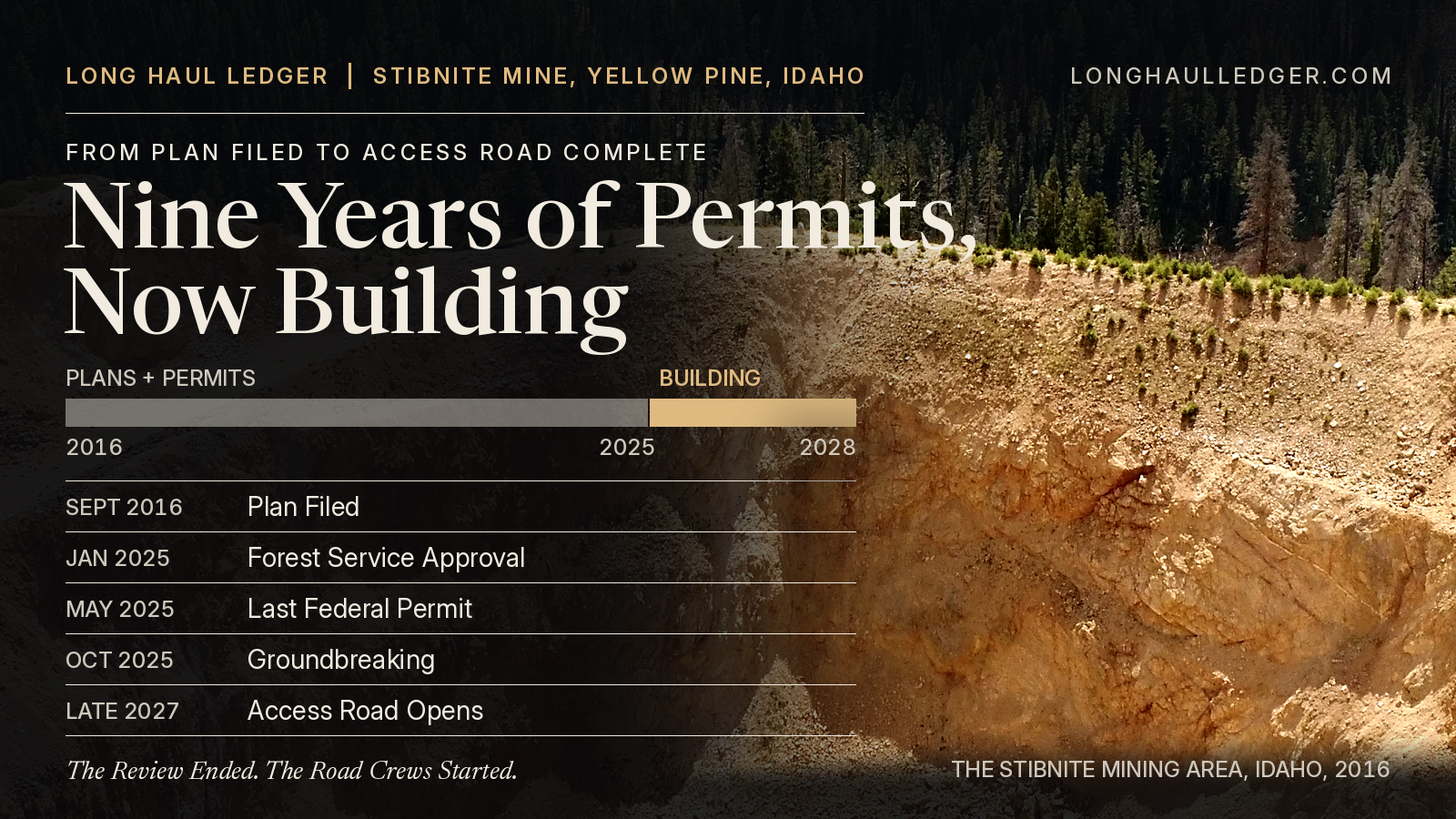
Because a big mine on federal land needs a full environmental review plus separate water, wildlife and air permits, and each step can be challenged in court. Idaho's Stibnite mine filed its plan in September 2016, won Forest Service approval in January 2025 and its last federal permit that May. Crews broke ground in October 2025.
The review ended. The road crews started.
Photo: USGS, August 25, 2016, public domain, via Wikimedia Commons. An old open pit in the Stibnite mining district near Yellow Pine, Idaho. Dates: USDA Forest Service, U.S. Army Corps of Engineers and Perpetua Resources. Access road date is Perpetua's target.
The review is long, but it ends, and Stibnite shows what comes next: road crews, power lines and a worker camp going up in the Idaho backcountry.
Stibnite is being built now
The Stibnite Gold Project is Perpetua Resources' gold and antimony mine on an old mining site near the village of Yellow Pine, in Valley County, about 40 air miles east of McCall. Perpetua broke ground on early works on October 21, 2025, after posting $139 million in financial assurance, money set aside to guarantee cleanup.
Work so far. Crews logged 494,480 work hours through September 30, 2026 with no serious injuries, Perpetua reported on November 13.
The camp. Foundations are in and 178 of 357 dormitory modules have been placed, Perpetua said on a November 17 update call.
The road. Rough road is built on 5.4 miles of the new Burntlog Route, the year-round access road. Perpetua expects the route to be active in late 2027 and complete in 2028.
Power. Power poles have been going up since October on a line that will deliver 65 megawatts to the site, with substations and transformers on order.
Money. The U.S. Export-Import Bank's board approved a $2.9 billion loan on May 21, 2026, with closing expected in the first quarter of 2027. Perpetua estimates direct construction costs of about $2.6 billion and says a final investment and construction decision is still ahead.
Where the nine years went
September 2016: Perpetua submitted its plan to the Forest Service, the company told Congress.
2016 to 2024: The environmental impact statement, the full federal study of what the mine would do to land, water, fish and wildlife. Perpetua's testimony counts 8 years in the federal environmental review, with a draft in 2020 and a revised draft in 2022 after the design changed.
September 6, 2024: The Forest Service released the final impact statement and a draft decision, followed by a 45-day objection period.
January 3, 2025: The Payette and Boise forest supervisors signed the final decision. Payette supervisor Matthew Davis called it “the culmination of over seven years of scientific study and analysis.”
May 19, 2025: The Army Corps of Engineers issued the permit for construction work in streams and wetlands. The Corps says that permit “does not authorize mining activity” by itself.
September 2025: The Forest Service said construction could start once financial assurance was posted.
October 21, 2025: Groundbreaking. Perpetua's CEO called it the end of “nine years of permitting.”
Each step had its own purpose. Counted from the plan to the groundbreaking, it took nine years and one month.
Why a mine like this needs so many reviews
It is on national forest land, so the Forest Service must approve a plan of operations and do a full impact study.
It touches a salmon river, so it needs a Clean Water Act permit for work in streams and wetlands, and Endangered Species Act consultation for threatened bull trout and wolverines.
It needs a state air permit from the Idaho Department of Environmental Quality, which has been challenged in state court, Valley Lookout reported.
It is an old mine. The East Fork South Fork Salmon River runs through the old Yellow Pine pit, and water at the site does not meet drinking water standards because of arsenic and antimony left by earlier mining, Valley Lookout reported. The plan includes cleaning that up.
Get the free Monday Haul, which follows Stibnite and other mine builds each week.
The Monday Haul · free weekly email
Energy, industry, infrastructure and policy in one short email every Monday, including new factories and grid projects. Every item sourced and dated. More about the Haul
How long US mines take, by the numbers
Two different measures are worth keeping apart.
The federal plan review alone. GAO found that from fiscal 2010 to 2014, the Bureau of Land Management and the Forest Service approved 68 mine plans, taking from about 1 month to over 11 years, about 2 years on average. The two most cited causes of delay were low-quality information in mine plans and limited agency staff and money. Most of those were smaller mines.
Discovery to production. S&P Global found in July 2024 that a new US mine takes 29 years on average from discovery to production, second longest of the countries it studied, after Zambia at 34. The National Mining Association supported that study; S&P says the group did not provide data or substantive input.
Big mines that need a full impact study sit at the long end of the plan-review range. Stibnite's federal review took about eight and a half years. (For a mine on private land with state permits only, see Copper World in Arizona.)
What could shorten it
The Senate passed the bipartisan permitting bill 62-33 on November 19, 2026, and the House takes it up next. It covers mines as well as power lines; see what the permitting bill would change. GAO's 2016 report suggested two fixes: meetings with companies before a plan is filed so it arrives complete, and letting the agencies keep review fees to pay for staff. Stibnite was also listed as a federal “Transparency Project” under the FAST-41 program, which puts a public schedule on the permits, Perpetua says.
Where people land
4 camps in the debate over how long mine permits should take. Each camp gets the same space. This is not a poll, and the segments are not shares of support.
The question
Is nine years the right amount of time to permit a mine?
Where they agree Everyone involved says the old Stibnite site needs repair. Water there does not meet drinking water standards because of arsenic and antimony left by past mining, the Nez Perce Tribe has spent years funding fish restoration in the watershed, and Perpetua's plan is built around cleanup. They disagree on whether a new mine is the right way to do it.
Set firm clocks
Senate 62-33, Nov 19, 2026
When a mine takes the better part of a decade to approve, they say, the country waits on metals it needs and investors go elsewhere, so reviews should run on firm deadlines with one lead agency. The Senate's permitting bill, passed November 19, would add review deadlines and new rules for mines on federal land. Perpetua CEO Jon Cherry said at the groundbreaking: “After nine years of permitting, Stibnite can once again serve this country's national interest.”
What they get right S&P Global found a new US mine takes 29 years on average from discovery to production, second longest of the countries it studied.
Stibnite sits in the headwaters of a salmon river next to a wilderness area, they say, so a careful study and the right to challenge it in court are how neighbors make sure the river comes out better, not worse. Sydney Luvaas of Idaho Rivers United said: “We believe this appeal is essential to prevent long-term damage to this cherished part of Idaho.”
What they get right The federal court upheld the approval but did order the Fish and Wildlife Service to fix its protections for bull trout and wolverines (Judge Amanda K. Brailsford, August 18, 2026).
The mine sits in the Nez Perce homeland, where the Tribe kept treaty rights to fish, hunt and gather, they say, and after nearly a decade of raising concerns, the Tribe argues the Forest Service should have chosen a less harmful alternative. Chairman Shannon F. Wheeler said: “Our treaty-reserved rights are the supreme law of the land and fundamental to the culture, identity, economy, and sovereignty of the Nez Perce people.”
What they get right The Tribe says the Forest Service's own final study found significant, long-term effects on its treaty resources, and it already spends about $2.8 million a year restoring salmon, steelhead and bull trout in the watershed.
The site was mined for a century and then abandoned, they say, and a company with money on the line and a cleanup bond can reconnect fish to their spawning grounds and treat the water, while producing gold and antimony. USGS estimates the US relied on imports for 91% of the antimony it used in 2025. Perpetua says the project “is also designed to clean up legacy contamination, reconnect fish to their native spawning grounds, and restore habitat.”
What they get right Perpetua posted $139 million in financial assurance before breaking ground, and its plan includes three water treatment plants now being built.
The camp is going up Nine years after the plan was filed, crews are setting dormitory modules and power poles in the Idaho mountains, and the Burntlog Route is on track to open to big deliveries in late 2027.
What to watch next
The Export-Import Bank loan closing, expected in the first quarter of 2027, and Perpetua's final investment and construction decision. The Burntlog Route, targeted to be active in late 2027. The conservation groups' appeal, filed August 25, 2026 at the Ninth Circuit; the Nez Perce Tribe's separate case before the same district judge; and the state air permit appeal. House action on the permitting bill after Thanksgiving. The Monday Haul follows these each week, and the project tracker follows other mine builds like Thacker Pass.
Common questions
How long did Stibnite take to permit?
Perpetua submitted its plan to the Forest Service in September 2016. The Forest Service signed its final decision on January 3, 2025, and the Army Corps issued the last federal permit on May 19, 2025. Crews broke ground on October 21, 2025, which Perpetua called the end of nine years of permitting.
What permits does a mine on federal land need?
For Stibnite, that meant Forest Service approval of a plan of operations after a full environmental impact statement, a Clean Water Act permit from the Army Corps for work in streams and wetlands, Endangered Species Act consultation for bull trout and wolverines, and a state air permit from Idaho.
Is Stibnite under construction?
Early works are underway. Crews are building the Burntlog access road, a power line and a worker camp, with 178 of 357 dormitory modules placed as of November 17, 2026. Perpetua says a final investment and construction decision is still ahead, after a $2.9 billion Export-Import Bank loan expected to close in the first quarter of 2027.
What will the mine produce?
Gold and antimony, a metal used in flame retardants, lead-acid batteries and ammunition, according to USGS. USGS estimates the US relied on imports for 91% of the antimony it used in 2025. Perpetua's plan also cleans up contamination from past mining and reconnects fish to their spawning grounds.
Third quarter 2026 results, Perpetua Resources, November 13, 2026. 494,480 work hours; Export-Import Bank loan approved May 21, 2026, closing expected first quarter 2027; power poles since October.