Why does a big power line take 15+ years to build, and what would the Senate permitting bill change?
The SunZia line from Corona, New Mexico, to Pinal County, Arizona, took about 17 years to reach a shovel and under 3 to build. Here is what the bill would speed up.
Updated November 21, 2026 · Numbers as published by each source on the date shown
Update, November 21, 2026: The Senate passed the bill 62-33 on the evening of November 19, 2026 (Senate vote 270). It is not law yet. The House now has to agree to the Senate's version before it can go to the President.
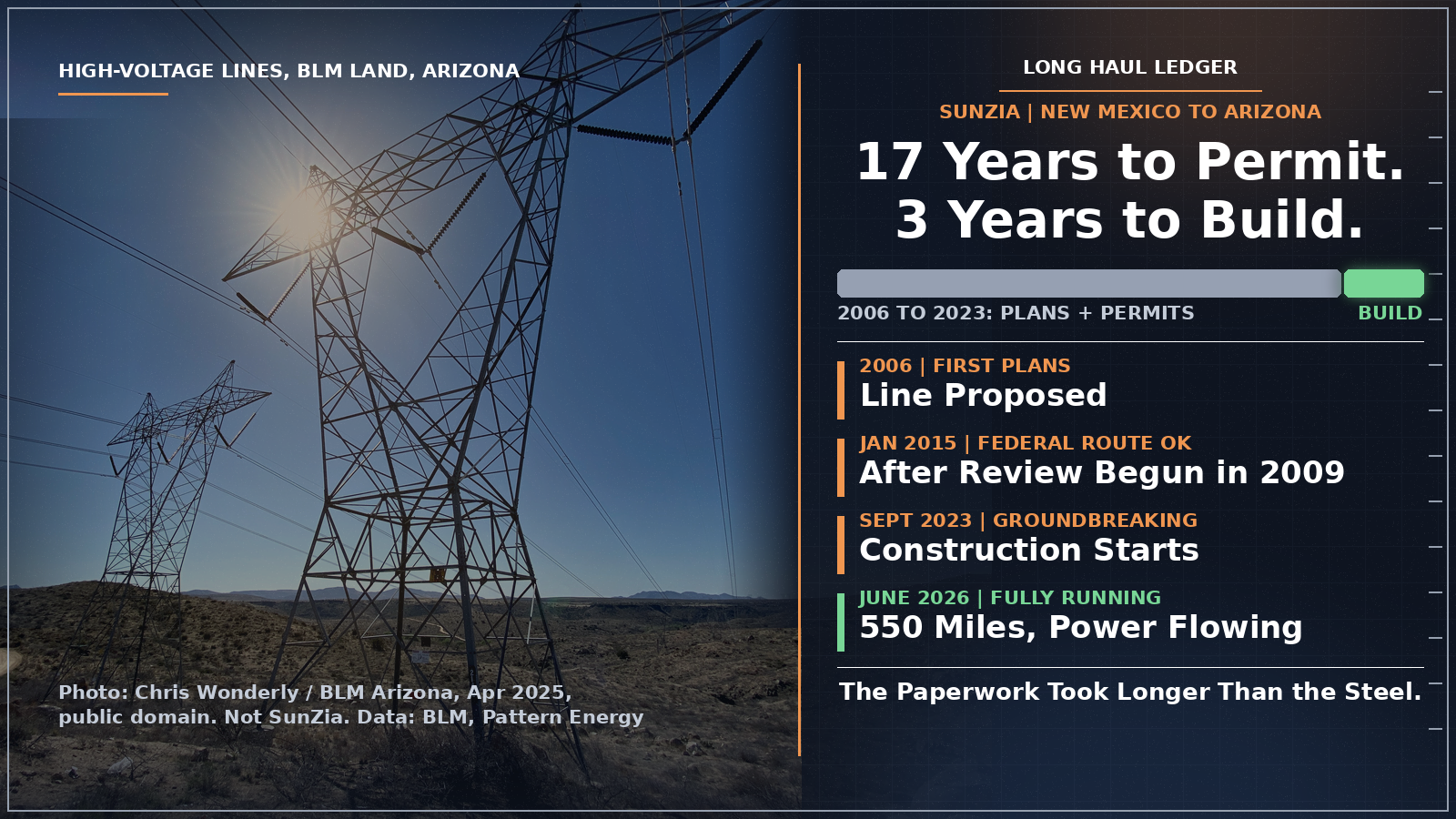
Mostly the paperwork, not the steel. SunZia, a 550-mile line from Corona, New Mexico, to Pinal County, Arizona, was first planned in 2006, won its federal route approval in January 2015, broke ground in September 2023 and was fully running in June 2026. The bipartisan permitting bill the Senate passed 62-33 on November 19, 2026, would set firmer review deadlines, shrink the time to sue over a federal environmental review from six years to 150 days, and let federal regulators approve an interstate line if a state does not act within a year.
The United States can still build big lines fast once the permits clear. SunZia's crews needed under three years. The bill is a fight over the 17 years before that.
SunZia is running today
On June 18, 2026, Sen. Martin Heinrich announced that the SunZia project "has become fully operational." It is a 550-mile high-voltage direct current line, rated 3,000 megawatts, from an east converter station in Corona, New Mexico, to a west converter station in Pinal County, Arizona. Pattern Energy, in a September 1, 2023 release, said the line would carry power from its SunZia Wind project in New Mexico and that construction would support more than 2,000 jobs, with more than 100 permanent jobs once the line was running.
The steel went up quickly once work was allowed to start. The longer story is the years before that.
Where the 17 years went
The Arizona State Law Journal wrote on February 22, 2024, that Southwestern Power Group, a Phoenix-based developer, "conceived the idea for SunZia in 2006." The Bureau of Land Management, in a January 24, 2015 release, said approval followed "an extensive public process initiated by the BLM in 2009 that included fourteen cooperating federal and state agencies, three public scoping periods, 28 public meetings, and consultation with American Indian tribes."
Western Electricity Coordinating Council's 2026 annual progress report for the project, issued March 18, 2026, says the BLM "issued a Record of Decision on January 23, 2015 approving SunZia's request for right-of-way on federal lands," and that SunZia "executed a fifty-year Right-of-Way Grant Agreement with the BLM on September 1, 2016." Route changes, more permits and court fights followed. Pattern Energy said on September 1, 2023, that the BLM had issued a Notice to Proceed and that Secretary Deb Haaland joined the groundbreaking that day at the SunZia East Converter Station in Corona, New Mexico. The Department of the Interior's release the same day is dated September 1, 2023, from Corona.
Crews then built the line in under three years. Sen. Heinrich, on June 18, 2026, called full operation "a milestone more than 18 years in the making" and said "it should not take 18 years to build critical energy infrastructure in America." The 17 years in this page's headline is the span from first plans in 2006 to groundbreaking in 2023.
The paperwork took longer than the steel.
Photo: Chris Wonderly, Bureau of Land Management Arizona, April 10, 2025, public domain, via Wikimedia Commons. The photo shows high-voltage lines on BLM land in Arizona, not the SunZia line. Data: Bureau of Land Management (January 24, 2015), Pattern Energy (September 1, 2023) and Sen. Martin Heinrich (June 18, 2026).
How rare a line like this is
In a July 2025 revision, Grid Strategies compiled FERC data showing 888 miles of new 345-kilovolt and higher transmission were built in the United States in 2024: 334 miles at 345 kilovolts and 554 miles at 500 kilovolts. An earlier version of the same report had used 322 miles, before FERC revised the 2024 figures. Grid Strategies says the country built an average of 536 new miles a year from 2020 to 2024, down from 942 a year from 2015 to 2019 and 1,781 a year from 2010 to 2014. The group says roughly 5,000 miles a year are needed, a figure it bases on the Energy Department's 2024 National Transmission Planning Study.
Get the free Monday Haul to follow the bill and the big builds it affects each week.
The Monday Haul · free weekly email
Energy, industry, infrastructure and policy in one short email every Monday, including new factories and grid projects. Every item sourced and dated. More about the Haul
What the Senate bill would change in that timeline
The bill is not law yet. On November 18, 2026, the Senate voted 69-27 to adopt Sen. Shelley Moore Capito's new text for H.R. 2347. That text is the Bipartisan American Affordability and Jobs Act of 2026. On November 19, the Senate passed the amended bill 62-33. The House has to agree to the same text before it can become law.
On lawsuits, most challenges to a federal environmental review today are brought under the Administrative Procedure Act. The Congressional Research Service, in a November 6, 2026 report, says plaintiffs typically have up to six years to file such a claim under 28 U.S.C. 2401. Section 1110 of the bill would add a new judicial review section to the National Environmental Policy Act. A claim would be barred unless it is "filed not later than 150 days after" the authorization is published in the Federal Register, if an environmental impact statement was prepared, or otherwise made public. The bill also sets 150-day windows for certain Clean Water Act and Endangered Species Act claims, and shortens one federal fast-track program's lawsuit window from two years to 150 days.
On interstate lines, section 2101 would amend section 216 of the Federal Power Act. The Federal Energy Regulatory Commission "shall," after notice and a public comment period of at least 45 days, issue a construction permit for qualifying electric transmission facilities if it makes required findings, including that the line would be used in interstate or foreign commerce, is consistent with the public interest, and is generally capable of 230 kilovolts or more. The Commission would have no authority to issue that permit inside a state except as provided in paragraph (1) of that subsection. One of those conditions, as amended, is that the state "has not made a determination on an application" by one year after "the date on which the application was filed with the State commission or other entity." Current law already uses a one-year clock, but only inside Department of Energy national interest corridors. The bill drops that corridor limit and starts the one-year clock from the state filing date.
The bill would also require a record of decision within 45 days after a lead agency publishes an environmental impact statement, and would require other federal agencies to decide on remaining authorizations within 90 days if they took part in the review, or 120 days if they did not. Neighboring grid regions would have to plan lines together. A separate section would create a faster path for upgrades and reconductoring on existing rights-of-way. For large computing loads, section 2107 directs changes in how transmission costs are assigned. For the wait to connect a plant to the grid, see why projects stall in the interconnection queue. For the wait for the equipment itself, see the transformer shortage. For how data centers show up on power bills, see what is driving home power bills.
Where people land
Four camps in the fight over the Senate permitting bill and new power lines. Each camp gets the same space. This is not a poll, and the segments are not shares of support.
The question
How should the US speed up new power lines?
Where they agree Nearly every camp says the United States needs more power lines, and that today's process takes too long. They disagree on how far federal law should change to get there.
Build it faster
Senate passed 62-33
America's review process takes too long, they say, and a national bill is how you fix it. Sen. Martin Heinrich, a co-author, put it this way: "It should not take decades to build the infrastructure our country needs." The Senate bill would set firmer review deadlines, cut the time to sue over a federal environmental review from six years to 150 days, and let federal regulators approve an interstate line if a state does not act within a year.
What they get right Once the permits cleared, SunZia's crews built the 550-mile line in under three years. The long wait really was the years before the shovel.
Speeding up reviews is one thing, they say. Shrinking the time to go to court to 150 days, and telling courts they can send a flawed review back but cannot stop the project, would leave communities, tribes and wildlife with weaker tools if an agency rushes the work or gets it wrong. Earthjustice's Sambhav Sankar wrote that in that case, "The permit stands in the meantime, and the project can continue."
What they get right Cutting the lawsuit window from six years to 150 days, and limiting what a court can do, really does change who can challenge a project and whether work can be paused. That is a tradeoff, not just faster paperwork.
Approving where a power line goes has long been a state job, they say. The Senate bill would let federal regulators approve major interstate lines across most of the country, not only in designated national-interest corridors, which would allow Washington to override a state's decision and the people who live along the route. Former FERC Chairman Mark Christie wrote that the bill "contains no geographic limits on FERC's permitting power."
What they get right An interstate line still has to cross someone's land in a particular state. State regulators sit closer to those landowners and local tradeoffs than a federal commission in Washington.
Christie was writing about the bill as it stood then. The November text still drops the corridor limit.
A start, not the finish
The bill points in the right direction on planning and getting more power onto the grid, they say, but important parts still need clearer rules so the reforms actually cut delays and do not create new legal risks. That includes how new plants get a place in line on the grid, and how firmly a permit holds once it is issued. Clean Air Task Force's Alan Mitchell wrote that the bill "points in the right direction, but clearer Congressional direction will help."
What they get right Passing a bill is not the same as a working grid. How plants connect to the lines, and how permits can later be changed, will decide whether the power actually shows up.
The build can still move fast Once SunZia's crews broke ground in September 2023, the 550-mile line was fully running in under three years.
What critics worry about
Critics say the bill goes too far. Conservation groups argue it weakens the Endangered Species Act, Clean Water Act reviews and the National Environmental Policy Act. Some tribal leaders and historic-preservation advocates say changes to historic-site reviews were developed without enough Tribal input. SunZia itself was challenged by the Tohono O'odham Nation and other plaintiffs over a stretch of the route in Arizona's San Pedro River Valley; that dispute is one reason a long line can still spend years in court after a federal approval. Landowners and some senators have also called for stronger compensation rules and tighter limits on federal siting. Those concerns are now part of the fight in the House.
What happens next
Official Senate votes show a 70-27 vote on November 16, 2026, to move the bill forward (vote 264), the Senate's 69-27 vote on November 18 to adopt the bill's new text (vote 267), a 65-31 vote on November 18 to move the amended bill forward (vote 268), and the final vote on November 19 at 9:30 p.m. Eastern: "Bill Passed (62-33)" (vote 270), with 5 senators not voting. Because the bill is H.R. 2347, a House bill the Senate rewrote, it now goes back to the House. As of November 21, 2026, Congress's record shows no House action on the Senate's version. If the House passes the same text, the bill goes to the President to sign or veto. If the House changes it, the Senate has to vote again. This page will not guess the outcome.
Why faster lines matter to you
Power lines are how a wind farm in New Mexico or a gas plant in Texas reaches a light switch, a factory floor or a data center. Building them faster means more power for the work already under way, a better shot at keeping bills in check, and steady jobs for the crews who string the wire. SunZia, Pattern Energy said, kept more than 2,000 people working at its peak. The encouraging part of this story is already on the ground: once the permits cleared, crews built 550 miles of line in under three years.
Common questions
Why does a big power line take 15+ years to build, and what would the Senate permitting bill change?
Mostly the paperwork, not the steel. SunZia, a 550-mile line from Corona, New Mexico, to Pinal County, Arizona, was first planned in 2006, won its federal route approval in January 2015, broke ground in September 2023 and was fully running in June 2026. The bipartisan permitting bill the Senate passed 62-33 on November 19, 2026, would set firmer review deadlines, shrink the time to sue over a federal environmental review from six years to 150 days, and let federal regulators approve an interstate line if a state does not act within a year. Those lawsuit and approval rules are in the bill text the Senate adopted on November 18, 2026. A final Senate vote is still ahead, and the House has to agree.
What is the Senate permitting reform bill?
The bill is the Bipartisan American Affordability and Jobs Act of 2026. The Senate passed it 62-33 on November 19, 2026, as new text for H.R. 2347, after adopting that text 69-27 on November 18. It now goes back to the House, and it is not law yet.
How long did SunZia take to build?
Plans for the line date to 2006. The Bureau of Land Management began its public review in 2009 and issued a record of decision on January 23, 2015. Construction began with a groundbreaking on September 1, 2023, in Corona, New Mexico. Sen. Martin Heinrich announced on June 18, 2026, that the project had become fully operational. The build itself took under three years. The longer wait was the years before groundbreaking.
How many miles of high-voltage transmission line did the US build in 2024?
FERC data compiled by Grid Strategies in a July 2025 revision show 888 miles of new 345-kilovolt and higher lines in 2024, after FERC revised earlier figures that had shown 322 miles. The five-year average for 2020 to 2024 was 536 miles a year.
Would the bill let federal regulators approve a power line over a state's objection?
The bill would amend the Federal Power Act so the Federal Energy Regulatory Commission shall issue a construction permit for qualifying interstate lines, generally 230 kilovolts or more, when the required findings are met. One of those existing conditions, as amended, is that the state has not made a determination within one year after the application was filed with the state. A state that lacks siting authority, or that has denied an application, can also trigger federal permitting. FERC already had a narrower version of this power, limited to Department of Energy corridors, and that authority has rarely been used.
Why do people oppose the permitting bill?
Critics, including tribes and conservation groups, say the bill weakens protections for species, water and historic sites, and that some changes were developed without enough Tribal input. Landowners and some senators have also pushed for stronger compensation and limits on federal siting. The bill is not law yet.
Senate bill text adopted Nov 18, 2026 (PDF), posted by Sen. Heinrich's office for Sen. Shelley Moore Capito, with Sens. Mike Lee, Sheldon Whitehouse and Martin Heinrich. Short title: "Bipartisan American Affordability and Jobs Act of 2026." Section 1110 would bar a NEPA lawsuit unless it is "filed not later than 150 days after" the authorization is published or made public. Section 1134 would shorten one federal fast-track program's lawsuit window from "2 years" to "150 days." Section 2101 would amend Federal Power Act section 216 so the Federal Energy Regulatory Commission "shall" issue a construction permit for qualifying interstate facilities, generally 230 kilovolts or more, and would start the one-year state-decision clock on "the date on which the application was filed with the State commission or other entity." Record of decision within 45 days of a published environmental impact statement; remaining federal authorizations within 90 or 120 days.
Congressional Research Service report on the Senate permitting bill (R49510), November 6, 2026. "Plaintiffs typically have up to six years to file an APA claim pursuant to 28 U.S.C. §2401." The report analyzes the bill as of early November, before the November 18 vote; the 150-day environmental-review lawsuit limit is confirmed in section 1110 of the bill text the Senate adopted.
16 U.S.C. §824p, Federal Power Act section 216, current law. The Commission may issue a construction permit for facilities in a national interest electric transmission corridor if, among other findings, a state "has not made a determination on an application seeking approval pursuant to applicable law by the date that is 1 year after the later of" the application date and the corridor designation.
SunZia Southwest Transmission Project, Annual Progress Report: 2026, SunZia Transmission, LLC, issued March 18, 2026, to the Western Electricity Coordinating Council. "The BLM issued a Record of Decision on January 23, 2015 approving SunZia's request for right-of-way on federal lands managed by the BLM. SunZia executed a fifty-year Right-of-Way Grant Agreement with the BLM on September 1, 2016." The report, written before June 2026, also said the project "was energized in 2025."
Fewer New Miles, on how the slow pace of transmission has limited strategic industries, Nathan Shreve, Zach Zimmerman, Gretchen Kershaw and Rob Gramlich, Grid Strategies LLC, July 2025, Rev. 1. Addendum on FERC's April 2025 Energy Infrastructure Update: "For 2024, FERC now reports 334 miles of new 345 kV transmission lines were constructed and 554 miles of new 500 kV lines, for a total of 888 miles of new 345 kV+ transmission constructed in 2024." Averages of 536 miles a year from 2020 to 2024, 942 from 2015 to 2019, and 1,781 from 2010 to 2014. The roughly 5,000 miles a year figure is Grid Strategies' reading of the Energy Department's 2024 National Transmission Planning Study, not a DOE headline number.