Explainer · Energy
What can a small town get from hosting data centers?
The farming town of Quincy, Washington has answers.
Updated November 11, 2026 · Numbers as published by each source on the date shown
Quincy is a farming town of about 8,500 people in Grant County, central Washington. A larger property-tax base, and the public buildings that followed. Washington's Data Center Workgroup findings, adopted in October 2025, say Grant County's top 10 taxpayers represented $54,267,353 in tax paid in 2025, up from $4,246,801 in 2006, an increase of 1,277% over 2006. 6 of the 7 data centers on that list are located in Quincy. The city levy rate is approximately 70% less than it was in 2006. Grant PUD currently serves 8 data center operators that accounted for approximately 280 average megawatts in 2025, about 37% of overall county load. EPA lists a demand offset of 138 million gallons per year at the reuse utility, operational since 2021.
Clearer local ledgers help towns and builders see what follows when campuses plug into hydro, pay onto the tax rolls, and reuse cooling water.
What is moving forward right now
The buildings are already up. The findings say the additional assessed value of data centers on the town enabled the city to reinvest and upgrade services while its citizens pay less in property taxes. On the list: new schools, including a new high school; the Quincy Valley Medical Center; a new fire station; a new City of Quincy Public Safety and Policy Department; a new reuse water system; a new wastewater treatment plant; new City Hall; and the Quincy Public Market. While the city had sidewalks on approximately 5% of its streets, approximately 80% of the city's streets now have sidewalks. 95% of streets are now paved.
KOMO News, on September 10, 2026, reports that the new school opened in 2019 and that Quincy Valley Medical Center opened in May 2025. Grant PUD is still serving the data center load, and the Quincy Transmission Expansion Plan is moving toward full completion by June 2029.
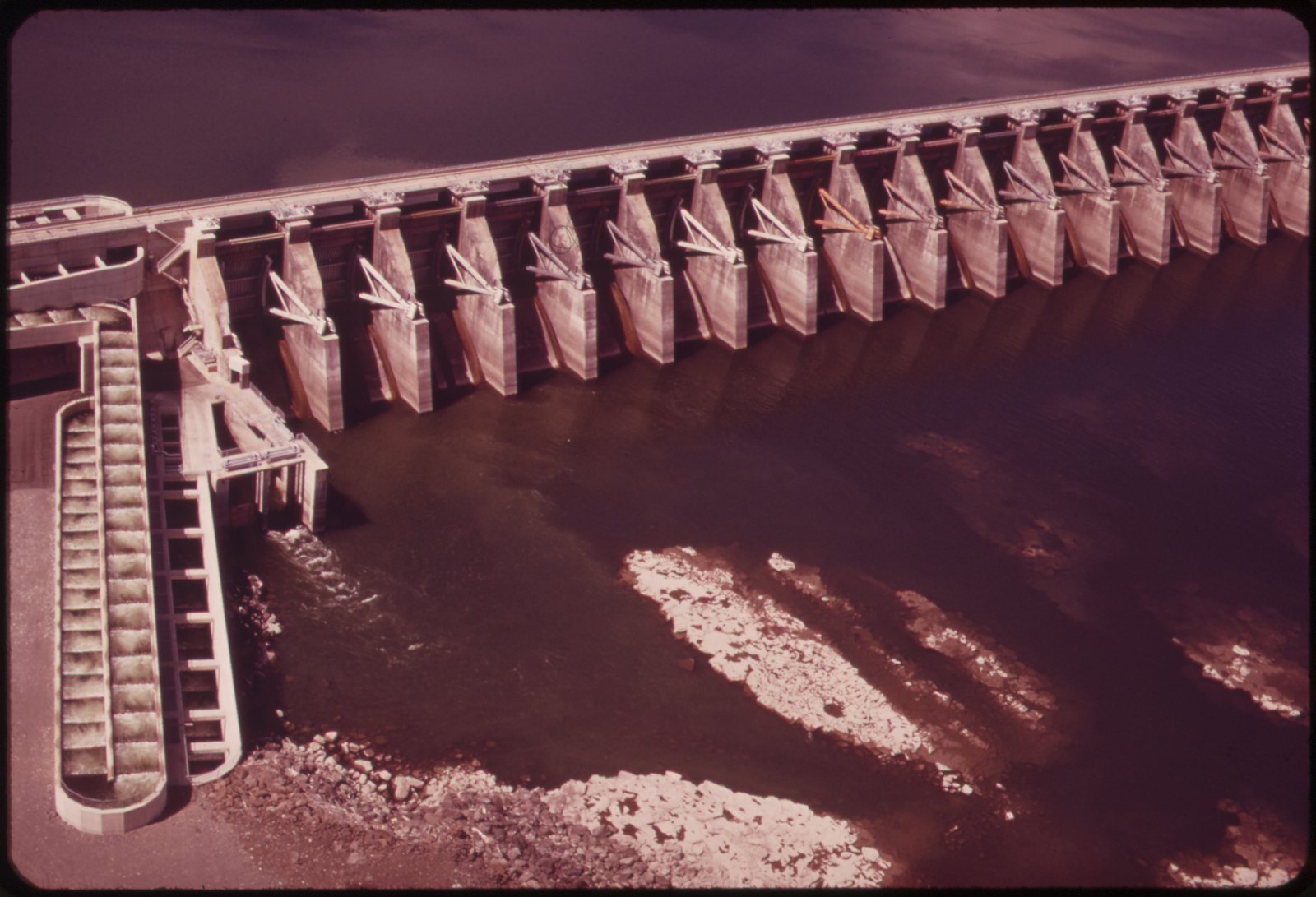
Those dams are the hydro the campuses plug into. The tax rolls, the load, and the reuse plant are the local record of what followed.
Eight operators, and what campus means
Grant PUD currently serves 8 data center operators in Grant County. That count is from the utility's data center FAQ, dated August 28, 2026. In 2025, Grant PUD's 8 data center operators accounted for approximately 280 average megawatts (aMW) of electrical load. Grant PUD's total average system load in 2025 was approximately 757 average megawatts, meaning data centers represented about 37% of overall county load.
An average megawatt is a way to state that load across the year. Is a megawatt the same as a megawatt-hour? walks through the two units.
State Rep. Alex Ybarra attributes the city's growth and enhanced services to the eight data centers that sit just on the perimeter of Quincy, The Spokesman-Review reported on July 26, 2026. NBC Montana reported on November 8, 2026 that eight data center campuses operate in Quincy. A campus can hold more than one building. The Spokesman-Review names Microsoft, Sabey, Vantage, H5 Data Centers, CyrusOne, NTT Data, and Oath.
For on-site staff and the county employment picture, see Do data centers create local jobs, or just a few on site?
The tax base that funded schools and a hospital
In 2006, before data centers located to Grant County, the assessed value of the top 10 taxpayers was $312,977,310, which represented $4,246,801 in tax paid. In 2025, after data centers located to Grant County, that assessed value was $6,136,727,665, a 1,961% increase over 2006, which represented $54,267,353 in tax paid, an increase of 1,277% over 2006. 7 of the 10 highest assessed values and taxes paid are from data centers, and 6 of the 7 are located in Quincy. The seventh is located in Moses Lake.
The data center's additional assessed value has driven down the City of Quincy's levy rate over time. The current rate is approximately 70% less than it was in 2006, before data centers located to Quincy. The findings list $3.12 per thousand in 2006, $1.97108 per thousand in 2016, and $0.87788 per thousand in 2025. As a result, Quincy's other taxpayers are generally paying significantly less in property taxes.
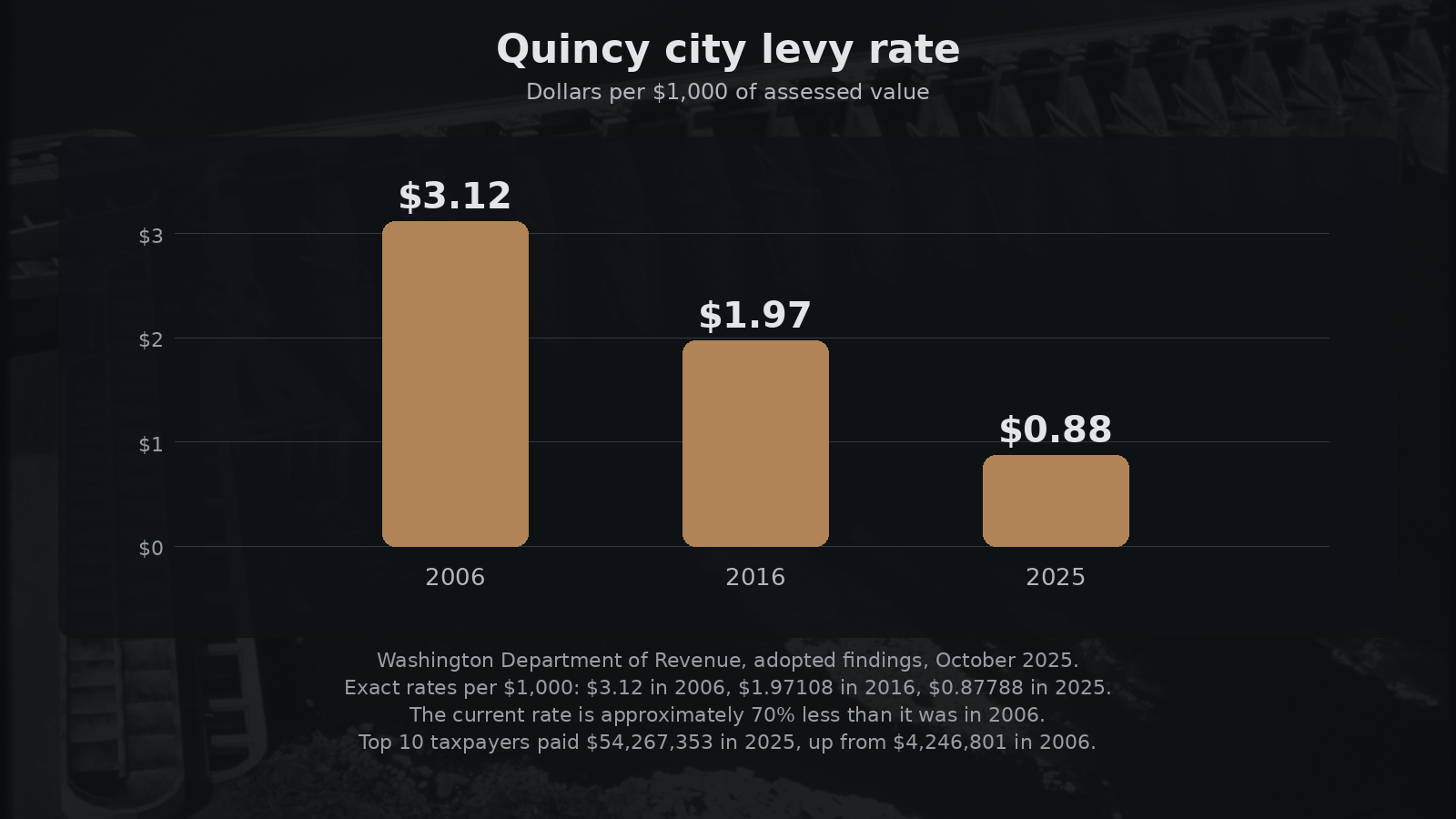
A typical Quincy homeowner, with a $336,800 home, paid about $296 in city property tax in 2025 instead of about $1,051 in 2006, nearly 72% less than before the data centers arrived. School, hospital, county, state and other property taxes are separate.
As a result of lower levy rates, the City of Quincy has been able to replace, upgrade, and/or newly construct important buildings and infrastructure in the city. In some cases, voter approval was secured to finance some of these projects, such as a bond to build a new high school.
KOMO News reports that voters approved a $108 million school bond in 2016. Superintendent Nik Bergman said data centers account for about 54% of the district's local tax base, and that the tax rate connected to the bond fell from about $1.96 per $1,000 of assessed value to less than 90 cents. The $55 million Quincy Valley Medical Center project won 64% voter support in 2022. CEO Glenda Bishop said what began as a proposed 30-year bond at 48 cents per $1,000 of assessed value was ultimately issued over 22 years, and that this year's rate is 34 cents per $1,000. The 54% figure is Bergman's description of the school district's local tax base. The Spokesman-Review, citing audit reports, says Quincy collected $9.8 million in tax revenue in 2018 and $20 million in 2024. Ybarra said data centers pay 57% of all the taxes collected in Quincy. The 57% figure is what Ybarra told the paper.
The schools and the hospital were paid for with voter-approved bonds. The larger assessed base is what made those bonds cheaper per $1,000.
Get the free Monday Haul for local power and tax numbers each week.
The Monday Haul · free weekly email
Energy, industry, infrastructure and policy in one short email every Monday, including new factories and grid projects. Every item sourced and dated. More about the Haul
Power: hydro first, then other resources
Priest Rapids and Wanapum dams have a combined generating capacity of more than 2,100 MW. Average annual generation is approximately 1,000 MW. Grant PUD holds physical rights to 63.31% of the dams' output. The same FAQ lists the Nine Canyon Wind Project, providing 12 MW of generating capacity, the Goose Prairie Solar Project in Moxee through a power purchase agreement for 85 MW, and market purchases, used when needed to help meet peak demand.
Grant PUD's Board of Commissioners has established a power-supply strategy that prioritizes residential, small business, and agricultural customers for access to the utility's lowest-cost power resources, which currently come primarily from the dams. Data centers and other large power users are served using available excess hydro generation along with Grant PUD's other power resources and market purchases as needed.
In 2006, the all-in residential rate was 4.12 cents per kilowatt-hour. In 2026, the all-in residential rate is 6.4 cents per kWh. This represents an increase of approximately 55% over twenty years. If Grant PUD's 2006 rate had simply increased with inflation (Consumer Price Index), it would be approximately 6.8 cents per kWh today. Washington state's average residential electric rate increased from 7.28 cents per kWh in 2006 to 14.95 cents per kWh in 2026, an increase of approximately 105%. The U.S. average residential rate increased from 10.40 cents per kWh to 18.44 cents per kWh, an increase of approximately 77%. By nearly every comparison, Grant PUD customers have continued to benefit from electricity rates that remain well below state and national averages.
For how home power prices are moving nationally, see why your power bill is rising, and what brings it down.
Under the same strategy, core customers continue to receive priority access to Grant PUD's lowest-cost power resources. Large power users, including data centers, are responsible for paying the costs of additional generation, transmission, and distribution infrastructure needed specifically to serve their loads. The FAQ says this strategy is intended to help ensure that costs associated with future large-load growth do not shift to residential customers.
Water reuse and quieter cooling
The Quincy Water Reuse Utility officially became operational on June 30, 2021. EPA's water reuse case study, updated July 6, 2026, lists a demand offset of 138 million gallons per year, an overall cost of $31 million, and industry process water (cooling water) as the source of water. Microsoft and the City of Quincy partnered to construct the utility, which treats cooling water from a Microsoft data center and recirculates it to the data center for the same purpose, reducing reliance on local potable groundwater. Because the utility is a closed-loop system, it does not discharge industrial wastewater with high mineral content to the environment. As of 2022, only Microsoft's data center campus was connected.
That 138 million gallons per year is the demand offset EPA lists for the reuse utility. The case study ties the connected load, as of 2022, to the Microsoft campus.
On a November 8, 2026 tour with NBC Montana, Montana Tech's Robert Morris said the facilities have gone from evaporative coolers that use utility supply or civil supply of water to air-cool chillers, which use no external water for cooling. City officials say data centers account for about 5% to 8% of Quincy's water use. The Spokesman-Review quotes interim City Administrator Greg Meinzer saying the data centers only use between 4% and 5% of the city's water. Those are two comments from city officials, given to two newsrooms.
Inside Sabey Data Centers' newest building, Morris noted that the air chillers were quiet during the visit. He also used a phone app to take a rough, uncalibrated sound reading near the campus. The app fluctuated between about 70 and 100 decibels.
A town can put the campuses on hydro, run the cooling water through a reuse plant, and still take a sound reading at the fence. The tour wrote down both.
What the clip gets right, and what to double-check
The public record lines up with the main claims in the November 9, 2026 clip. Grant PUD currently serves 8 data center operators. The City of Quincy's levy rate is approximately 70% less than it was in 2006. The new schools and the Quincy Valley Medical Center are on the state's project list, and KOMO reports the voter-approved bonds that paid for the school and the hospital. On the November 8 tour, Morris noted that the air chillers were quiet during the visit.
A few phrases belong at the scale the sources actually use. Eight, in the Grant PUD FAQ, is operators in Grant County. Ybarra's eight data centers sit on Quincy's perimeter, and NBC Montana counts eight campuses in Quincy. A campus can hold more than one building. The approximately 70% comparison is the city levy rate, from $3.12 per thousand in 2006 to $0.87788 per thousand in 2025. The school bond rate and the hospital district rate are the separate figures above. The schools and the hospital were paid for with voter-approved bonds. The larger assessed base is what made those bonds cheaper per $1,000. Quiet, on that tour, is a visitor's observation, set next to a phone-app reading of about 70 to 100 decibels.
What to watch next
Grant PUD currently has approximately 800 MW of large-load requests in its power application queue, the utility said in the August 28, 2026 FAQ. The transmission and electric-system upgrades that form part of the Quincy Transmission Expansion Plan (QTEP) are progressing simultaneously toward full completion by June 2029 at a total estimated cost of $260 million, commissioners heard on February 17, 2026. The projects will increase available transmission into the Quincy area from the current approximately 372 megawatts to approximately 750 megawatts. The findings also say that in the near future, Quincy will construct a Q Plex, a new indoor soccer facility.
The next Department of Revenue or county assessor top-taxpayer tables will show whether the 2025 list still holds. School district and hospital district rates will show up in the next budget books. Any campus that connects to the reuse utility after the Microsoft connection EPA described as of 2022 would change the water story.
Grant PUD's large-load requests are the local waiting list. The national line of projects waiting to connect is covered in Is 2,000 GW of new power about to hit the grid?
The Monday Haul follows these local power and tax numbers each week, with the rest of the buildout in energy, industry, and infrastructure. Follow the projects on the live dashboard. Past issues are in the archive.
Common questions
How many data centers are in Quincy, Washington?
Grant PUD currently serves 8 data center operators in Grant County. NBC Montana reports that eight data center campuses operate in Quincy. State Rep. Alex Ybarra attributes the city's growth to the eight data centers that sit just on the perimeter of Quincy. A campus can hold more than one building.
Do data centers lower property taxes in Quincy?
The City of Quincy's levy rate is approximately 70% less than it was in 2006. The Data Center Workgroup findings list $3.12 per thousand in 2006, $1.97108 per thousand in 2016, and $0.87788 per thousand in 2025. The new high school and the Quincy Valley Medical Center were paid for with voter-approved bonds on that larger assessed base. School and hospital district rates are their own figures.
Where does Grant PUD power for data centers come from?
Priest Rapids and Wanapum dams have a combined generating capacity of more than 2,100 MW, and average annual generation is approximately 1,000 MW. Grant PUD holds physical rights to 63.31% of the dams' output. Data centers and other large power users are served using available excess hydro generation along with Grant PUD's other power resources and market purchases as needed. Residential, small business, and agricultural customers have priority access to the lowest-cost power from the dams.
Does Quincy reuse data center cooling water?
Yes. The Quincy Water Reuse Utility officially became operational on June 30, 2021. EPA lists a demand offset of 138 million gallons per year and an overall cost of $31 million. The utility treats cooling water from a Microsoft data center and recirculates it, and EPA describes it as a closed-loop system. As of 2022, only Microsoft's campus was connected.
Sources
- Tax Revenue and Economic Development Subgroup Findings, Washington State Department of Revenue, Data Center Workgroup, adopted October 2025. Top 10 Grant County taxpayers: assessed value $312,977,310 in 2006, which represented $4,246,801 in tax paid; assessed value $6,136,727,665 in 2025, a 1,961% increase over 2006, which represented $54,267,353 in tax paid, an increase of 1,277% over 2006. "7 of the 10 highest assessed values and taxes paid are from data centers, and 6 of the 7 are located in Quincy." City of Quincy levy rate: $3.12 per thousand in 2006, $1.97108 per thousand in 2016, $0.87788 per thousand in 2025. "The current rate is approximately 70% less than it was in 2006." Project list includes new schools, a new high school, the Quincy Valley Medical Center, the reuse water system, and the note that voter approval was secured for some projects, such as a bond to build a new high school. Quincy population in the findings: approximately 8,500 people.
- Median value of owner-occupied housing units, 2020-2024, U.S. Census Bureau QuickFacts, Quincy city, Washington. The figure is $336,800, from the 2020-2024 American Community Survey 5-year estimates. The city levy example on this page holds that value constant and applies the Data Center Workgroup rates of $3.12 per $1,000 in 2006 and $0.87788 per $1,000 in 2025, which comes to about $1,051 and about $296. That is only the City of Quincy levy.
- Grant PUD and Data Centers: FAQs, Grant PUD, August 28, 2026. "Grant PUD currently serves 8 data center operators in Grant County." In 2025 those operators accounted for approximately 280 average megawatts of electrical load. Total average system load was approximately 757 average megawatts, so data centers represented about 37% of overall county load. Priest Rapids and Wanapum: combined generating capacity of more than 2,100 MW, average annual generation approximately 1,000 MW, Grant PUD holds physical rights to 63.31% of the dams' output. Nine Canyon Wind Project, 12 MW. Goose Prairie Solar, power purchase agreement for 85 MW. Data centers "are served using available excess hydro generation along with Grant PUD's other power resources and market purchases as needed." All-in residential rate 4.12 cents per kWh in 2006 and 6.4 cents per kWh in 2026. Approximately 800 MW of large-load requests in the power application queue.
- Commission recap, February 17, 2026, Grant PUD, published February 20, 2026. The Quincy Transmission Expansion Plan upgrades "are progressing simultaneously toward full completion by June 2029 at a total estimated cost of $260 million." The projects "will increase available transmission into the Quincy area from the current approximately 372 megawatts to approximately 750 megawatts."
- Water Reuse Case Study: Quincy, Washington, U.S. Environmental Protection Agency, updated July 6, 2026. Demand offset 138 million gallons per year. Operational since 2021. Officially became operational on June 30, 2021. Overall cost $31 million. Source of water: industry process water (cooling water). "Treats cooling water from a Microsoft data center and recirculates it to the data center for the same purpose, reducing reliance on local potable groundwater." "Because the QWRU is a closed-loop system..." As of 2022, only Microsoft's data center campus was connected.
- Quincy's Microsoft data center boom prompts new school, library, hospital, police station, KOMO News, Chris Daniels, September 10, 2026. The projects were paid for through voter-approved bonds. A $108 million bond voters approved in 2016. Superintendent Nik Bergman said data centers account for about 54% of the district's local tax base. The tax rate connected to the bond fell from about $1.96 per $1,000 to less than 90 cents. The new school opened in 2019. Quincy Valley Medical Center opened in May 2025. The $55 million hospital project won 64% voter support in 2022. CEO Glenda Bishop on the bond: a proposed 30-year bond at 48 cents per $1,000 was issued over 22 years, and this year's rate is 34 cents per $1,000.
- Where agriculture meets technology: Inside the small Washington town that became a data center hub, The Spokesman-Review, Julia Pentasuglio, July 26, 2026. Ybarra attributes growth "to the eight data centers that sit just on the perimeter" of Quincy. Quincy collected $9.8 million in tax revenue in 2018 and $20 million in 2024, audit reports show. "Data centers pay 57% of all the taxes collected in Quincy, Ybarra said." Operators named: Microsoft, Sabey, Vantage, H5 Data Centers, CyrusOne, NTT Data, and Oath. Greg Meinzer: the data centers only use between 4% and 5% of the city's water.
- Quincy data center tour offers lessons as Montana weighs development, NBC Montana, Laurel Staples, November 8, 2026. "Eight data center campuses operate in Quincy." Robert Morris: air-cool chillers "use no external water for cooling." City officials say data centers account for about 5% to 8% of Quincy's water use. Morris noted that the air chillers were quiet during the visit. A phone app took a rough, uncalibrated sound reading near the campus and fluctuated between about 70 and 100 decibels.
- Innovation Council post, November 9, 2026. The clip this page checks: eight campuses, schools, a hospital, and infrastructure, property tax rates about 70% lower, and quiet cooling.
- The spillway at Priest Rapids Dam, photo by David Falconer, June 1973, U.S. National Archives and Records Administration. Public domain, via Wikimedia Commons. The chart background is the same photograph, darkened.
