How much infrastructure would AI need if half the world used it?
One AI campus in Memphis, Tennessee, went from cleared land to about 950 megawatts in a year and a half. Here is what it would take to serve 4 billion people, from chips to power lines to water.
Updated November 21, 2026 · Numbers as published by each source on the date shown · Model figures are our rough estimates
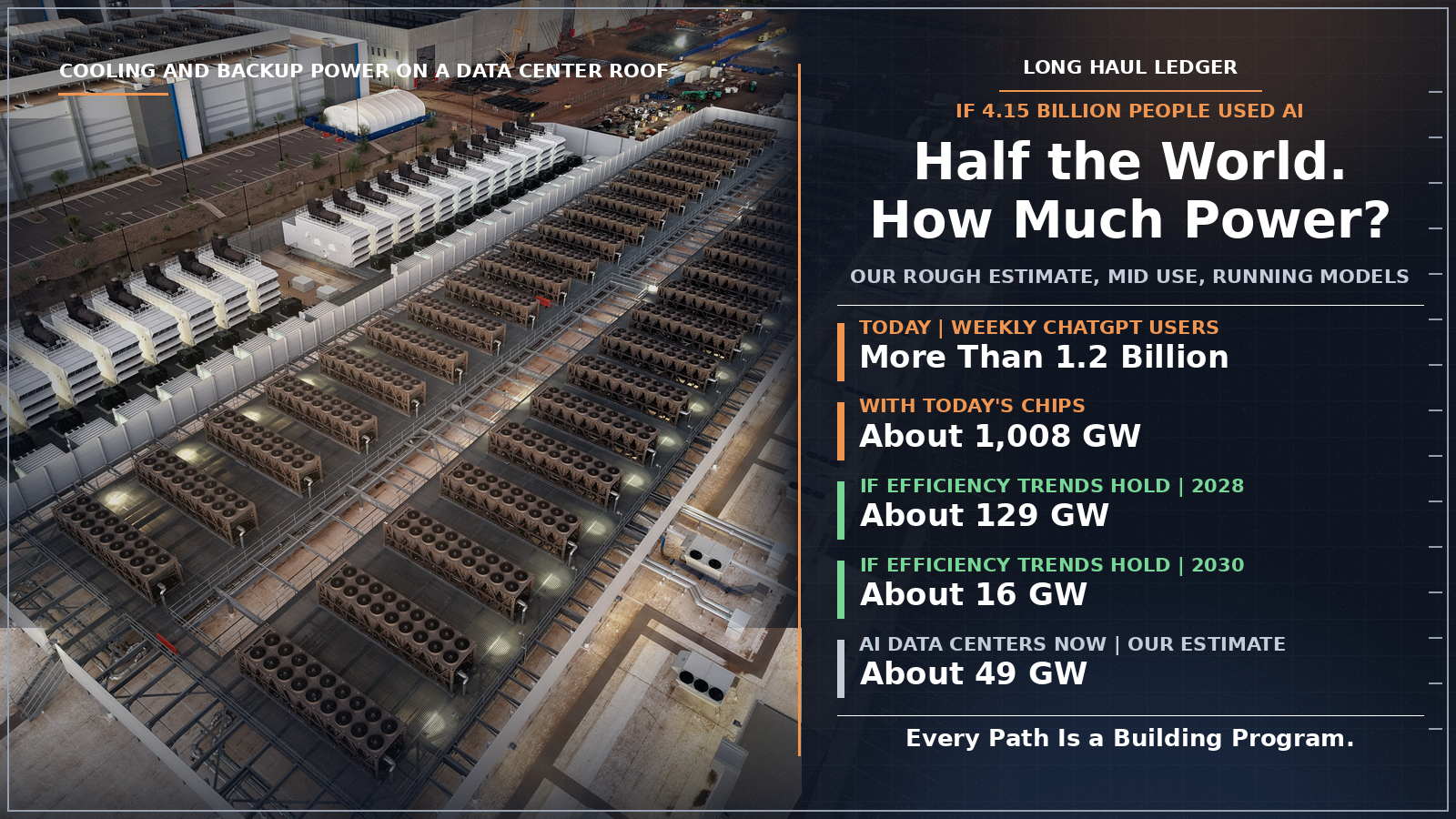
A lot today, and far less as chips and software improve. OpenAI says more than 1.2 billion people use ChatGPT each week, about 14% of the world. Our rough estimate, not a forecast, puts half the world (4.15 billion people) at about 1,000 GW at mid-level personal use with today's technology, roughly 20 times the AI data centers running now. If efficiency keeps improving at published rates, that falls to about 130 GW by 2028 and about 16 GW by 2030.
Every path is a building program.
Photo: Rsparks3, November 23, 2025, CC0, via Wikimedia Commons. Cooling units and backup generators on a data center roof. Location not given by the photographer. Figures: OpenAI; our rough estimate from Epoch AI, aiadoption.org and UN data.
Every path on this page is a building program. Even the most efficient one needs new chip plants, power plants, transformer factories and power lines, and America is already building all four.
How many people use AI today
OpenAI said on October 21, 2026 that "More than 1.2 billion people use ChatGPT each week." The United Nations projects 8.30 billion people on Earth in mid 2026, so that is about 14.5%, roughly 1 in 7. Weekly users are not exactly the same as people, since some use more than one account, and this count leaves out every other AI app.
Most of them don't pay. On February 27, 2026, OpenAI said it had "more than 50 million consumer subscribers" and "More than 9 million paying business users." That was its last official count of paying users.
What a gigawatt of AI looks like
Colossus 2, an AI supercomputer campus on Tulane Road in Memphis, Tennessee, shows how fast one site can go. Epoch AI, which tracks the world's big AI data centers, says land clearing started in February 2025, and a year and a half later there was enough infrastructure, including on-site power and cooling, to support about 950 megawatts of computers.
How much AI is running worldwide? No one publishes one official number, so we built an estimate. Epoch AI estimates about 31.6 million top-end AI chips (counted as Nvidia H100 equivalents) had been delivered by September 2026. aiadoption.org, using Stanford's AI Index method on Epoch's data, puts AI data center capacity at about 39.4 GW in early 2026, which works out to about 1.56 kilowatts per chip once cooling and the rest of the building are counted. Multiply the two and you get about 49 GW, our estimate of the AI data centers running now. That covers training new models and every other AI job, not just people chatting. For scale, the International Energy Agency puts all data centers worldwide, AI and everything else, at about 120 GW.
A gigawatt figure here means the power a site can draw, not what it uses every hour. For what a gigawatt data center headline really measures, see what a 1-gigawatt data center really means.
Our rough math for half the world
Our rough estimate, not a forecast. It counts only running the models (what engineers call inference), not training them, and not images, video or voice. All of those would push the numbers up.
Half the world is about 4.15 billion people. We looked at two levels of personal use.
Mid use assumes about 2 million tokens per person per day on a model with 1 trillion active parameters. That is well above today's average use. A token is a small chunk of text a model reads or writes, and the 2 million is a mix: most people at a few hundred thousand tokens a day, plus one in ten heavy users at about 20 million. With today's chips running at a realistic 15% of their peak speed, that takes about 243 GW for every billion people.
Heavy use is ten times the tokens on the same model, about 20 million per person per day. That is people building apps for their business or running deep research, close to what Google says its own engineers' tools use today, more than 3 trillion tokens a day across the company. It does not mean fleets of agents running all day. That takes about 2,430 GW for every billion people.
Half the world (4.15 billion people), running models only. Our rough estimate.
Mid use
Heavy use
Today's chips and software
About 1,008 GW20.6x today's 49 GW
About 10,084 GW206x
Around 2028, if trends hold
About 129 GW2.6x
About 1,286 GW26x
Around 2030, if trends hold
About 16 GWAbout a third of today
About 164 GW3.3x
How big is that? Ember says the whole world used 31,779 terawatt-hours of electricity in 2025, an average of about 3,630 GW. Mid use with today's chips would be about 28% of that, and heavy use would be about 2.8 times all the electricity the world uses. The EIA says the United States "generated 4.43 thousand terawatthours" in 2025, an average of about 506 GW (see megawatts versus megawatt-hours).
Chips and software keep getting better
Epoch AI found that "Leading ML hardware becomes 40% more energy-efficient each year," a trend going back years. We also assumed software and models get twice as efficient each year, which is our own guess and on the slow side. Google says the energy used by its median Gemini text prompt "dropped by 33x" over 12 months to May 2025, a drop that mixes better chips, better software and fuller machines.
Year
Chips1.4x a year
Software2x a year
Total
2028
1.96x
4x
about 7.8x
2030
3.84x
16x
about 61.5x
Divide today's row by those totals and you get the 2028 and 2030 rows.
There's a catch. Every time AI got cheaper, people used far more of it. Google's monthly token count "jumped 7x" in a year, to over 3.2 quadrillion, Sundar Pichai said on May 19, 2026. Better chips shrink what each person needs, while more people using AI more often grows the total.
Get the free Monday Haul to follow the chips, power plants and lines being built for AI, every week.
The Monday Haul · free weekly email
Energy, industry, infrastructure and policy in one short email every Monday, including new factories and grid projects. Every item sourced and dated. More about the Haul
What has to be built
Chips. In Bernstein's breakdown of a gigawatt of AI data center, the AI chips alone are 39% of the cost, the biggest single item. The most advanced chips are mostly made in Taiwan today, and new plants are going up in the US (see whether leading-edge chips are being made on US soil).
Data centers. Bernstein puts the full cost of a gigawatt, chips and building together, at about $35 billion. Nvidia chief executive Jensen Huang said on the company's August 2026 earnings call that "Each gigawatt of data center increased from say $30 billion about five years ago to now $60 billion today."
Power plants. GE Vernova, the biggest US maker of gas turbines, said in April 2026 its lead time was "about three years," and in July that it expects to be "mostly sold out through '30." The IEA counts about 180 GW of gas plants planned in the US to power data centers directly, and expects most of them not to come online until the 2030s because of the turbine backlog.
Power lines and transformers. The US built 888 miles of new high-voltage line in 2024, per FERC data compiled by Grid Strategies (see why a big power line takes 15+ years). Waits for the big transformers that power plants need passed 160 weeks by early 2026 (see the transformer shortage). The IEA says the world would need 26 million kilometers of new lines by 2035 under its main scenario.
Cooling and water. Data centers use water in two places: at the buildings, mostly for cooling, and at the power plants that make their electricity.
On site, Berkeley Lab estimates US data centers used about 66 billion liters in 2023, about 17 billion gallons (1 gallon = 3.785 liters). The lab says "Hyperscale data centers in 2028 are expected to consume between 60 and 124 billion liters." That range runs from roughly flat with the 2023 total for all US data centers to about double. The 2028 figures are for hyperscale data centers only.
Most of the water is at the power plants. The lab puts the "indirect water footprint of U.S. data centers" at "nearly 800 billion liters" in 2023, about 12 times the water used at the buildings.
For scale, 66 billion liters is about 17 days of New York City's water use in 2024, when average demand was 1,002 million gallons a day. It is also about 12 days of the water US golf facilities used in 2024 (about 1.63 million acre-feet, and an acre-foot is 325,851 gallons) and about four hours of US crop irrigation withdrawals in 2020, which the USGS puts at 110,904 million gallons a day in the lower 48 states.
Google says its median Gemini Apps text prompt uses 0.26 milliliters, "about five drops." That figure is for one typical text prompt and counts only the water used at the data center, based on Google's 2024 fleetwide water usage effectiveness. Power plants, training, and image or video prompts are counted separately.
What it would cost, and how long
Our arithmetic, using $35 billion to $60 billion per gigawatt for the data center and the chips inside it: mid use around 2028, about 129 GW, would cost about $4.5 trillion to $7.7 trillion. Mid use around 2030, about 16 GW, would be about $0.6 trillion to $1 trillion. Heavy use around 2030, about 164 GW, would be about $5.7 trillion to $9.8 trillion. None of that counts the power plants and lines outside the fence. For scale, the IEA expects about $4 trillion more in data center spending worldwide by 2030.
The timeline depends on the slowest piece. One campus went from dirt to about 950 megawatts in about 18 months. Gas turbines take about three years to arrive, big transformers more than three, and a long power line can take more than a decade from first plans to power flowing. Building faster means working on all of them at once.
Where people land
Four camps in the debate over how much to build for AI. Each camp gets the same space. This is not a poll, and the segments are not shares of support.
The question
How much should we build for AI?
Where they agree Every camp expects AI use to keep growing, and none of them says to stop building power. They also agree the slowest piece, whether turbines, transformers, lines or local approval, sets the pace.
Build it all, and fast
Use is climbing faster than anyone planned, they say, and running short on computing power means choosing which good things AI gets to do. Build the chips, the power and the data centers at factory speed, here at home. OpenAI's Sam Altman wrote: "Our vision is simple: we want to create a factory that can produce a gigawatt of new AI infrastructure every week."
What they get right More than 1.2 billion people use ChatGPT each week, and Google's monthly token count jumped about 7 times in a year.
Every year the same answer takes less energy, they say. Better chips, smaller and smarter models and fuller machines mean today's scary numbers overstate tomorrow's needs. Google's Amin Vahdat and Jeff Dean wrote that "our AI systems are becoming more efficient through research innovations and software and hardware efficiency improvements."
What they get right Leading AI chips have been getting about 40% more energy efficient every year, and Google says the energy of its median Gemini text prompt dropped 33 times in 12 months.
A data center can rise in 18 months, they say, but turbines, transformers and power lines take years. Plan the wires and the power plants first, or the buildings sit waiting. GE Vernova's Scott Strazik put it this way: "in many of the cases with these projects, the gas turbines are really not the gating item," pointing to construction, permitting and fuel supply.
What they get right Gas turbine lead times are about three years, and the IEA expects most of the gas plants planned for US data centers to come online only in the 2030s.
Build, they say, but make the big new loads pay for the wires and plants they need, and count the water and land in the towns that host them. Sen. Shelley Moore Capito said a bill she backs "will make potential data centers pay their own way instead of American consumers facing increased costs through rising utility bills."
What they get right Berkeley Lab estimates US data centers directly used about 66 billion liters of water in 2023, with hyperscale sites alone expected at 60 to 124 billion liters in 2028.
The building has already started One campus in Memphis went from cleared land to about 950 megawatts in a year and a half. GE Vernova is adding turbine output toward 30 gigawatts a year by 2030, and new transformer plants are rising in Virginia, North Carolina and South Carolina. However much AI the world ends up using, crews are already at work on it.
What to watch next
OpenAI's next official count of paying subscribers, since the last one was in February. Epoch AI's next update to its count of AI chips. GE Vernova's fourth-quarter results in January, for how many turbine slots are left for 2031 and 2032. Wood Mackenzie's transformer lead-time surveys. Berkeley Lab's next report on US data center energy and water. The Monday Haul follows these each week, and the live dashboard tracks the big projects.
Common questions
How much power does AI use today?
No one publishes a single official number. Our estimate is about 49 GW, built from Epoch AI's count of about 31.6 million AI chips delivered by September 2026. aiadoption.org puts global AI data center capacity at about 39.4 GW in early 2026, and the International Energy Agency puts all data centers worldwide, AI and everything else, at about 120 GW.
How many people use ChatGPT?
OpenAI said on October 21, 2026 that more than 1.2 billion people use ChatGPT each week. In February 2026 it said it had more than 50 million consumer subscribers and more than 9 million paying business users.
Would AI really need 1,000 GW?
Only on our rough math, with half the world at mid-level use and today's chips and software. If chips keep getting about 40% more efficient a year and software twice as efficient a year, the same use would need about 129 GW around 2028 and about 16 GW around 2030. Heavier use, or training new models, would push it up.
How much water do data centers use?
Berkeley Lab estimates US data centers directly used about 66 billion liters of water in 2023, about 17 billion gallons, and expects hyperscale data centers alone to use 60 to 124 billion liters in 2028. The power plants that serve them use far more, nearly 800 billion liters in 2023 by the lab's estimate.
Sources
Every source this page uses, grouped by section. Quotes are word for word from the source named. Model figures marked as our estimate are our own arithmetic on these sources.
We're scaling our AI Data Centers research, Epoch AI, 2026. 20.3 million H100 equivalents at the end of 2025, extrapolated to 31.6 million by September 2026; Colossus 2 timeline.
Measuring the environmental impact of AI inference, Amin Vahdat and Jeff Dean, Google Cloud, August 21, 2025, and the accompanying paper, Measuring the environmental impact of delivering AI at Google Scale. 33 times less energy per median prompt in 12 months; 0.26 milliliters of water per median Gemini Apps text prompt, from Google's 2024 fleetwide water usage effectiveness (on-site data center water). Google notes the figures were not verified by an independent third party.
2024 United States Data Center Energy Usage Report, Lawrence Berkeley National Laboratory, December 2024. Direct water, 66 billion liters in 2023; hyperscale data centers in 2028, 60 to 124 billion liters; "indirect water footprint of U.S. data centers" of "nearly 800 billion liters."
2025 Water Use and Conservation on U.S. Golf Courses, Golf Course Environmental Profile, Phase IV, Volume I, Golf Course Superintendents Association of America, 2025. About 1.63 million acre-feet used by US golf facilities in 2024; an acre-foot is 325,851 gallons.
Irrigation Water Use, U.S. Geological Survey, accessed November 21, 2026. Crop irrigation withdrawals of about 110,904 million gallons a day in 2020 across the lower 48 states, from Martin et al., 2025, and Haynes et al., 2023.
Capito floor remarks, Senate Environment and Public Works Committee, November 9, 2026.
Photo
Data center roof, photograph by Rsparks3, November 23, 2025, CC0, via Wikimedia Commons. Location not given. Toned, cropped and overlaid with text for this page.