When Big Tech says it will spend hundreds of billions, where does the money actually go?
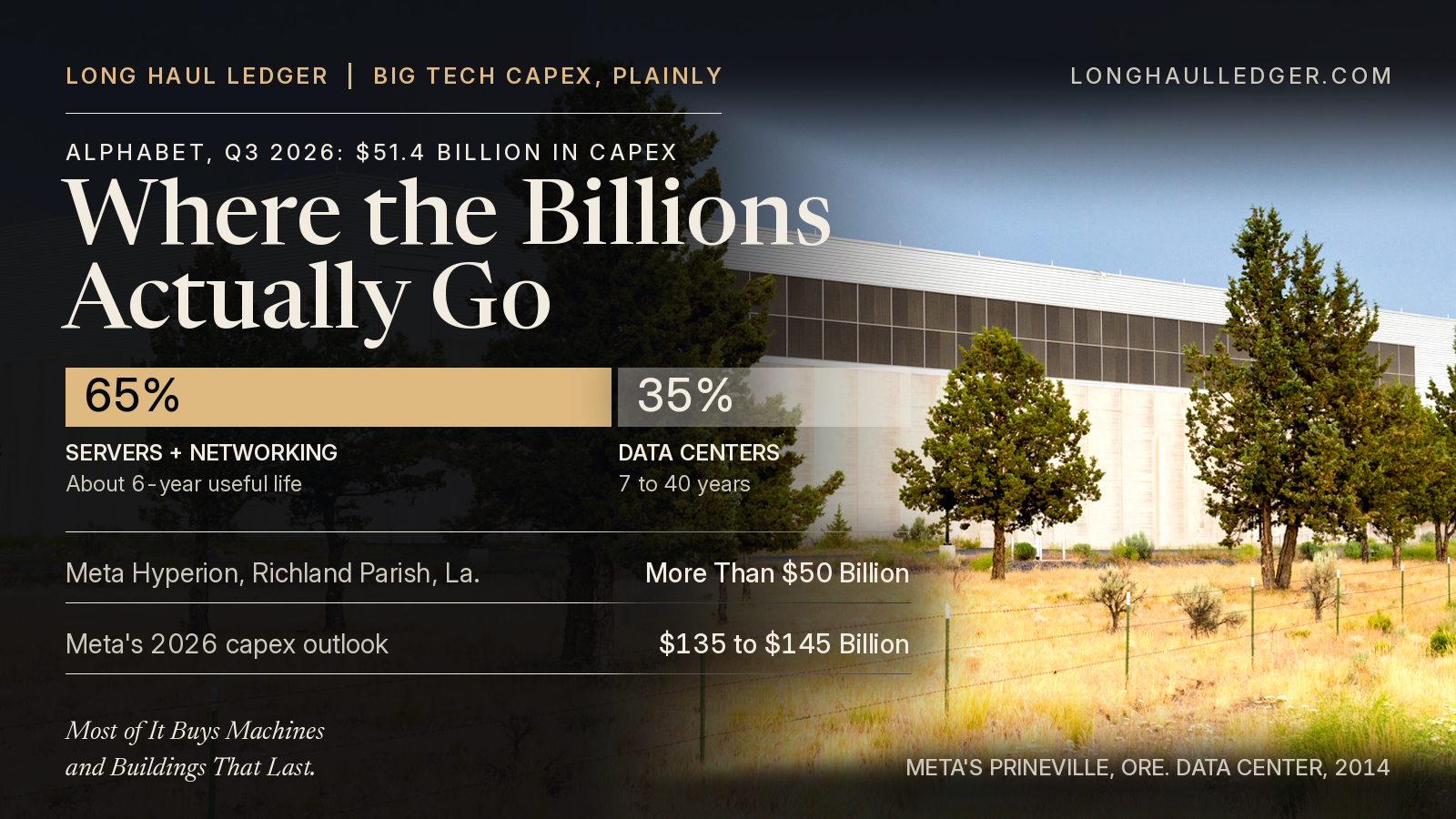
Alphabet spent $51.4 billion on capex in one quarter, about 65% on servers and networking and 35% on data centers. Here's what that money buys, and why it is not one year's expense.
Updated November 27, 2026 · Numbers as published by each source on the date shown
Most of it buys servers, networking gear and the buildings that house them, which are written down over years instead of counted as one year's cost. Alphabet's third-quarter 2026 capex was $51.4 billion, about 65% servers and networking, 35% data centers. Meta says it is investing more than $50 billion in the Richland Parish, Louisiana, region around its Hyperion campus.
Most of it buys machines and buildings that last.
Photo: Gary Halvorson, Oregon State Archives, July 8, 2014, CC BY 4.0, via Wikimedia Commons. Meta's (then Facebook) data center west of Prineville, Oregon. Not the Hyperion campus in Louisiana. Figures: Alphabet's third quarter 2026 earnings call and Meta. The 65/35 split is Alphabet's, for one quarter.
That money is already pouring into steel, chips, power plants, roads and paychecks in places like northeast Louisiana, and the campuses it builds will run for decades.
Hyperion is rising in Richland Parish
Meta's campus sits on a former farm megasite between Rayville and Delhi, near Holly Ridge, in Richland Parish in northeast Louisiana. It broke ground in December 2024. On July 13, 2026, Meta said it was expanding the campus to 5 gigawatts of compute, “the largest in Meta's fleet,” housing Hyperion, “our largest multi-gigawatt AI training cluster,” with an investment of “more than $50 billion in the Richland Parish region.” That figure counts related spending in the region, not one building. (For what a gigawatt figure means for a data center, see what a 1-gigawatt data center really means.)
Jobs. Over 7,500 at peak construction and 1,000 once the campus is running, Meta says. (For how on-site jobs compare with wider county gains, see data center local jobs.)
Local spending. More than $1.6 billion contracted with Louisiana businesses, and more than $1 billion for roads, water and wastewater.
Training. $5 million to Louisiana Delta Community College, the largest gift in the college's history, with full scholarships for Richland Parish high school graduates in data center trades.
Timeline. The full two-phase build-out is not expected to be complete until 2036, WWNO reported, citing officials at the announcement.
Capital expenditure, or capex, buys things that last years, like buildings, servers and equipment. They go on the company's books as assets, and the cost shows up later as depreciation, a little each year over the asset's useful life. Operating expense is the cost of running the business in a given period: salaries, electricity, repairs.
Meta reported on October 21, 2026 that “Capital expenditures, including principal payments on finance leases, were $34.91 billion” in the third quarter, and it expects full-year 2026 capex, including those lease payments, “to be in the range of $135-145 billion.” That is cash going out to buy assets, not a $135 billion hit to 2026 profit. Meta also reported free cash flow of negative $2.12 billion for the quarter. Free cash flow is cash from operations minus purchases of property and equipment and lease principal, so the negative number shows the spending is real cash going out the door.
Where a dollar of Big Tech capex actually goes
Alphabet CFO Anat Ashkenazi gave the clearest breakdown on the company's October 28, 2026 earnings call: “CapEx was $51.4 billion in the third quarter with the vast majority of the spend in technical infrastructure to support our investments in AI. Approximately 65% of our investments in technical infrastructure in Q3 was related to servers and networking equipment, which generally have useful lives of six years. The remaining 35% was for data centers, which have useful lives of seven to 40 years.”
So most of the money that quarter bought machines that last about six years, and the rest bought buildings and plant that last much longer. Alphabet kept its full-year 2026 capex guidance at $195 billion to $205 billion. Each company reports its own numbers, and no primary source adds them into one Big Tech total, so this page does not either.
The money also buys power, water and roads
A campus this size is not just a building. Meta says its agreement with Entergy Louisiana “will fund seven new natural gas-fueled generating plants, three grid-scale batteries, nuclear uprates, and other purchased power,” and that it is “expected to deliver approximately $2 billion in customer savings to Entergy Louisiana customers, on top of the $650 million we previously announced.” Gov. Jeff Landry put the savings at about $2.6 billion over 20 years at the announcement, WWNO reported. Those savings figures are Meta's and the governor's; consumer advocates dispute them, as the camps below show.
On water, Delhi Mayor Jesse Washington said Meta will pay for water system upgrades and a new treatment plant, and “Rate payers will not be affected,” KNOE reported. Meta also says it will match 100% of the campus's energy use with clean and renewable energy. (For what is driving home power bills nationally, see power bills and data centers.)
Get the free Monday Haul, which follows Hyperion and other big campus builds each week.
The Monday Haul · free weekly email
Energy, industry, infrastructure and policy in one short email every Monday, including new factories and grid projects. Every item sourced and dated. More about the Haul
Where people land
4 camps in the debate over Big Tech's data center spending. Each camp gets the same space. This is not a poll, and the segments are not shares of support.
The question
Is spending on this scale the right way to build?
Where they agree The money is going into real things you can see: buildings, servers, power plants, roads and water systems in Richland Parish, with thousands of people already at work on the site. The fight is over who should pay, how fast the gear will wear out, and what the state is giving up in tax breaks.
Build it and win
The companies that put this money into campuses, chips and power now will run the next wave of computing, they say, and states that land the campuses get the construction jobs, the training pipelines and a shot at being a long-term computing hub. Meta CEO Mark Zuckerberg said: “Our investments are paying off, the core business is strong, and we're seeing velocity across the board.” Gov. Jeff Landry said Louisiana “is now going to lead America's AI future.”
What they get right The Richland Parish site is already hiring, training and buying local, with more than $1.6 billion contracted to Louisiana businesses and 7,500 construction jobs planned at the peak, Meta says.
A headline budget of hundreds of billions is cash used to buy machines and buildings that last years, they say, so judging it as if it were one year's operating cost misses how the spending actually works. Alphabet CFO Anat Ashkenazi laid out the useful lives on the October 28 call: servers and networking equipment “generally have useful lives of six years,” and data centers “have useful lives of seven to 40 years.”
What they get right Alphabet said about 65% of its third-quarter technical infrastructure investment was servers and networking and 35% was data centers.
If a single customer needs new gas plants and high-voltage lines, they say, that customer should pay for them for as long as the plants run, so families on the same utility are not left holding the bag if costs rise or the company ever leaves. Logan Burke of the Alliance for Affordable Energy said of a cost increase at one of the new plants: “On the one hand, you hate to be right,” and “On the other hand, this raised some major alarm bells for us.” Burke also said Meta agreed to pay more during its 15-year contract, but the plants will run longer.
What they get right Entergy's Waterford 5 gas plant, one of the plants being built to serve the campus, is now projected at $1.755 billion, $676 million (63%) above the original $1.079 billion estimate, according to Entergy's quarterly report to the Louisiana Public Service Commission as reported by WWNO.
If the servers are replaced faster than the books assume, or if the revenue from them falls short, companies could have to write down huge investments, they say, so the useful life and the payback deserve as much attention as the headline budget. Gartner's Will Sommer said: “However, our research indicates that enterprise and consumer AI revenue will be insufficient to support profitable returns on all planned AI capital expenditures during this period.” Gartner also said hyperscalers “have massive and highly diversified revenue sources that could plausibly sustain AI investments for years.”
What they get right The spending is running ahead of the cash coming in for now: Meta's third-quarter free cash flow was negative $2.12 billion, and Alphabet publishes the six-year server life its books assume. Gartner's forecast says more than $3.5 trillion of AI infrastructure spending could be exposed to write-downs by the end of 2030 if the current pace continues.
The campus is going up On a former farm in Richland Parish, the largest campus in Meta's fleet is already going up, with thousands of people on the job and a 2036 finish line for the full build-out.
What to watch next
Entergy plans to ask the Louisiana Public Service Commission in December 2026 to approve seven more gas plants and new power lines, WWNO reported. The next Waterford 5 cost update, and who pays for any overruns. The November 9 lawsuit over the commission's fast-track “Lightning Directive.” Meta's next earnings, when 2027 capex guidance may arrive. Construction progress toward the first buildings; Meta has not published an opening date for the full 5-gigawatt campus. The Monday Haul follows these each week, and what a small town gets from hosting data centers tells a related town story.
Common questions
Is a $50 billion data center an expense this year?
No. Money spent on buildings, servers and equipment is capital spending. It goes on the books as assets and is written down as depreciation over each asset's useful life, about six years for servers and seven to 40 years for data center buildings at Alphabet. Meta's more than $50 billion for Richland Parish counts related spending in the region over a build-out expected to run to 2036.
What is capex?
Capex, short for capital expenditure, is money spent on things that last years, like buildings, machines and servers. Operating expense is the cost of running the business in a period, like salaries and electricity. Meta expects 2026 capex, including finance lease payments, of $135 billion to $145 billion.
How much of the money is spent on servers versus buildings?
Alphabet said about 65% of its third-quarter 2026 technical infrastructure investment went to servers and networking equipment and 35% to data centers. Other companies split their spending differently, and the split changes from quarter to quarter.
Who pays for the power plants that serve Hyperion?
Meta's agreement with Entergy Louisiana funds seven new gas plants, three grid-scale batteries and other power, and Meta says it will save Entergy customers about $2 billion on top of $650 million announced earlier. Consumer advocates say families could still pay for the plants after Meta's 15-year contract ends, and one plant, Waterford 5, is projected at $1.755 billion, 63% above its first estimate, WWNO reported.
Sources
Spending
2026 Q3 Earnings Call transcript, Alphabet, October 28, 2026. CFO Anat Ashkenazi: $51.4 billion capex; 65% servers and networking, six-year lives; 35% data centers, seven to 40 years; full-year guidance $195 billion to $205 billion.
Meta Reports Third Quarter 2026 Results, Meta, October 21, 2026. Capex including finance lease principal $34.91 billion; full-year outlook $135 billion to $145 billion; free cash flow negative $2.12 billion; Zuckerberg quote.
Google Data Center, The Dalles, Oregon, Tony Webster, May 17, 2015, via Wikimedia Commons, CC BY 2.0. A Google campus in The Dalles, Oregon, not the Hyperion campus in Louisiana. Used on the page's share card.