At Starbase, near Brownsville in Cameron County, South Texas, SpaceX's supercompute campus went from graded dirt in early September to standing buildings by late November. Here is what made it fast, what it means for the town, the grid and the air, and whether others can copy it.
Updated November 27, 2026 · Numbers as published by each source on the date shown
Cut out the waits that slow most builds. Near Brownsville, Texas, SpaceX built on its own land outside the city, is building its own power plant instead of waiting for a grid hookup, and got its gas plant approved through Texas's pre-written standard permit, which needs no public hearing, with nitrogen oxides capped at 248.86 tons a year, 1.14 tons under the line for a full review. Aerial photos show grading on September 3 and buildings by November 25.
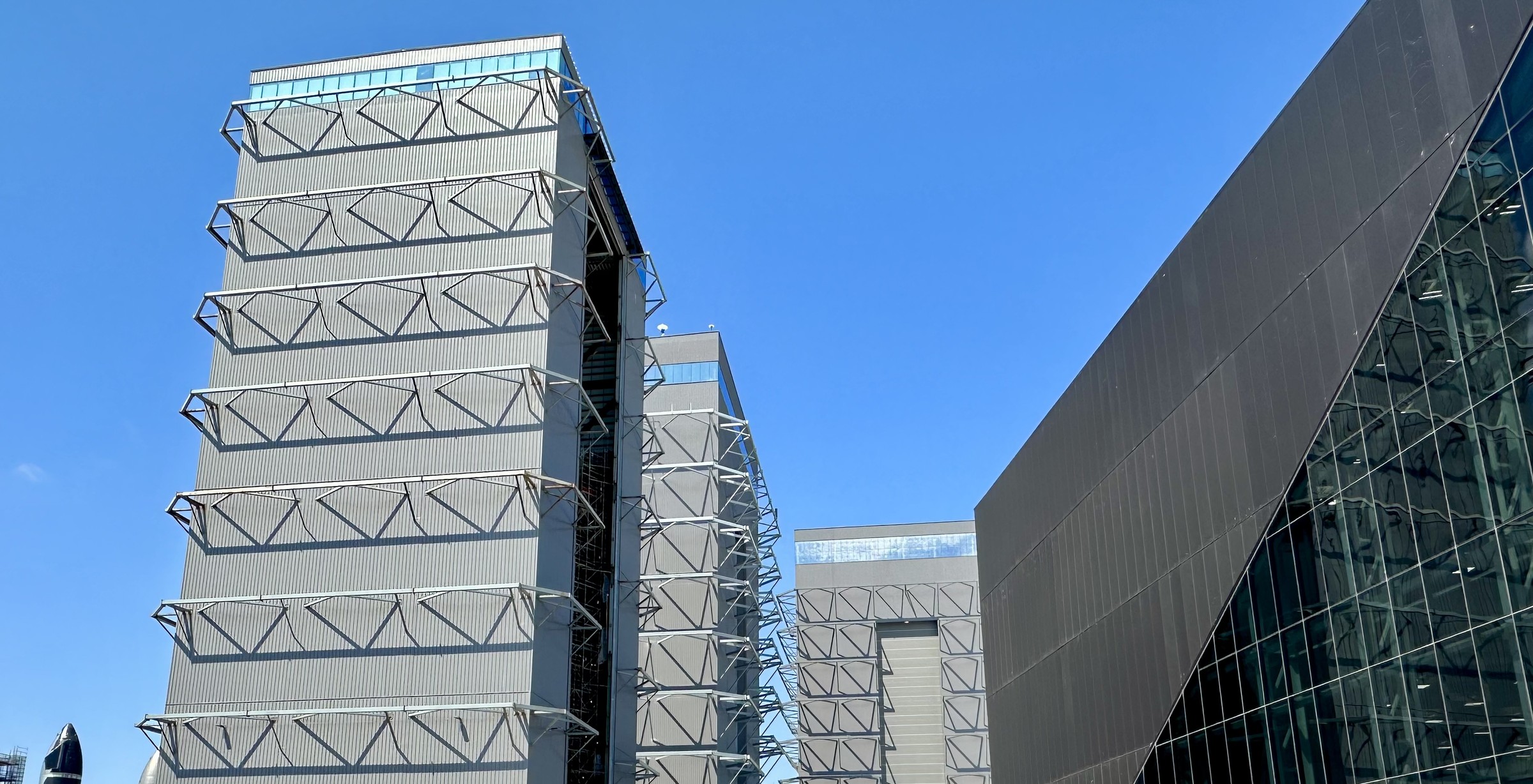
Photo: Steve Jurvetson, October 13, 2024, CC BY 2.0, via Wikimedia Commons. The Starbase production site, with the Megabay at the back and the million-square-foot manufacturing building to the right. This photo shows the rocket factory, not the data center campus about 13 miles west.
The hard part of building big in America is usually the waiting, and Starbase shows how much of it can be cut. The popular “90 days” line is a rounding. The dated aerial photos that set off the attention are 83 days apart, from grading on September 3 to standing buildings on November 25. SpaceX has not published a start date. The open question is how to keep the speed while sharing the gains with the town next door. Follow the build.
Dirt to buildings in 83 days
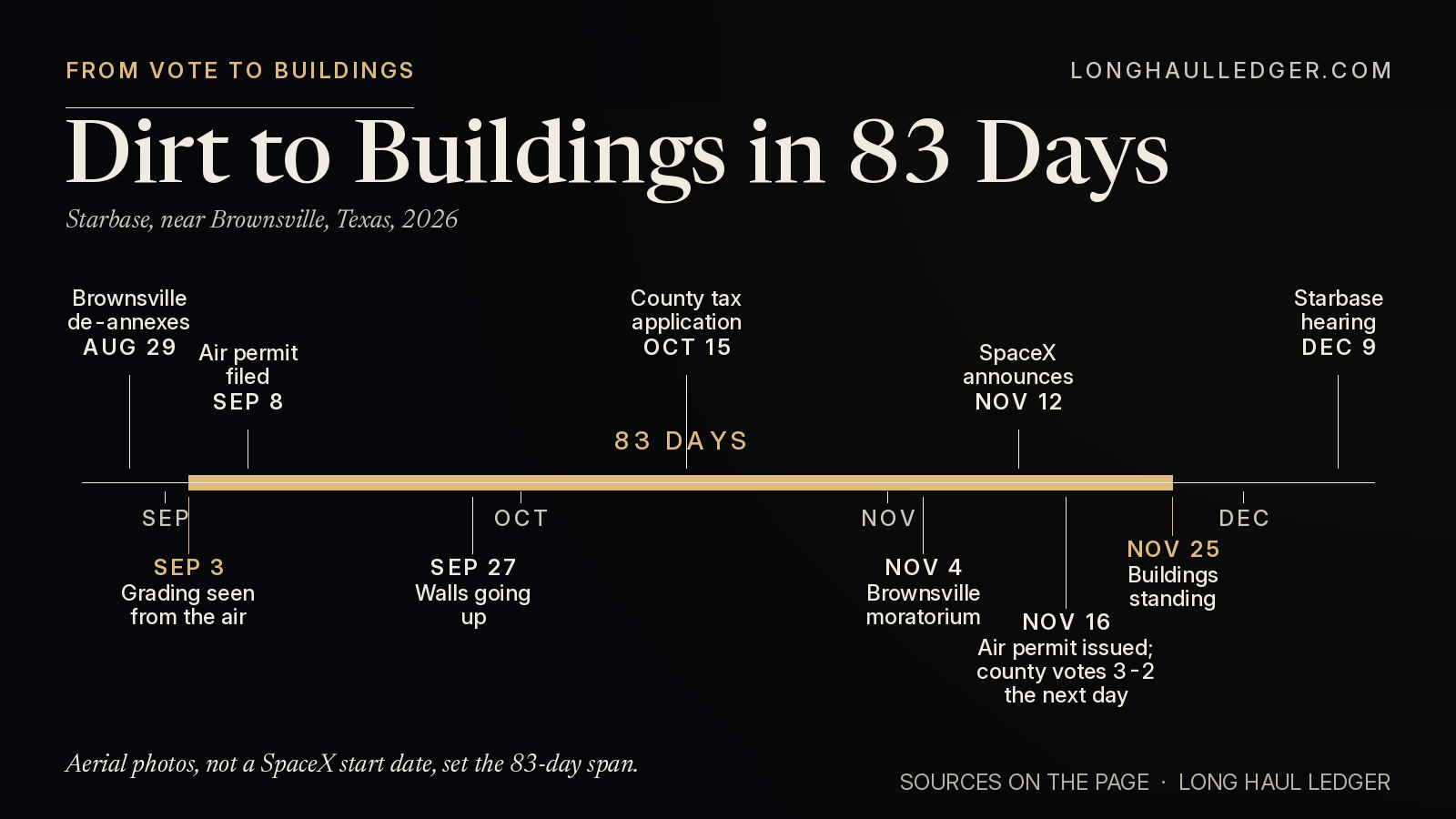
RGV Aerial Photography, a local drone photographer, posted an “Aerial view of the grading work happening near highway 4 and Brownsville port access road” on September 3, 2026. On September 14 the same account reported that “51 foundation footings were spotted” a few days earlier. On September 27 it wrote, “walls are going up already!” On November 25 it posted “The 444 site today,” with buildings standing on the tract. September 3 to November 25 is 83 days.
Those buildings are a start, not a finished campus. SpaceX's application to Cameron County, filed October 15 and revised November 9, said the company had “started initial construction” and put completion in the second quarter of 2027, the Brownsville Herald reported.
From Brownsville's August 29 de-annexation vote to the December 9 Starbase hearing. The amber span marks the 83 days between the September 3 and November 25 aerial photos. Sources: RGV Aerial Photography posts; City of Starbase notice, November 6, 2026; SpaceX, November 12, 2026; the Brownsville Herald, November 17 and 18, 2026; Public Citizen, November 18, 2026; Texas Commission on Environmental Quality authorization letter, November 16, 2026.
Why most builds take years
The usual waits are land and zoning, a hookup to the public grid, and permits. In Texas, Governor Greg Abbott in August “directed operators of the electric grid” to “pause requests for data center connections,” the Texas Tribune reported on November 10, 2026. The same story noted that “not all data centers rely on the state's power grid.” Making power on site is one way around the line, and big power lines and reviews are often what stretch a project out. For what a number like 750 megawatts means in this industry, see what a one-gigawatt campus is.
Shortcut 1: land the company controls
On Saturday, August 29, 2026, the Brownsville City Commission voted unanimously, at a special meeting that lasted six hours, to de-annex the tract after SpaceX offered up to $220 million for water and wastewater projects. The offer was good only that day. Mayor John Cowen Jr. told the meeting, “It is rushed. There's no doubt.” He also said, “this is a take it or leave it deal.”
Sheila McCorkle, SpaceX's vice president for Starship legal and regulatory issues, told commissioners the company sought de-annexation because the city was not providing services to the area, and that those services could be brought online through the city of Starbase faster and more economically, the Tribune reported. Starbase later annexed the tract; the city has not published a date for that annexation in the records reviewed for this page.
Brownsville later approved a 90-day moratorium on data centers, which Public Citizen says passed on November 4. The Tribune wrote on November 10 that the moratorium had gone into effect the week before, and that “Had the 444.45-acre tract of land remained within Brownsville's city limits, the SpaceX project likely would have had to find a different location.” The city said it stands by the decision, based on “information and circumstances presented at the time.”
Shortcut 2: make your own power
SpaceX's November 12, 2026, update says: “It will generate its own electricity rather than drawing power from the public grid, ensuring that its energy demands do not compete with local homes and businesses or shift generation costs onto existing ratepayers.” County documents, as reported by the Herald, say “the power plant will provide behind-the-meter power generation to limit the burden of new load on the ERCOT grid.” In plain words, the plant is meant to feed the campus directly, not the public lines. Battery units are visible in aerial photos of the site; no count or dollar value has been confirmed. For why power bills are rising nationally, see how data centers show up on bills.
Shortcut 3: a pre-written permit
The plant was registered under Texas's Air Quality Standard Permit for Electric Generating Units, “a streamlined, pre-written permit rather than a case-by-case review,” The 956 Report wrote after reading the SpaceX filing prepared by Trinity Consultants and submitted on September 8, 2026. The fee was $900, the filing and the state's later review both show.
The Texas Commission on Environmental Quality issued the authorization on Monday, November 16, 2026. The letter, Standard Permit Registration Number 185303, is for the site SpaceX calls the Boca Chica Facility in Brownsville, Cameron County, and expires November 16, 2036. “We understand that this registration is for emissions associated with forty-three (43) natural gas-powered generators,” the letter says. The attached emissions table adds this note: “The initial and final configuration will not operate simultaneously.”
The state's technical review lists all 43 units and a “total generating capacity of 1,456.22 MW,” which is the two setups added together. The first setup is 35 turbines whose nameplates add up to about 748 megawatts. The second is eight GE Vernova 7E turbines, about 708 megawatts, that replace the first set. The Brownsville Herald, citing Politico, reported the permit as 35 turbines producing 750 megawatts, a rounding of the first setup. Public Citizen's figure of 43 turbines and 1,456 megawatts is the same addition.
Nitrogen oxides are capped at 248.86 tons a year on the authorization table, 1.14 tons under the 250-ton line that would trigger a full federal review for this kind of plant. Public Citizen says standard permits are granted “without public notice as long as the developer's emissions calculations stay under the major source threshold.” The plant still needs a federal Title V operating permit, a permit for plants that can emit more than 100 tons of a pollutant a year. The technical review says SpaceX “has confirmed that a Title V Operating Permit will be obtained.” Public Citizen says those federal permits add no new pollution limits, and that a plant can start running once the application is filed.
TCEQ told the Texas Tribune and Politico that it “has resumed its normal permit review process” after Governor Abbott's September 21 pause, Public Citizen reported, quoting those outlets.
Shortcut 4: temporary turbines first
The September 8 filing, as read by The 956 Report, lists an “initial configuration” of 35 turbines that it calls temporary: six GE Vernova TM2500 (Plus) units, two TM2500 (+G4) units, nine Mitsubishi FT8 units and 18 Solar SMT-130 units. A “final configuration” of eight GE Vernova 7E turbines follows. The temporary units “will operate at the site on a temporary basis pending installation of permanent units,” which begin running “as the initial units are removed from the site.” Trinity Consultants told the state the same thing in a September 17 email: the 35 units run until the eight permanent turbines are installed, and emissions limits still apply during the changeover.
“The units are used and/or refurbished existing units rather than freshly manufactured units,” the filing says, according to The 956 Report. That is one reason a builder in a hurry can move before a new turbine would arrive; new machines have long lead times.
Get the free Monday Haul, which follows big builds like this one each week.
The Monday Haul · free weekly email
Energy, industry, infrastructure and policy in one short email every Monday, including new factories and grid projects. Every item sourced and dated. More about the Haul
What the town, the grid and the air get
The town. SpaceX has committed $220 million to expand Brownsville's water and wastewater infrastructure, and “has already provided $40 million to the Brownsville Public Utilities Board,” its November 12 update says. The August agreement, the Tribune reported, was $40 million in escrow and then six quarterly payments of $30 million, for a maximum of $220 million. SpaceX says the money helps fund projects that can add “approximately 20 million gallons of water per day from sources independent of the Rio Grande,” including 8 million gallons a day of potable reuse and 12 million gallons a day of brackish-groundwater treatment. The Tribune, writing at the time of the August vote, described the second project as about 10 million gallons a day. SpaceX says it “is not acquiring water rights” and “will continue paying standard rates.”
The same SpaceX update says the project “has already generated more than 3,000 construction jobs and is expected to support more than 500 permanent jobs once operational.” The county application, the Herald reported, estimated 5,500 jobs at the peak of construction, a different measure, and said the largest permanent job category would be 155 electricians at about $38 an hour. For how data-center job counts are usually presented, see what local data-center jobs look like.
Taxes. SpaceX asked Cameron County for a 10-year, 100% abatement. The Commissioners Court voted 3-2 on November 17 not to hold a hearing, ending that request. County Judge Eddie Treviño Jr. and Precinct 2 Commissioner Joey Lopez voted for the hearing; Precinct 1 Commissioner Sofia Benavidez, Precinct 3 Commissioner David Garza and Precinct 4 Commissioner Gus Ruiz voted against it. The application put the project's cost at $24 billion and its first-year taxable value at $13.8 billion, the Herald reported. In a statement after the vote, SpaceX said the proposed abatement was designed to provide “substantial, predictable new revenue through payments in lieu of taxes.” The Starbase City Commission hearing is still set for December 9.
The grid. SpaceX says the campus will not draw power from the public grid.
The air. The authorization caps nitrogen oxides at 248.86 tons a year. The 956 Report, reading the filing, wrote that startup and shutdown emissions were not used to set the caps, and that each turbine is allowed 50 of those events a year. Using the standard permit's own nitrogen oxides limit at full output, the outlet's math puts uncapped full-time output near 458 tons a year, which the filing handles by running less: “the maximum capacity factor will be adjusted proportionately.”
On November 13, before the permit was issued, FracTracker Alliance filed a complaint with TCEQ citing images that, Public Citizen wrote, “appear to show the power plant already under construction.” As of Public Citizen's November 18 report, TCEQ “has not responded beyond an automatic acknowledgment.” That construction claim is FracTracker's allegation; the state has not ruled on it. Public Citizen also says SpaceX asked for expedited review of another standard permit for more gas generation at the same site; that request has not been independently confirmed here.
Can others copy it?
Parts of it. Any Texas builder can use the standard permit if its numbers stay under the line, and any builder with gas and land can skip the grid queue by making its own power. Harder to copy: a company town next door willing to annex the land, a set of used turbines ready to go, and a crew that already builds rockets on site.
The rules may also tighten. Governor-elect Gina Hinojosa said she would ban data center approvals until lawmakers pass laws “to protect Texans,” the Tribune reported. Brownsville's moratorium runs 90 days. SpaceX's Arizona campus, near Willcox, takes the opposite path: no gas plant, and a power deal with the local co-ops. Follow that build.
Where people land
Four camps in the debate over SpaceX's Starbase data center. Each camp gets the same space. This is not a poll, and the segments are not shares of support.
The question
Is the Starbase build a model to copy, and on what terms?
Where they agree Every side says the Rio Grande Valley needs more investment. Brownsville's mayor took the deal for water “for generations to come.” Valley Interfaith has said the community has long been asking for investment in infrastructure. SpaceX says it is “committed to making sure the communities where we build share in the benefits.” Even the commissioner who wanted the tax hearing said the point was to show “the numbers” with “public input.” The fight is over terms and process: who pays the taxes, who gets a say, and how closely the air is watched.
Build fast, this is the model
America needs computing and power now, and this site proves a big build can go from dirt to buildings in under three months, they say. Making its own power keeps the campus off the public grid and its costs off everyone else's bill. Evan Luthra wrote on X on November 27, 2026: “Imagine what he could do if they stopped fighting him on every permit.”
What they get right Dated aerial photos show grading on September 3 and buildings by November 25, and SpaceX says the campus will not draw power from the public grid.
Brownsville got money to fix its water future without borrowing, and the region gets thousands of building jobs and hundreds of steady ones, they say. Taking that deal was the responsible choice. Mayor John Cowen Jr. told the Texas Tribune: “This investment will allow us to reduce or completely eliminate our reliance on the Rio Grande River.” Janie Melendez, a Brownsville resident and school teacher, said: “There's a lot of people that need jobs in our community and SpaceX has contributed to those jobs.”
What they get right SpaceX has paid $40 million so far toward up to $220 million for new water capacity, and Brownsville gets a large share of its water from the Rio Grande. SpaceX says roughly three-quarters of the city's primary supply comes from two Rio Grande reservoirs. The Tribune, at the August vote, put that share at 70%.
One of the poorest counties in the country should not give a 100% tax break to one of the richest companies, they say, and residents should know what is being built before the land changes hands. Rosalie Tristan of Valley Interfaith told the Cameron County Commissioners Court on November 17: “Your priority should be families, not corporate welfare.” Uriel Gavito, a Brownsville resident, asked at the August 29 meeting: “Why can't we know what they're going to do with the land?”
What they get right SpaceX asked for a 10-year, 100% abatement while its application said it had already started construction, and the de-annexation vote came at a Saturday special meeting about a week and a half after the offer.
A plant this size should get the full review with public notice, they say, not a pre-written permit that lands 1.14 tons under the line. Let neighbors see the numbers and ask questions before it runs. Sam Law, a researcher at FracTracker Alliance, said: “This process has lacked transparency and regulatory scrutiny of this powerful industry.” The 956 Report wrote that “the standard permit route offers residents little formal opportunity to weigh in before approval.”
What they get right The nitrogen oxides cap is 248.86 tons a year against a 250-ton line, startup and shutdown emissions were not used to set it, and the standard permit route has no public notice.
The cranes are already up Whatever Starbase decides on December 9th, the Valley now has proof that a big American build can go from dirt to buildings in under three months. SpaceX's own application targets completion in the second quarter of 2027, and the next test is whether the terms can keep pace with the cranes.
What to watch next
Wednesday, December 9, 2026, at 7:00 p.m. Central (6:00 p.m. Mountain): Starbase City Commission hearing on the tax abatement and economic development agreement, at 48491 State Highway 4.
TCEQ's answer, if any, to FracTracker's November 13 complaint.
Whether TCEQ grants the second standard permit Public Citizen says SpaceX requested.
The federal Title V operating permit application, which Public Citizen says lets a plant start running once it is filed.
The end of Brownsville's 90-day moratorium, and any statewide action after Governor-elect Hinojosa takes office.
The second quarter of 2027, the completion target in the county application.
Common questions
Is it really on the Starbase launch site?
No. The campus sits about 13 miles west of the Starship launch pad, between Boca Chica Blvd and the Port of Brownsville, next to the city landfill. Texas's permit registration calls the plant site the Boca Chica Facility; that name refers to the road, not Boca Chica Beach.
Will it use the Texas grid?
SpaceX says the facility “will generate its own electricity without drawing power from the public grid.” County documents describe the plant as behind-the-meter, meaning it would feed the campus directly rather than sending the new load onto public lines.
Did SpaceX get a tax break?
Not from Cameron County. Commissioners voted 3-2 on November 17, 2026, not to hold a hearing on a 10-year, 100% tax abatement, which ended that request. The City of Starbase is still scheduled to hold its own hearing on a tax abatement and economic development agreement on Wednesday, December 9, 2026, at 7:00 p.m. Central at 48491 State Highway 4.
What about water?
County documents say the supercompute facility will use closed-loop cooling. SpaceX says its $220 million for water and wastewater projects is not a purchase of water rights, and that it “will continue paying standard rates for the water they use.” No water-use figure for the campus itself has been published.
RGV Aerial Photography posts of the 444-acre site: November 25, 2026, and earlier dated posts on September 3, 14 and 27, 2026. Those photos are not reused on this page.