Texas lifts its freeze on data centers. What does that mean for the build out?
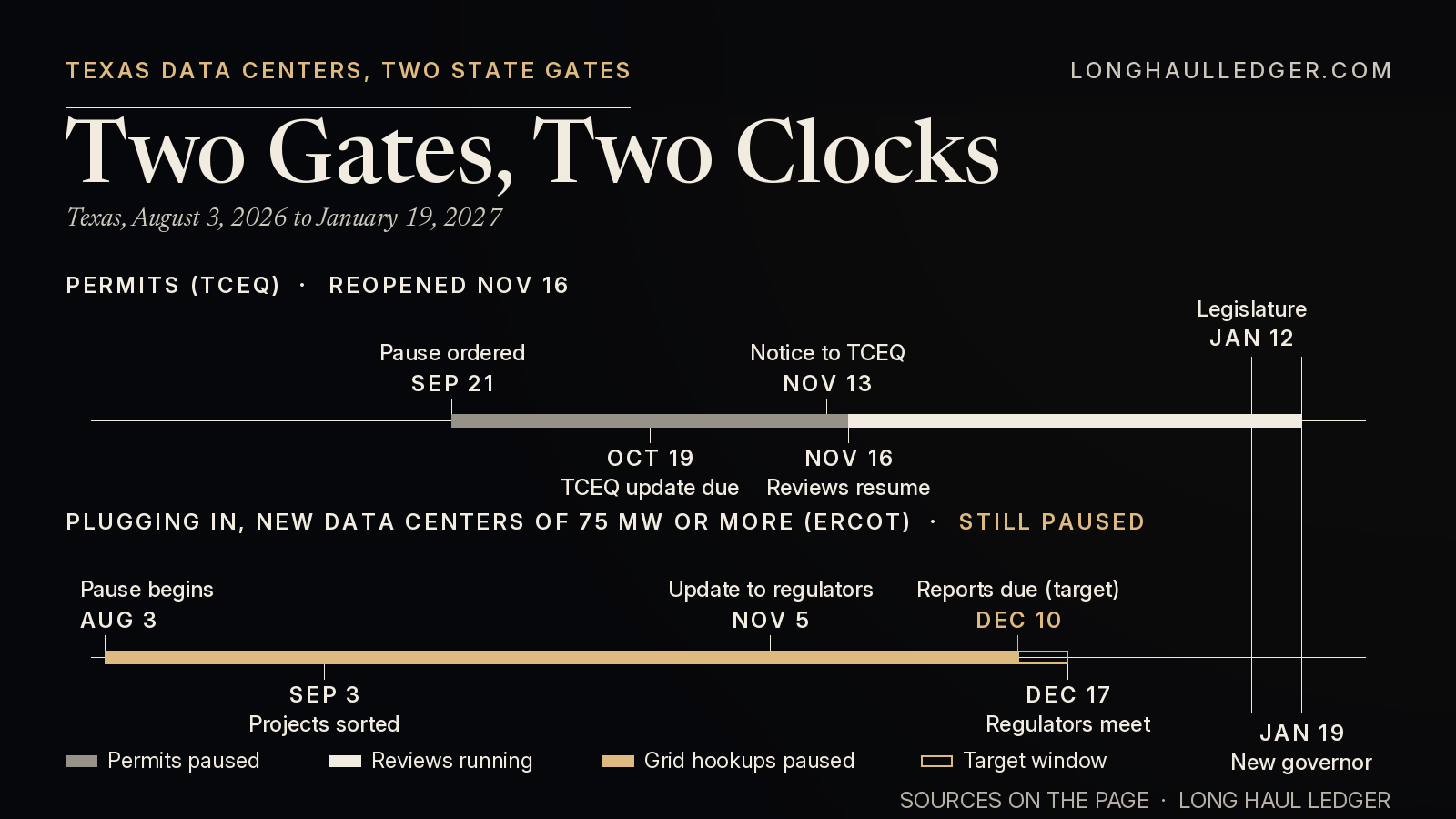
In Austin, Texas, the state’s environmental agency (TCEQ) restarted data center permit reviews on November 16, 2026. The grid operator ERCOT’s pause on hooking up new data centers of 75 MW or more stays in place until its audit is done, with reports targeted for December 10. Here is what reopened, what is still paused, and where the viral “1,800 projects” number comes from.
Updated November 28, 2026 · Numbers as published by each source on the date shown
Only part of it. Texas’s environmental agency, TCEQ, went back to its “normal permit review process” for data centers on November 16, eight weeks after the governor ordered permits paused. The grid gate is still closed: ERCOT’s pause on switching on new data centers and crypto mining facilities of 75 megawatts or more stays in place until its audit and community-impact review are complete, with reports targeted for December 10. The “1,800 projects” in the viral posts is the size of ERCOT’s whole waiting line for big power, as the Texas Tribune reported in August.
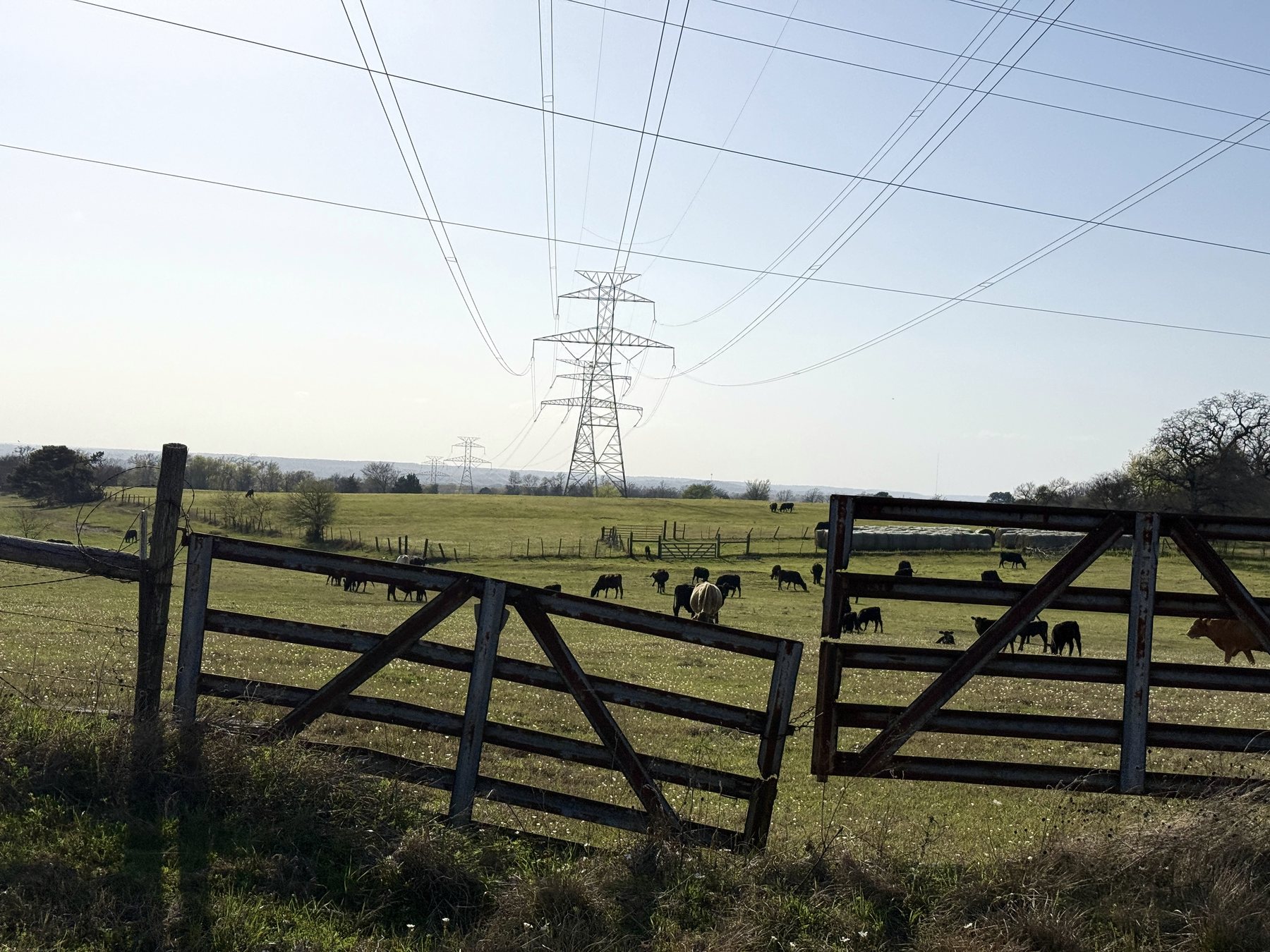
Photo: Mxmls, March 18, 2025, CC BY 4.0, via Wikimedia Commons. Cattle graze behind a half-open ranch gate beneath high-voltage transmission lines near Reese and Cove Springs, in East Texas. This is a general view of Texas power lines, not a data center or a specific project.
A Polymarket post on November 27 said, “JUST IN: Texas lifts its freeze on more than 1,800 data center projects.” It drew more than 1.4 million impressions by the next morning. The permit half of that happened on November 16. The grid half is still waiting on ERCOT’s reports, and the 1,800 describes a waiting line. Texas has two state gates for a big new data center. The Texas Commission on Environmental Quality (TCEQ) handles “permits related to air pollution at facilities and stormwater runoff on construction sites,” the Texas Tribune reported. ERCOT, the Electric Reliability Council of Texas, is the grid operator for most of the state and approves when a big new power user can switch on. Both gates were tied to ERCOT’s audit, and its reports are due in December.
The short answer
Permits reopened. On November 16, TCEQ went back to its “normal permit review process,” spokesperson Laura Lopez said in a written statement.
Plugging in is still paused. ERCOT paused approvals to switch on new data centers and crypto mining facilities of 75 MW or more until its verification and audit and community-impact review are complete. As of November 28, no ERCOT notice or PUC order lifting that pause had turned up.
The 1,800 is a waiting-line count. The Tribune reported on August 3 that ERCOT was “currently tracking more than 1,800 projects in the queue, representing over 474 gigawatts of electricity.”
Permits (TCEQ)
Reopened November 16
Normal permit reviews for air and stormwater permits are running again.
Plugging in (ERCOT, 75 MW or more)
Still paused
Reports are targeted for December 10, with a regulators’ meeting expected December 17.
Two gates, two clocks. December 10 and 17 are ERCOT’s targets and could move. Sources: Office of the Texas Governor, August 3 and September 21, 2026; ERCOT Market Notice M-A080326-01 and board deck, September 14 and 15, 2026; ERCOT PUC updates, August 20 and November 5, 2026; Texas Tribune, August 3, November 4 and November 17, 2026; Data Center Dynamics, November 18, 2026; Newsweek, November 27, 2026.
What Texas actually froze
It began on August 3, 2026. Gov. Greg Abbott directed the Public Utility Commission of Texas (PUC) and ERCOT “to conduct a comprehensive verification and audit of all data centers advancing through ERCOT’s interconnection process,” and his release said, “The PUCT and ERCOT must complete this audit before any data center project moves forward.” That day ERCOT said it would not send out its “Batch Zero” classifications on schedule. Batch Zero is ERCOT’s one-time study of big new power users as a group, in place of the one-at-a-time studies used before, the Tribune explained. ERCOT’s board deck lists the grid pause as “Paused approvals to energize data centers or virtual currency mining facilities (crypto facilities) that are 75 MW or greater.”
On September 21, Abbott wrote TCEQ Executive Director Kelly Keel to “halt all permits sought by data centers” and “pause the issuance of all permits related to data center projects until ERCOT completes its review.” That is eight weeks to the day before TCEQ’s restart on November 16.
The grid pause covers the ERCOT region. The Tribune noted that “The ERCOT region also does not include the entirety of the state, like El Paso,” and that some data centers “are building on-site power generation that allows them to bypass traditional connection to the grid.” See the Meta El Paso build tracker for one campus in that part of the state.
Where the 1,800 comes from
The Texas Tribune reported on August 3 that ERCOT “is currently tracking more than 1,800 projects in the queue, representing over 474 gigawatts of electricity, or more than five times the grid’s record for peak demand, according to ERCOT.” The governor’s August 3 release gave the same size as “approximately over 474 gigawatts of requests” and said “Approximately 90 percent of the new power requests are data centers.” An ERCOT slide for state senators on July 29 put the total at about 474 GW as of June 2026, about 90% of it data centers. For the grid’s record peak, see Did the grid set a record for how much power it used this summer? For why waiting lines hold more than gets built, see Is 2,000 GW of new power about to hit the grid?
Both ERCOT and data center companies told regulators that many of those projects “are unlikely to come to fruition” because they lack elements such as financing and a company that has agreed to lease the server space, the Tribune reported on August 14.
The audit covers a smaller group. ERCOT officials told the PUC on August 14 that it involves “about 250 to 300 projects, most of which are data centers,” the Tribune reported. ERCOT’s September 3 conditional list put 204 projects in its first batch as base load and 158 as studied load, 362 in all, and listed 373 projects as excluded. Each count describes a different group, so read them one at a time.
What reopened on November 16
The Tribune reported on November 17 that TCEQ “received notice on Friday from Abbott’s office that officials at the state’s electric grid had completed gathering information on potential community impacts from data centers.” That Friday was November 13, and TCEQ resumed approvals on Monday, November 16, Data Center Dynamics reported. “The agency has resumed its normal permit review process and will evaluate applications under all applicable state and federal laws and regulations,” Lopez said in a written statement.
The restart followed a rocky stretch. In October, advocacy groups noticed some data center construction permits being cleared despite the order. TCEQ said it suspended the permits and shut down its automated filing system, requiring paper applications, the Tribune reported.
ERCOT’s September board deck says: “ERCOT has paused the energization of new Large Load data centers and crypto mining facilities until the completion of the verification and audit and community impact review.” ERCOT calls a load of 75 MW or more a Large Load. At its August 20 update to the PUC, ERCOT said the pause does not reach medium loads of 25 MW to under 75 MW, and that it “may approve energization for non-data center large loads.”
ERCOT’s November 5 update, marked preliminary, says: “Although ERCOT has not completed its review, common issues are emerging.” They include missing documents on affiliate relationships, “Inability to demonstrate site control,” long-lead equipment not shown as ordered, and “Difficulty confirming the amount of financial security posted.” ERCOT and outside counsel had reviewed responses from 257 developers, about 5,140 questions, and ERCOT expected to send second requests to 80% of the developers.
Gibson Dunn wrote on November 18: “ERCOT has said that it is still working to complete its audit and plans to report its full findings on December 10.” ERCOT told ABC13, in a story published November 20, that its full findings will not be complete until December 10. ERCOT’s Batch Zero market notices, the M-A080326 series, run through September 3 and none lifts the pause, and Ask the Grid reported the PUC docket showed “no order lifting that pause” when it checked on November 27.
Get the free Monday Haul, one short email every Monday on new factories, grid projects and the policy behind them.
The Monday Haul · free weekly email
Energy, industry, infrastructure and policy in one short email every Monday, including new factories and grid projects. Every item sourced and dated. More about the Haul
What ERCOT learned from the builders
ERCOT sent a state and community impact survey to 465 loads. Its November 5 summary, marked preliminary, says 433 of the 465 loads, 93%, submitted it, covering about 177 GW, about 97% of the requested capacity. “All 245 Large Loads (75 MW or greater) responded to the RFI.” Respondents answered 83% of nearly 67,000 questions, “sufficient to provide a statistically meaningful analysis for the final report.” The most unanswered questions were about cooling, because many projects “had not determined their final cooling configuration.”
Every one of the 245 large loads answered, so the biggest builders are still in the process. Among them, “33 projects representing 36% of capacity are requesting interconnections greater than 1 GW,” and West Texas holds the most, 41% of capacity, 73 GW. For what projects of that size look like, see What does a 1-gigawatt data center really mean?
What changes in January
The Legislature convenes January 12, 2027, Newsweek reported, and Gov.-elect Gina Hinojosa takes office January 19, the Tribune reported. On the campaign trail she called for a moratorium until lawmakers pass “real protections so Texans can have a seat at the table to decide if and how data centers come into their communities,” the Tribune reported on November 4. After winning she told CNN, “We can have a strong economy, strong industry and protections for the people,” HuffPost reported. Bill prefiling opened November 9 with “bipartisan proposals to repeal the data center sales tax exemption, require water-use disclosure, and bar local tax incentives,” Gibson Dunn wrote. Newsweek reported that as governor she can “rescind or replace Abbott’s directives.”
Where people land
Four camps in the debate over data centers in Texas. Each camp gets the same space, so segment size carries no vote count.
The question
How fast should Texas let big new data centers build and plug in?
Where they agree Abbott, Hinojosa and the data center industry’s trade group all put what Texans pay first. Abbott: “Data centers must pay their own way, protect our grid and water.” The Tribune reported Hinojosa “would push to ensure Texans wouldn’t pay more for electricity because of data centers.” The Data Center Coalition lists “Enhancing affordability” first. All of them are waiting on the same ERCOT reports in December. The fight is over timing and who gets a say.
Keep Texas building
Texas has what builders need, they say, and Reuters pointed to its “plentiful energy supplies, relatively cheap land and a pro-business policy.” Let permits run on the normal rules so the serious projects can move, or the investment goes elsewhere. Jess Heck, Texas director of government affairs at the Data Center Coalition, told Reuters on November 4, 2026: “Enhancing affordability, creating jobs, and keeping the state’s economy strong are top priorities for Texans. Data centers can continue to play a crucial role in advancing those priorities by bringing investment to local communities.”
What they get right Builders kept showing up and answering. All 245 large loads in ERCOT’s survey responded, ERCOT said on November 5.
A waiting line of more than 474 gigawatts, more than five times the grid’s record peak, will not all get built, they say. Both ERCOT and data center companies told regulators that many projects “are unlikely to come to fruition,” the Tribune reported, so verify land, equipment and money before anyone gets power. Thomas Gleeson, chair of the Public Utility Commission of Texas, said on August 14, 2026: “The goal of the verification audit is to provide more certainty and confidence in the Batch Zero process.” Gov. Greg Abbott said on September 21, 2026: “Simply put, Texans must come first.”
What they get right ERCOT said on November 5, in a preliminary update, that common issues are emerging in its review: missing proof of site control, long-lead equipment not shown as ordered, and difficulty confirming the financial security posted.
Directives come and go with governors, they say. Write the protections into state law first, on bills, water, tax breaks and local say, so builders and towns both know the rules for years. Gov.-elect Gina Hinojosa told CNN, as HuffPost reported on November 6, 2026: “We can have a strong economy, strong industry and protections for the people.”
What they get right The Legislature meets January 12, and bipartisan bills to repeal the data center sales tax exemption and require water-use disclosure are already proposed, Gibson Dunn wrote on November 18.
The pause was meant to show how data centers affect neighbors, water and air, they say, so publish what ERCOT found and explain how it shapes permits before issuing them. Kathryn Guerra, TCEQ watchdog campaign director at Public Citizen, said TCEQ leadership acted “without sharing those results with communities or detailing how the TCEQ will incorporate the findings into permitting decisions.” She told ABC13 on November 20, 2026: “Texans were promised a pause on these data centers so that we could understand the community impacts.”
What they get right ERCOT’s community-impact results are still preliminary, and ERCOT told ABC13 the full findings will not be complete until December 10, after TCEQ resumed reviews.
December sorts the line ERCOT’s reports should show which of the hundreds of big projects in line can show land, equipment and money. ERCOT says large loads that do not pass verification, or do not respond, will be disqualified from Batch Zero, so the projects that stay are the ones with their footing in place, and every side says they should pay their own way when they plug in.
What to watch next
Thursday, December 10, 2026: ERCOT’s target date to file its Batch Zero Eligibility Verification Report and its Community Impact Review Report with the PUC.
Thursday, December 17, 2026: the PUC open meeting where ERCOT plans to discuss the findings, the Tribune reported.
Any ERCOT notice or PUC order that lifts the pause on switching on new data centers of 75 MW or more, and ERCOT’s final Batch Zero list, which the September deck says comes in December.
Tuesday, January 12, 2027: the Legislature convenes. Tuesday, January 19, 2027: Hinojosa takes office.
Can a data center get a Texas environmental permit right now?
Yes. TCEQ spokesperson Laura Lopez said in a written statement, reported by the Texas Tribune on November 17, that the agency “has resumed its normal permit review process and will evaluate applications under all applicable state and federal laws and regulations.” Each application is still evaluated one at a time.
Can a big new data center plug into the Texas grid right now?
Not a new data center or crypto mining facility of 75 MW or more inside the ERCOT grid. ERCOT’s September board deck says it “has paused the energization of new Large Load data centers and crypto mining facilities until the completion of the verification and audit and community impact review.” ERCOT told the PUC on August 20 that the pause does not reach medium loads of 25 MW to under 75 MW, and that it “may approve energization for non-data center large loads.” As of November 28, no ERCOT notice or PUC order lifting the pause had turned up.
Were 1,800 data centers frozen and now approved?
Texas’s environmental agency restarted permit reviews on November 16, one application at a time, and ERCOT’s grid pause stays until its audit and community-impact review are complete. The 1,800 is the Texas Tribune’s August 3 count of projects in ERCOT’s queue for big power, citing ERCOT, and the governor’s office said about 90 percent of the new power requests are data centers.
Do data centers that make their own power need ERCOT?
Some are building on-site power generation “that allows them to bypass traditional connection to the grid,” the Texas Tribune reported on August 3. A gas-fired power plant on site needs an air permit from TCEQ, as SpaceX’s Starbase plant got on November 16. Parts of Texas outside the ERCOT region, such as El Paso, follow separate grid rules.